
UNITED STATES
SECURITIES AND EXCHANGE COMMISSION
Washington, D.C. 20549
FORM 10-K
ANNUAL REPORT PURSUANT TO SECTION 13 OR 15(d) OF THE SECURITIES EXCHANGE ACT OF 1934 | |||||
For the fiscal year ended December 31 , 2024
OR
TRANSITION REPORT PURSUANT TO SECTION 13 OR 15(d) OF THE SECURITIES EXCHANGE ACT OF 1934 | |||||
For the transition period from _____ to _____
Commission file number 001-12019
(Exact name of registrant as specified in its charter)
| (State or other jurisdiction of incorporation or organization) | (I.R.S. Employer Identification No.) | ||||
| (Address of principal executive offices) | (Zip Code) | ||||
Registrant’s telephone number, including area code: (610 ) 832-4000
Securities registered pursuant to Section 12(b) of the Act:
| Title of each class | Trading Symbol(s) | Name of each exchange on which registered | ||||||||||||
Securities registered pursuant to Section 12(g) of the Act: None
Indicate by check mark if the registrant is a well-known seasoned issuer, as defined in Rule 405 of the Securities Act. Yes x No o
Indicate by check mark if the registrant is not required to file reports pursuant to Section 13 or Section 15(d) of the Act. Yes ☐ No x
Indicate by check mark whether the registrant (1) has filed all reports required to be filed by Section 13 or 15(d) of the Securities Exchange Act of 1934 during the preceding 12 months (or for such shorter period that the registrant was required to file such reports), and (2) has been subject to such filing requirements for the past 90 days. Yes x No o
Indicate by check mark whether the registrant has submitted electronically every Interactive Data File required to be submitted pursuant to Rule 405 of Regulation S- T (§ 232.405 of this chapter) during the preceding 12 months (or for such shorter period that the registrant was required to submit such files). Yes x No o
Indicate by check mark whether the registrant is a large accelerated filer, an accelerated filer, a non-accelerated filer, a smaller reporting company, or an emerging growth company. See the definitions of “large accelerated filer,” “accelerated filer,” “smaller reporting company,” and “emerging growth company” in Rule 12b-2 of the Exchange Act.
| x | Accelerated filer | o | ||||||||||||||||||
| Non-accelerated filer | o | Smaller reporting company | ||||||||||||||||||
| Emerging growth company | ||||||||||||||||||||
If an emerging growth company, indicate by check mark if the registrant has elected not to use the extended transition period for complying with any new or revised financial accounting standards provided pursuant to Section 13(a) of the Exchange Act. o
Indicate by check mark whether the registrant has filed a report on and attestation to its management’s assessment of the effectiveness of its internal control over financial reporting under Section 404(b) of the Sarbanes-Oxley Act (15 U.S.C. 7262(b)) by the registered public accounting firm that prepared or issued its audit report. x
If securities are registered pursuant to Section 12(b) of the Act, indicate by check mark whether the financial statements of the registrant included in the filing reflect the correction of an error to previously issued financial statements. o
Indicate by check mark whether any of those error corrections are restatements that required a recovery analysis of incentive-based compensation received by any of the registrant’s executive officers during the relevant recovery period pursuant to §240.10D-1(b). o
Indicate by check mark whether the registrant is a shell company (as defined in Rule 12b-2 of the Act). Yes o No x
State the aggregate market value of the voting and non-voting common equity held by non-affiliates computed by reference to the price at which the common equity was last sold, or the average bid and asked price of such common equity, as of the last business day of the registrant’s most recently completed second fiscal quarter. (The aggregate market value is computed by reference to the last reported sale on the New York Stock Exchange on June 30, 2024): $2,337,846,765
Indicate the number of shares outstanding of each of the registrant’s classes of common stock, as of the latest practicable date: 17,671,654 shares of Common Stock, $1.00 Par Value, as of February 19, 2025.
DOCUMENTS INCORPORATED BY REFERENCE
Portions of the Registrant’s definitive Proxy Statement relating to the 2025 Annual Meeting of Shareholders are incorporated by reference into Part III.
Quaker Chemical Corporation
Table of Contents
| Page | ||||||||
| Item 1C. | ||||||||
1
PART I
As used in this Annual Report on Form 10-K (the “Report”), the terms “Quaker Houghton,” the “Company,” “we,” and “our” refer to Quaker Chemical Corporation (doing business as Quaker Houghton), its subsidiaries, and associated companies, unless the context otherwise requires.
Item 1. Business.
General Description
The Company was organized in 1918 and incorporated as a Pennsylvania business corporation in 1930. Quaker Houghton is the global leader in industrial process fluids. With a robust presence around the world, including operations in over 25 countries, the Company’s customers include thousands of the world’s most advanced and specialized steel, aluminum, automotive, aerospace, offshore, can, mining, and metalworking companies. Quaker Houghton develops, produces, and markets a broad range of formulated specialty chemical products and offers chemical management services (which we refer to as “FluidcareTM”) for various heavy industrial and manufacturing applications throughout its three segments: Americas; Europe, Middle East and Africa (“EMEA”); and Asia/Pacific.
The major product lines of Quaker Houghton include metal removal fluids, cleaning fluids, corrosion inhibitors, metal drawing and forming fluids, die cast mold releases, heat treatment and quenchants, metal forging fluids, hydraulic fluids, specialty greases, offshore sub-sea energy control fluids, rolling lubricants, rod and wire drawing fluids and surface treatment chemicals. The following are the respective contributions to consolidated net sales of each of our principal product lines representing more than 10% of consolidated net sales for any of the past three years based on the Company’s current product line segmentation:
| Major Product Line | 2024 | 2023 | 2022 | |||||||||||||||||
| Metal removal fluids | 22.4 | % | 23.6 | % | 22.9 | % | ||||||||||||||
| Rolling lubricants | 20.5 | % | 19.5 | % | 20.8 | % | ||||||||||||||
| Hydraulic fluids | 14.2 | % | 14.1 | % | 14.1 | % | ||||||||||||||
Sales Revenue
The Company’s sales worldwide are made directly through its own employees and its FluidcareTM programs, with the balance sold through distributors and agents. The Company’s employees typically visit the plants of customers regularly, work on site, and through training and experience, identify production needs which can be resolved or otherwise addressed either by utilizing the Company’s existing products or by applying new formulations developed in its laboratories.
As part of the Company’s FluidcareTM business, certain third-party product sales to customers are managed by the Company. Where the Company acts as principal, revenues are recognized on a gross reporting basis at the selling price negotiated with its customers. Where the Company acts as an agent for its customers, revenue is recognized on a net reporting basis at the amount of the administrative fee earned by the Company for ordering the goods. See Note 5, Net Sales and Revenue Recognition, to the Consolidated Financial Statements for more information.
Competition
The specialty chemical industry comprises a number of companies similar in size to Quaker Houghton, as well as companies larger and smaller in size. The Company cannot readily determine its precise competitive position in every industry it serves. However, the Company estimates it holds the leading global position in the market for industrial process fluids including leading global positions in the markets for process fluids in portions of the automotive and industrial markets, and a leading position in the market for process fluids to produce sheet steel and aluminum. The offerings of many of the Company’s competitors differ from those of Quaker Houghton; some offer a broad portfolio of fluids, including general lubricants, while others have more specialized product ranges. All competitors provide different levels of technical services to individual customers. Competition in the industry is based primarily on the ability to supply products and provide technical services that meet the needs of the customer at an appropriate price and value to both the Company and the customer.
Major Customers and Markets
In 2024, Quaker Houghton’s five largest customers (each composed of multiple subsidiaries or divisions with semi-autonomous purchasing authority) accounted for approximately 12% of consolidated net sales, with its largest customer accounting for approximately 3% of consolidated net sales. A significant portion of the Company’s revenues are realized from the sale of process fluids and services to manufacturers of steel, aluminum, automotive, aerospace, industrial equipment, and durable goods and, therefore, Quaker Houghton is subject to the same business cycles as those experienced by these manufacturers and their customers.
The Company’s financial performance is generally correlated to the volume of global production within the industries it serves, rather than directly related to the financial performance of its customers. Furthermore, steel and aluminum customers typically have limited manufacturing locations compared to metalworking customers and generally use higher volumes of products at a single location.
2
Raw Materials
Quaker Houghton uses approximately 3,000 raw materials, including animal fats, vegetable oils, mineral oils, oleochemicals, surfactant agents, and various chemical compounds that act as additives to our base formulations. Quaker Houghton utilizes a significant number of raw materials derived from crude oil and natural gas. The price of mineral oil and its derivatives can be affected by the price of crude oil and industry refining capacity. Animal fat and vegetable oil prices, as well as the prices of other raw materials, are impacted by their own unique supply and demand factors, and by biodiesel consumption, which in turn can be affected by the price of crude oil and by government incentives for low-carbon fuels. Accordingly, significant fluctuations in the price of crude oil can have a material impact on the cost of these raw materials. In addition, many of the raw materials used by Quaker Houghton are commodity chemicals which can experience significant price volatility. As experienced during 2024 and 2023, the Company’s earnings have been and could continue to be affected by market changes in raw material prices. Refer to the disclosure contained in Item 7A of this Report for additional information.
Patents and Trademarks
Quaker Houghton has a limited number of patents and patent applications including patents issued, applied for, or acquired in the U.S. and in various foreign countries, some of which may be material to its business, with the earliest patent expiry in 2026. The Company principally relies on its proprietary formulae and its applications know-how and experience to meet customer needs. Quaker Houghton products are identified by numerous trademarks that are registered throughout its marketing area.
Research and Development- Laboratories
The Company maintains approximately 30 separate laboratory facilities worldwide that are primarily devoted to applied research and development. In addition, the Company maintains quality control labs at each of its manufacturing facilities. Quaker Houghton research and development is directed primarily toward applied technology since the nature of the Company’s business requires continual modification and improvement of formulations to provide specialty chemicals to satisfy customer requirements. If problems are encountered which cannot be resolved by local laboratories, the problem is referred to one of our 10 principal laboratories, located in Conshohocken, Pennsylvania; Valley Forge, Pennsylvania; Aurora, Illinois; Santa Fe Springs, California; Uithoorn, Netherlands; Coventry, United Kingdom; Dortmund, Germany; Barcelona, Spain; Turin, Italy or Qingpu, China.
Research and development costs are expensed as incurred. Research and development expenses during the years ended December 31, 2024, 2023 and 2022 were $57.3 million, $50.3 million and $46.0 million, respectively.
Recent Acquisition Activity
Subsequent to the date of these financial statements, in February 2025, the Company acquired Chemical Solutions & Innovations (Pty) Ltd. (“CSI”), for approximately $3.9 million, subject to routine and customary post-closing adjustments. CSI is based in South Africa and is a supplier of metalworking fluids and lubricants to the South African market. CSI will be reported as part of the EMEA reportable segment. This acquisition strengthens Quaker Houghton’s position in South Africa and expands the Company’s presence in that region.
In July 2024, the Company acquired the Sutai Group (“Sutai”), for approximately $16.2 million, including an initial cash payment of $14.6 million, subject to routine and customary post-closing adjustments related to working capital and net indebtedness levels, as well as earn-out provisions with an initial estimated payout of $1.6 million related to the finalization of 2024 and 2025 earnings. Assets acquired included cash and cash equivalents of $5.5 million. Sutai is based in Japan and provides impregnation treatment products and services to the automotive and other industries. Sutai is reported as part of the Asia/Pacific reportable segment. This acquisition strengthens Quaker Houghton’s technology portfolio, enabling the Company to better support and optimize production processes for customers across the Japanese, Asia Pacific and global markets.
During February 2024, the Company acquired I.K.V. Tribologie IKVT and its subsidiaries (“IKV”) for $35.2 million, including an initial cash payment of $29.7 million, subject to routine and customary post-closing adjustments related to working capital and net indebtedness levels as well as earn-out provisions related to the finalization of 2023 earnings. Assets acquired included approximately $4.8 million of cash and cash equivalents. IKV, which is part of the Company’s EMEA segment, specializes in high-performance lubricants and greases, including original equipment manufacturer first-fill greases that are primarily used in the automotive, aerospace, electronics and other industrial markets. The acquisition of IKV strengthens the Company’s position in first-fill greases.
The results of operations of Sutai and IKV subsequent to the acquisition dates are included in the Consolidated Statements of Operations for the year ended December 31, 2024.
3
Regulatory Matters
In order to facilitate compliance with applicable federal, state, and local statutes and regulations relating to occupational health and safety and protection of the environment, the Company has an ongoing program of site assessments for the purpose of identifying capital expenditures or other actions that may be necessary to comply with such requirements. The program includes periodic inspections of each facility by the Company and/or independent experts, as well as ongoing inspections and training by on-site personnel. Such inspections, among other things, address operational matters, record keeping, reporting requirements and capital improvements. Capital expenditures directed solely or primarily to regulatory compliance amounted to approximately $6.0 million, $3.5 million and $2.2 million during the years ended December 31, 2024, 2023 and 2022, respectively.
Company Segmentation
The Company’s operating segments, which are consistent with its reportable segments, reflect the structure of the Company’s internal organization, the method by which the Company’s resources are allocated and the manner by which the Chief Operating Decision Maker assesses the Company’s performance.
During the first quarter of 2023, the Company reorganized its executive management team to align with its new business structure. The Company’s new structure includes three reportable segments: (i) Americas; (ii) EMEA; and (iii) Asia/Pacific. Prior period information has been recast to align with the Company’s business structure as of January 1, 2023, including reportable segments and customer industry disaggregation. See Notes 4, 5, and 15 of Notes to Consolidated Financial Statements in Item 8 of this Report.
Non-U.S. Activities
Since significant revenues and earnings are generated by non-U.S. operations, the Company’s financial results are affected by currency fluctuations, particularly between the U.S. dollar and the euro, the Brazilian real, the Mexican peso, the Chinese renminbi, the British pound sterling and the Indian rupee, and the impact of those currency fluctuations on the underlying economies. In addition, trade policies and tariffs, including those affecting the Company’s key markets, could further impact exchange rates and economic stability, influencing both the cost of raw materials and the competitiveness of the Company’s products in international markets. Reference is made to (i) the foreign exchange risk information contained in Item 7A of this Report, (ii) the geographic information in Note 4, Business Segments, to the Consolidated Financial Statements and (iii) information regarding risks attendant to foreign operations included in Item 1A of this Report.
Number of Employees
On December 31, 2024, Quaker Houghton had approximately 4,400 full-time employees globally of whom approximately 1,000 were employed by the parent company and its U.S. subsidiaries, and approximately 3,400 were employed by its non-U.S. subsidiaries. Associated companies of Quaker Houghton (in which it owns 50% or less and has significant influence) employed approximately 600 people on December 31, 2024.
Core Values
Quaker Houghton considers its employees as its greatest strength in differentiating our business and strengthening our market positions. The Company’s goal is to have an organization that is inclusive of all of its people and is representative of the communities in which we operate.
The Company’s core values are (i) live safe; (ii) act with integrity; (iii) drive results; (iv) exceed customer expectations; (v) embrace diversity; and (vi) do great things together. Our core values embody who we are as a company, build a safer, stronger Quaker Houghton, and guide the Company’s internal conduct and relationship with the outside world. By fostering a culture and environment that exemplifies our core values, we gain, as a company, unique perspectives, backgrounds and varying experiences to ensure continued long-term success.
Aligned to our core values, all full-time employees are provided up to 16 hours per calendar year to volunteer for a non-profit or charity of their choice. The approach is supported by recommendations to our employees regarding volunteering opportunities, such as environmental conservation, STEM education, community health, safety and development opportunities for underrepresented groups. In 2024, we expanded our donation-matching and grantmaking programs to impact our local communities globally with matching and grants available to eligible organizations across the globe.
Sustainability Governance and Strategy
In 2020, the Company established the Board Sustainability Committee, which has specific responsibility to assist the Board of Directors (the “Board”) in its assessment, evaluation, and oversight of the Company’s sustainability programs and initiatives. In formulating our sustainability strategy, our Executive Leadership Team (“ELT”) and Board consider certain risks and uncertainties that may materially impact our financial condition and results of operations. These risks and uncertainties are further described in Item 1A of this Report.
4
In 2020, we completed an impact materiality assessment identifying critical environmental, social, and governance topics that our sustainability program was founded on in 2021. Since then we have made significant progress towards our strategy to Innovate Together for a Better Tomorrow, Protect Our Planet, Empower Our Colleagues and Communities, and Source Our Materials Responsibly. Details of that progress can be found in our Sustainability Report. In 2024, the Company initiated its first double materiality assessment to identify its material sustainability impacts, risks and opportunities as a part of Corporate Sustainability Responsibility Directive (“CSRD”) compliance. The potential impacts of this assessment are still being evaluated.
In 2024, we achieved eighteen of the twenty internal sustainability goals set to support our strategy. The Company increased its renewable electricity usage by approximately 5% compared to 2023 and implemented over 167 projects to reduce waste, water and energy usage. The Company consumes approximately 76% of its electricity consumption from renewable and zero carbon sources. Additionally, the Company launched its See Beyond™ portfolio of sustainable solutions and avoided or eliminated over 23,000 metric tons of waste at FluidcareTM customer locations. Finally, we achieved zero serious injury recordables and exceeded our industry’s standard for volunteering. We plan to provide further progress updates in our 2024 Sustainability Report.
Sustainability Report
We report our progress on our Sustainability strategy in our sustainability report, which is published annually and is available on our corporate website at https://home.quakerhoughton.com/sustainability. The Company’s 2023 Sustainability Report reflects the most recent data on a variety of topics, including specific information relating to the Company’s environmental, social, and governance initiatives. Information in these sustainability reports and on our website are not incorporated by reference in this Report and, accordingly, should not be considered part of this Report.
Talent Development, Culture and Total Rewards
Our Compensation and Human Resources Committee is responsible for overseeing our policies and strategies related to culture and human capital. We place importance on developing our leaders at all levels. Our leaders have access to training on coaching, performance and rewards, development planning and change management, as well as specialized opportunities for external coaching, leadership assessments, or external development programs. We continue to utilize a robust process in which each department’s talent landscape is evaluated, talent is assessed, critical roles are identified, and succession planning occurs. Output of these processes results in career development and other related talent plans designed to ensure we have the talent we need to deliver results both now and in the future.
Additionally, we regularly evaluate our total rewards offerings to ensure that our total compensation and benefits packages are aligned with our business strategy and organizational culture. We strive to create a culture where recognition is ingrained, including utilization of an enterprise reward and recognition program that incentivizes the results and behaviors of our employees and their impacts on our teams and business.
Inclusion
Quaker Houghton strives to cultivate an inclusive culture. Accordingly, Quaker Houghton provides equal employment opportunities and does not discriminate based on age, ethnicity, sex, sexual identity, disability/medical condition, race, religion, or sexual orientation.
Inclusion begins with the Board and ELT. For additional information on the Company’s leadership, refer to Item 4(a) Information about our Executive Officers and Item 10. Directors, Executive Officers and Corporate Governance.
Workplace Safety
We are committed to maintaining a strong safety culture and to emphasizing the importance of our employees’ role in identifying, mitigating and communicating safety risks. We maintain policies and operational practices that communicate a culture where all levels of employees are responsible for safety. We believe that the achievement of superior safety performance is both an important short-term and long-term strategic goal in managing our operations. We emphasize ten “lifesaving” rules which make a significant difference in preventing serious injuries and fatalities. We have launched several “Live Safe” initiatives to create an environment of openness and awareness in which all employees are actively engaged in meeting safety targets. We are keen in reporting near misses, hazard identifications and educating our employees on their “Stop Work Authority”, which are seen as leading indicators, helping us to get to zero incidents. Our leading indicators are proactive and preventive measures that can shed light about the effectiveness of safety and health activities and reveal potential problems in a safety and health program. We also require all employees to regularly complete safety training. Additionally, our ELT is closely involved in our safety programs, conducts regular reviews of safety performance metrics and reviews the Company’s safety performance during Company-wide meetings.
5
Quaker Houghton on the Internet
Financial results, news and other information about Quaker Houghton can be accessed from the Company’s website at https://www.quakerhoughton.com. This site includes important information on the Company’s locations, products and services, financial reports, news releases and career opportunities. The Company’s periodic and current reports on Forms 10-K, 10-Q, 8-K, and other filings, including exhibits and supplemental schedules filed therewith, and amendments to those reports, filed with the Securities and Exchange Commission (“SEC”) are available on the Company’s website as soon as reasonably practicable after they are electronically filed with or furnished to the SEC. Information contained on, or that may be accessed through, the Company’s website is not incorporated by reference in this Report and, accordingly, you should not consider that information part of this Report.
Factors that May Affect Our Future Results
Certain information included in this Report and other materials filed or to be filed by us with the SEC, including the Company’s other periodic reports on Forms 10-K, 10-Q and 8-K, press releases, and other materials released to, or statements made to, the public, as well as information included in oral statements or other written statements made or to be made by us, contain or may contain forward-looking statements that fall under the safe harbor provisions of the Private Securities Litigation Reform Act of 1995 and the Securities Act of 1933, as amended. These statements can be identified by the fact that they do not relate strictly to historical or current facts and can generally be identified by words such as “may,” “could,” “should,” “would,” “believe,” “expect,” “anticipate,” “estimate,” “intend,” “outlook,” “target,” “possible,” “potential,” “plan” or similar expressions, but these terms are not the exclusive means of identifying such statements. Such statements include information relating to current and future business activities, operational matters, capital spending, and financing sources. We have based these forward-looking statements on assumptions, projections and expectations about future events that we believe are reasonable based on currently available information, including statements regarding the potential effects of economic downturns, tariffs, including uncertainty surrounding changes in tariffs, inflation, and global supply chain constraints on the Company’s business, results of operations, and financial condition; our expectation that we will maintain sufficient liquidity and remain in compliance with the terms of the Company’s credit facility; expectations about future demand and raw material costs; and statements regarding the impact of increased raw material costs and pricing initiatives.
These forward-looking statements include statements with respect to our beliefs, plans, objectives, goals, expectations, anticipations, intentions, financial condition, results of operations, future performance, and business, which may differ materially from expectations, estimates and projections because of many factors, including, but not limited to:
•the timing and extent of the impacts on our business from acts of war, terrorism and military conflicts, including those in Ukraine and the Middle East, as well as related economic, political and governmental actions taken by various governments and governmental organizations in response;
•inflationary pressures, increases in raw material costs, supply chain constraints and other impacts of economic downturns, as well as high interest rates and their impact on our and our customers’ business operations;
•the potential timing, impacts, benefits and other uncertainties of acquisitions and divestitures, including our ability to realize synergies, integrate acquisitions and acquired businesses or separate divested assets and businesses;
•broader macroeconomic factors, including potential for changes in global and regional economic conditions, the possibility of global or regional slowdowns or recessions, a global pandemic, interest rate fluctuations, tariffs, deflation or stagflation and the potential for an economic recession; and
•our future results and plans including our sustainability goals and enterprise strategy.
A major risk is that demand for the Company’s products and services is largely derived from the demand for our customers’ products, which subjects the Company to uncertainties related to downturns in a customer’s business and unanticipated customer production slowdowns and shutdowns.
Other major risks and uncertainties include, but are not limited to, legislative and regulatory developments including changes to existing laws and regulations, or the way they are interpreted, applied or enforced; tariffs, trade restrictions and the economic and other sanctions imposed by other nations on Russia and Belarus and/or other governments or government organizations; suspensions of activities in Russia by many multinational companies; foreign currency fluctuations; significant changes in applicable tax rates and regulations; terrorist attacks and other acts of violence; the impacts of consolidation in our industry, including loss or consolidation of a major customer; the effects of climate change, fire or other natural disasters; and the potential occurrence of cyber-security breaches, cyber-security attacks, other technology outages and security incidents.
Furthermore, the Company is subject to the same business cycles as those experienced by our customers in the steel, automotive, aerospace, industrial equipment, aluminum, and durable goods industries.
6
Any or all of the forward-looking statements in this Report, in the Company’s Annual Report to Shareholders for 2024 or in any other public statements we make may prove to be incorrect due to inaccurate assumptions or unforeseen risks and uncertainties. In addition to the factors above, our forward-looking statements are qualified with respect to the risks disclosed elsewhere in this Report, including in Item 1A, Risk Factors, Item 7, Management’s Discussion and Analysis of Financial Condition and Results of Operations, and Item 7A, Quantitative and Qualitative Disclosures About Market Risk. These risks, uncertainties, and possible inaccurate assumptions relevant to our business could materially impact our future performance and cause our actual results to differ materially from expected and historical results. We undertake no obligation to publicly update any forward-looking statement, whether as a result of new information, future events or otherwise. However, additional disclosures on related subjects can be found in the Company’s subsequent reports on Forms 10-K, 10-Q, 8-K and other related filings.
We caution you not to place undue reliance on our forward-looking statements.
Item 1A. Risk Factors.
There are many factors that may affect our business and results of operations, including the following risks relating to: (1) the demand for our products and services and our ability to grow our customer base; (2) our business operations, including internal and external factors that may impact our operational continuity; (3) our international operations; (4) our supply chain; (5) domestic and foreign taxation and government regulation and oversight; and (6) more general risk factors that may impact our business.
Risks Related to the Demand for our Products and Services and our Customer Base
Changes to the industries and markets that we serve could have a material adverse effect on our liquidity, financial position and results of operations.
As a leader in industrial process fluids, the Company is subject to the same business cycles as those experienced by our customers that participate in the steel, automotive, industrial equipment, aerospace, aluminum and durable goods industries. Because demand for our products and services is largely derived from the global demand for our customers’ products, we are subject to uncertainties related to downturns in our customers’ businesses and shutdowns or curtailments of our customers’ production, including as a result of adverse changes affecting national, regional and global economies or increased competitive pressure within our customers’ industries. Our customers may experience deterioration of their businesses, cash flow shortages and difficulty obtaining financing, leading them to delay or cancel plans to purchase products, and they may not be able to pay our bills or fulfill their other obligations in a timely fashion. We have limited ability to adjust our costs contemporaneously with changes in sales; thus, a significant sudden downturn in sales or increased credit losses due to reductions in global production within the industries we serve and/or weak end-user markets could have a material adverse effect on our liquidity, financial position and results of operations. Further, our suppliers and other business partners may experience similar conditions, which could impact their ability to fulfill their obligations to us and also result in material adverse effects on our liquidity, financial position and results of operations.
Changes in competition in the industries and markets we serve could have a material adverse effect on our liquidity, financial position and results of operations.
The specialty chemical industry is highly competitive and there are many companies with significant financial resources and/or customer relationships that compete with us to provide similar products and services. Some competitors may be able to offer more favorable or flexible pricing and service terms or may be better able to adapt to changes in conditions in our industries, fluctuations in the costs of raw materials or to changes in global economic conditions, potentially resulting in reduced profitability and/or a loss of market share for us. The pricing decisions of our competitors could lead us to decrease our prices which could negatively affect our margins and profitability. In addition, our competitors could potentially consolidate their businesses and gain scale or better position their product offerings, which could have a negative impact on our profitability and market share. Competition in our industry historically has also been based on the ability to provide products that meet the needs of the customer and render technical services and laboratory assistance, which our competitors may be able to accomplish more effectively than us. If we are unsuccessful with differentiating ourselves, it could have a material adverse effect on our liquidity, financial position and results of operations and we could lose market share to our competitors.
7
Loss of a significant customer, bankruptcy of a major customer, or the closure of or significant reduction in production at a customer site could have a material adverse effect on our liquidity, financial position and results of operations.
During 2024, the Company’s top five largest customers (each composed of multiple subsidiaries or divisions with semi-autonomous purchasing authority) together accounted for approximately 12% of our consolidated net sales, with the largest customer accounting for approximately 3% of our consolidated net sales. The loss of a significant customer could have a material adverse effect on our liquidity, financial position and results of operations. Also, a significant portion of our revenues is derived from sales to customers in the cyclical steel, aerospace, aluminum and automotive industries, where bankruptcies have occurred in the past and where companies have periodically experienced financial difficulties. If a significant customer experiences financial difficulties or files for bankruptcy protection, we may be unable to collect on our receivables, customer manufacturing sites may be closed, or our contracts may be voided. The bankruptcy of a major customer could therefore have a material adverse effect on our liquidity, financial position and results of operations. Also, some of our customers, primarily in the steel, aluminum and aerospace industries, often have fewer manufacturing locations compared to other metalworking customers and generally use higher volumes of products at a single location. The loss, closure, or significant reduction in production at one or more of these locations or other major sites of a significant customer could have a material adverse effect on our business.
We may not be able to timely develop, manufacture and gain market acceptance of new and enhanced products required to maintain or expand our business, which could adversely affect our competitive position and our liquidity, financial position and results of operations.
We believe that our continued success depends on our ability to continuously develop and manufacture new products and product enhancements on a timely and cost-effective basis in response to customer demands for higher performance process chemicals and other product offerings. Our competitors may develop new products or enhancements to their products that offer performance, features and lower prices that may render our products less competitive or obsolete, and cause us to lose business and/or significant market share. The development and commercialization of new products require significant expenditures over an extended period of time, and some products that we seek to develop may fail to gain traction or never become profitable. In any event, ongoing investments in research and development for the future do not yield an immediate beneficial impact on our operating results and therefore could result in higher costs without a proportional increase in revenues.
In addition, our customers use our specialty chemicals for a broad range of applications. Changes in our customers’ products or processes or changes in regulatory, legislative or industry requirements may lead our customers to reduce consumption of the specialty chemicals that we produce or make them unnecessary or less attractive. Customers may also adopt alternative materials or processes that do not require our products. Examples of such evolving customer demands and industry trends are the movement towards lighter-weight materials and the growing prevalence of electric vehicles. Should a customer decide to use a different material or technology due to price, performance or other considerations, we may not be able to supply a product that meets the customer’s new requirements. Consequently, it is important that we develop new products to replace the products that mature and decline in use. Despite our efforts, we may not be able to develop and introduce products incorporating new technologies in a timely manner that will satisfy our customers’ future needs or achieve market acceptance. Moreover, new products may have lower margins than the products they replace. Our business, results of operations, cash flows and margins could be materially adversely affected if we are unable to successfully manage the maturation or obsolescence of our existing products and the introduction of new products successfully.
Risks Related to Business Operations, Including Internal and External Factors that May Impact Our Operational Continuity
Our ability to successfully implement our business strategy requires that we effectively and efficiently execute and integrate the acquisitions we identify as strategic as well as successfully divest those operations that are no longer important to that strategy. If we are unsuccessful, we may be unable to achieve our strategic objectives and could also be subject to unanticipated integration costs and claims for indemnification from the buyers of businesses we may divest, all of which could adversely impact our liquidity, financial position and results of operation.
Our business strategy includes making acquisitions and other investments that complement our existing businesses, and based on an evaluation of our business portfolio, sometimes divesting existing businesses that are not important to our strategy. We continually analyze and evaluate acquisition opportunities with the potential to strengthen our industry position, enhance our existing product offerings or deepen our relationships with our customers. We may not successfully identify suitable acquisition candidates or have sufficient financing and/or cash available to successfully complete acquisitions we identify, especially in a competitive sales process.
In addition, strategic acquisitions present operational, financial, and managerial challenges to integration, including diversion of management attention from existing businesses, difficulty with integrating or separating personnel and financial and other systems, increased expenses and raw material costs, assumption of unknown liabilities and indemnities that may not be discovered before an acquisition or fully reflected in the price we pay, and potential disputes with the sellers. If we are unable to consummate such transactions, or successfully integrate and grow completed acquisitions and achieve contemplated revenue synergies and cost savings, our financial condition and results of operations could be adversely affected.
8
We may also need to finance future acquisitions, and the terms of any financing, and the need to ultimately repay or refinance any indebtedness, may have negative effects on us. Acquisitions also could have a dilutive effect on our financial results. Acquisitions also generally result in goodwill, which would need to be written off against earnings in the future if it becomes impaired. Acquisitions and investments may involve significant cash expenditures, debt incurrences, equity issuances, operating losses, and expenses.
Further, the success of any acquisition we complete depends on our ability to navigate risks such as those listed above and successfully integrate acquisitions, including, but not limited to, our ability to:
•develop or modify financial reporting, information systems, and other related financial tools to ensure overall financial integrity and adequacy of internal control procedures;
•identify and capitalize on potential synergies, including cost reduction opportunities;
•adequately address challenges arising from the increased scope, geographic diversity and complexity of our operations; and
•further penetrate existing, and expand into new, markets with the products and capabilities acquired in acquisitions.
If we fail to successfully integrate acquisitions into our existing business, our financial condition and results of operations could be adversely affected. We may fail to obtain the benefits we anticipate from our recently completed or future acquisitions or joint ventures and we may not create the appropriate infrastructure to support the additional growth from organic or acquired businesses, which could also have a material adverse effect on our liquidity, financial position and results of operations.
Divestitures have inherent risks, including the possibility that we may not be able to achieve the proceeds we desire from a sale, potential post-closing liabilities and claims for indemnification, that may impact our ability to fully realize the anticipated benefits of a given divestiture. In particular, in connection with the sale of certain properties and businesses, we agreed to indemnify the purchasers for certain types of matters, including certain breaches of representations and warranties, taxes and certain environmental matters. With respect to environmental matters, the discovery of contamination arising from properties that we have divested may expose us to indemnity obligations under the sale agreements with the buyers of such properties or cleanup obligations and other damages under applicable environmental laws, even if we were not aware of the contamination. We may not have insurance coverage for such indemnity obligations. Further, we cannot predict the nature or amount of any indemnity or other obligations we may have to pay. These payments may be costly and may adversely affect our financial position and results of operations. If these or other post-closing risks materialize, the benefits of any divestiture may not be fully realized, if at all, and our business, financial condition, and results of operations could be negatively impacted.
Gulf and its wholly-owned subsidiary, QH Hungary Holdings Limited, have a significant minority stake in the Company and the contractual ability to nominate certain directors of the Company, which may enable them to influence the direction of our business and significant corporate decisions.
Gulf and its wholly-owned subsidiary, QH Hungary Holdings Limited (together, the “Gulf Affiliates”), remain our largest shareholders. If they were to make available for sale a portion of their shares, that portion could represent a significant amount of common stock of the Company being sold and any such transaction (if it were to occur) could have an adverse impact on the Company’s stock price or otherwise cause price volatility.
In addition, under our shareholders agreement with the Gulf Affiliates, they currently have the right to designate three individuals for election to the Board and this right, together with their share ownership, gives them substantial influence over our business, including over matters submitted to a vote of our shareholders, including the election of directors, amendment of our organizational documents, acquisitions or other business combinations involving the Company, and potentially the ability to prevent extraordinary transactions such as a takeover attempt or business combination. The concentration of ownership of our shares held by the Gulf Affiliates may make some future actions more difficult without their support. The Gulf Affiliates, however, among other provisions in the shareholders agreement, have agreed that for so long as any of their designees are on the Board, and for six months thereafter, they will vote all Quaker Houghton shares consistent with the recommendations of the Board for each director nominee as reflected in each proxy statement of the Company, including in support of any Quaker Houghton directors nominated for election or re-election to the Board (except as would conflict with their rights to designees on the Board). Nevertheless, the interests of Gulf may conflict with our interests or the interests of our other shareholders, though we are not aware of any such existing conflicts of interest at this time.
9
The timing and amount of the Company’s share repurchases are subject to a number of uncertainties, and there can be no assurance that we will continue to repurchase shares of our common stock.
On February 28, 2024, the Board approved a new share repurchase program (“2024 Share Repurchase Program”), authorizing the Company to repurchase up to an aggregate of $150 million of the Company’s outstanding common stock. The 2024 Share Repurchase Program replaced an earlier program, was effective immediately and has no expiration date. Under the 2024 Share Repurchase Program, the Company is authorized to repurchase shares through open market purchases, privately-negotiated transactions, accelerated share repurchases or otherwise in accordance with applicable federal securities laws, including through Rule 10b5-1 and under Rule 10b-18 of the Securities Exchange Act of 1934, as amended. The Company continues to employ trading plans for the repurchase of shares pursuant to the 2024 Share Repurchase Program, which permit the Company to purchase shares, at predetermined price targets, when it may otherwise be precluded from doing so. The 2024 Share Repurchase Program does not obligate us to acquire any particular amount of common stock, and it may be terminated at any time at the Company’s discretion. The specific timing and amount of repurchases will vary based on available capital resources and other financial and operational performance, market conditions, securities law limitations, and other factors. Important factors that could cause the Company to limit, suspend or delay its share repurchases include unfavorable trading market conditions, the price of the Company’s common stock, the nature of other investment opportunities presented to us from time to time, the ability to obtain financing at attractive rates and the availability of U.S. cash, all of which we cannot predict.
Repurchase activities could affect the price of our common stock and increase its volatility. The existence of the 2024 Share Repurchase Program could also cause the price of our common stock to be higher than it would be in the absence of such a program and could potentially reduce the market liquidity for our common stock. There can be no assurance that any stock repurchases will enhance stockholder value because the market price of our common stock could decline below the levels at which we repurchased such shares, as we experienced in 2024. Any failure to repurchase shares after we have announced our intention to do so could negatively impact our reputation and investor confidence in us and could negatively impact our stock price. Although the 2024 Share Repurchase Program is intended to enhance long-term shareholder value, short-term stock price fluctuations could reduce the program’s effectiveness.
Failure to comply with any material provision of our principal credit facility or other debt agreements could have a material adverse effect on our liquidity, financial position and results of operations.
Our principal credit facility requires the Company to comply with certain provisions and covenants and while we do not currently consider these provisions and covenants to be overly restrictive, they could become more difficult to comply with as our business or financial conditions change. We are also subject to interest rate risk due to the variable interest rates within the credit facility and if interest rates rise, interest costs would increase as well.
Our principal credit facility contains provisions that are customary for facilities of its type, including affirmative and negative covenants, financial covenants and events of default, including restrictions on (a) the incurrence of additional indebtedness, (b) investments in and acquisitions of other businesses, lines of business and divisions, (c) the making of dividends or capital stock purchases and (d) dispositions of assets. Other financial covenants contained in our principal credit facility include a consolidated interest coverage test and a consolidated net leverage test. Customary events of default in the credit facility include, among others, defaults for non-payment, breach of representations and warranties, non-performance of covenants, cross-defaults, insolvency, and a change of control of the Company in certain circumstances. If we are unable to comply with the financial and other provisions of our principal credit facility, we could become in default. The occurrence of an event of default under the credit facility could result in all loans and other obligations becoming immediately due and payable and the facility being terminated. In addition, deterioration in the Company’s results of operations or financial position could significantly increase borrowing costs.
Our variable-rate indebtedness subjects us to interest rate risk, which could cause our debt service obligations to increase significantly or result in an inability to obtain sufficient financing on favorable terms. Additionally, rising interest rates could have a material adverse effect on our business, financial condition, results of operations, or cash flows.
We carry, and expect to continue to carry for the foreseeable future, a substantial amount of debt and other fixed obligations. Our ability to satisfy these obligations, finance acquisitions, repurchase shares, and pay dividends rely on our access to capital, which depends in large part on cash flow generated by our business and the availability of debt financing. The Company’s principal credit facility permits interest on certain variable-rate borrowings to be calculated based on the Term Secured Overnight Financing Rate (“Term SOFR”), which exposes us to interest rate risk. See Note 19, Debt, to the Consolidated Financial Statements for more information.
Interest rate increases, which we have experienced in the past and may experience again in the future, increase our debt service obligations on the variable-rate indebtedness even though the amount borrowed remains the same, which requires us to use more of our available cash to service our indebtedness. In order to manage the Company’s exposure to variable interest rate risk associated with the Company’s principal credit facility, in the first quarter of 2023, the Company entered into three-year interest rate swaps to convert a portion of the Company’s variable interest rate borrowings to an average fixed rate plus an applicable margin as provided in the Company’s principal credit facility, based on the Company’s consolidated net leverage ratio. These swaps only cover a portion of our variable rate indebtedness. See Note 24, Hedging Activities, to the Consolidated Financial Statements for more information.
10
Rising interest rates not only increase our cost of capital but could also have a dampening effect on overall economic activity and the financial condition of the Company's customers, either or both of which could negatively affect customer demand for the Company's products and customers' ability to repay their obligations. Rising interest rates could also cause credit market dislocations, which could have an impact on the Company’s and its customers' cost of capital.
Risks Related to our International Operations
Our global presence subjects us to political and economic risks that could adversely affect our business, liquidity, financial position and results of operations.
A significant portion of our revenues and earnings are generated by our non-U.S. operations. Our success as a global business depends, in part, upon our ability to succeed across different legal, regulatory, economic, social and political conditions by developing, implementing and maintaining policies and strategies that are effective in all of the locations where we do business. Risks inherent in our global operations include:
•trade protection measures including import and export controls, trade embargoes, and trade sanctions affecting countries or regions we serve that could result in our losing access to customers and suppliers in those countries or regions;
•unexpected adverse changes in export duties, quotas and tariffs and difficulties in obtaining export licenses;
•termination or substantial modification of international trade agreements that may adversely affect our access to raw materials and to markets for our products;
•our agreements with counterparties in countries outside the U.S. may be difficult for us to enforce and related receivables may take longer or be difficult for us to collect;
•less protective foreign intellectual property laws, and more generally, legal systems that may be less developed and predictable than those in the U.S.;
•limitations on ownership or participation in local enterprises as well as the potential for expropriation or nationalization of enterprises;
•instability in or adverse changes to the economic, political, social, legal or regulatory conditions in a country or region where we do business, as a result of terrorist activities, political disruption and/or military conflict such as those that are being experienced in multiple areas around the world; and
•complex and dynamic local tax regulations, including changes in foreign laws and tax rates or U.S. laws and tax rates with respect to foreign income that may unexpectedly increase the rate at which our income is taxed, impose new and additional taxes on remittances, repatriation or other payments by subsidiaries, or cause the loss of previously recorded tax benefits.
The current global geopolitical and trade environment creates the potential for increased escalation of domestic and international tariffs and retaliatory trade policies, including the possibility of a “trade war” involving the United States and one or more of its trading partners. If tariffs are imposed or increased, materials and goods that U.S. companies import and export may face higher prices, and this could lead to significant shortages or price increases in our raw materials, decreased international sales, reduced margins or increased prices. Changes in U.S. trade policy and retaliatory actions by U.S. trade partners could also result in weakening economic conditions. If we are unable to successfully manage these and other risks associated with our international businesses, the risks could have a material adverse effect on our business, results of operations and financial condition.
The scope of our international operations subjects us to risks from currency fluctuations that could adversely affect our liquidity, financial position and results of operations.
Our non-U.S. operations generate significant revenues and earnings. Fluctuations in foreign currency exchange rates, including hyperinflationary conditions, may affect product demand and may adversely affect the profitability in U.S. dollars of the products and services we provide in international markets where payment for our products and services is made in the local currency. Our financial results are affected by currency fluctuations, particularly between the U.S. dollar and the Euro, the British pound sterling, the Brazilian real, the Mexican peso, the Chinese renminbi and the Indian rupee. During the past three years, sales by our non-U.S. subsidiaries accounted for approximately 63% to 65% of our consolidated net sales. We generally do not use financial instruments that expose us to significant risk involving foreign currency transactions; however, the relative size of our non-U.S. activities has a significant impact on reported operating results and our net assets. Therefore, as exchange rates change, our results can be materially affected. Incorporated by reference is the foreign exchange risk information contained in Item 7A of this Report and the geographic information in Note 4, Business Segments, to the Consolidated Financial Statements included in Item 8 of this Report.
Also, we occasionally source inventory in a different country than that of the intended sale. This practice can give rise to foreign exchange risk. We seek to mitigate this risk through local sourcing of raw materials in the majority of our locations.
11
Risks Relating to Our Supply Chain
If we are unable to obtain price increases or contract concessions sufficient to offset increases in the costs of raw materials, this could result in a loss of sales, gross profit, and/or market share and could have a material adverse effect on our liquidity, financial position and results of operations. Conversely, if we fail to adjust prices in a declining raw material cost environment, we could lose sales, gross profit, and/or market share which could have a material adverse effect on our liquidity, financial position and results of operations.
Quaker Houghton uses approximately 3,000 raw materials, including animal fats, vegetable oils, mineral oils, oleochemicals, ethylene, solvents, surfactant agents, and various chemical compounds that act as additives to our base formulations, and a wide variety of other organic and inorganic compounds and various derivatives of the foregoing. The price of mineral oil and its derivatives can be affected by the price of crude oil and industry refining capacity. Animal fat and vegetable oil prices, as well as the prices of other raw materials, are impacted by their own unique supply and demand factors, and by biodiesel consumption, which in turn can be affected by the price of crude oil and by government incentives for low-carbon fuels. Accordingly, significant fluctuations in the price of crude oil can have a material impact on the cost of these raw materials. In addition, many of the raw materials used by Quaker Houghton are commodity chemicals which can experience significant price volatility.
We generally attempt to pass through changes in the prices of raw materials to our customers, but we may be unable to do so (or may be delayed in doing so). In addition, raising prices we charge to our customers in order to offset increases in the prices we pay for raw materials could cause us to suffer a loss of sales volumes. Although we have been successful in recovering a substantial amount of raw material cost increases while retaining our customers, there can be no assurance that we will be able to continue to offset higher raw material costs or retain customers in the future. A significant change in margin or the loss of customers due to pricing actions could result in a material adverse effect on our liquidity, financial position and results of operations as described within Item 7 of this Report.
Lack of availability of raw materials and issues associated with sourcing from single suppliers and suppliers in volatile economic environments could have a material adverse effect on our liquidity, financial position and results of operations.
The specialty chemical industry periodically experiences supply shortages for certain raw materials. In addition, we source some materials from a single supplier or from suppliers in jurisdictions that have experienced political or economic instability. Even where we have multiple suppliers of a particular raw material, there are occasionally shortages. Any significant disruption in supply, such as was experienced several years ago, could affect our ability to obtain raw materials or satisfactory substitutes or could increase the cost of such raw materials or substitutes, which could have a material adverse effect on our liquidity, financial position and results of operations. In addition, certain raw materials that we use are subject to various regulatory laws, and a change in our ability to legally use such raw materials may impact the products or services we are able to offer which could negatively affect our ability to compete and could adversely affect our liquidity, financial position and results of operations.
Loss of a significant manufacturing facility or disruptions within our supply chain or in transportation could have a material adverse effect on our liquidity, financial position and results of operations.
Our manufacturing facilities are located throughout the world. While we have some redundant capabilities, if one of our facilities is forced to shut down or curtail operations because of damage or other unforeseen factors, including natural disasters, labor difficulties or public health crises, we may not be able to timely supply our customers. This could result in a loss of sales over an extended period or permanently. While the Company seeks to mitigate this risk through business continuity and contingency planning and other measures, the loss of production in any one region over an extended period of time could have a material adverse effect on our liquidity, financial position and results of operations. Any losses due to these events may not be covered by our existing insurance policies or may be subject to deductibles.
We could be similarly adversely affected by disruptions to our supply chain and transportation network. The Company relies heavily on railroads, ships, and over-the-road shipping methods to transport raw materials to its manufacturing facilities and to transport finished products to customers. The costs of transporting our products could be negatively affected by factors outside of our control, including shipping container shortages or global imbalances in shipping capabilities, port strikes or other labor disruptions, transportation disruptions or rate increases, increased border controls or closures, extreme weather events, tariffs, rising fuel costs, armed conflicts and capacity constraints. Significant delays or increased costs affecting our supply chain could materially affect our liquidity, financial condition and results of operations. Disruptions at our suppliers could lead to increases in raw material or energy costs and/or reduced availability of materials or energy, potentially affecting our liquidity, financial condition and results of operations.
12
Risks Relating to Domestic and Foreign Taxation and Government Regulation and Oversight
Changes in tax laws could result in fluctuations in our effective tax rate and have a material effect on our liquidity, financial position and results of operations.
We pay income taxes in the U.S. and various foreign jurisdictions. Our effective tax rate is derived from a combination of local tax rates and tax attributes applicable to our operations in the various countries, states and other jurisdictions in which we operate. Our effective tax rates and tax liabilities could therefore be materially affected by changes in the mix of earnings in countries with differing statutory tax rates, changes in tax rates, expiration or lapses of tax credits or incentives, changes in uncertain tax positions, changes in the valuation of deferred tax assets and liabilities, or changes in tax laws or in how they are interpreted or enforced, including matters such as transfer pricing. In addition, we are regularly under audit by tax authorities, and the final decisions of such audits could materially affect our current tax estimates and tax positions. See Note 10, Incomes Taxes, and Note 25, Commitments and Contingencies, to the Consolidated Financial Statements in Item 8 of this Report for a discussion of uncertain tax positions, tax years subject to examination, and audits and inspections. Any of these factors or similar tax-related risks could cause our effective tax rate and tax-related payments, including any such payments related to tax liabilities of businesses we have acquired, to significantly differ from previous periods and current or future expectations which could have a material effect on our liquidity, financial position and results of operations.
Pending and future legal proceedings including environmental matters could have a material adverse effect on our liquidity, financial position and results of operations, as well as our reputation in the markets we serve.
The Company and its subsidiaries are routinely party to proceedings, cases, and requests for information from, and negotiations with, various claimants and federal and state agencies relating to various legal matters, including tax and environmental matters. See Note 10, Incomes Taxes, and Note 25, Commitments and Contingencies, to the Consolidated Financial Statements in Item 8 of this Report, which describes uncertain tax positions and audits and inspections, as well as information concerning amounts accrued associated with certain environmental remediation costs and other potential commitments or contingencies. An adverse result in one or more pending or ongoing matters or any potential future matter of a similar nature could materially and adversely affect our liquidity, financial position, and results of operations, as well as our reputation in the markets we serve.
Failure to comply with the complex global regulatory environment in which we operate could have an adverse impact on our reputation and/or a material adverse effect on our liquidity, financial position and results of operations.
We are subject to government regulation in all jurisdictions in which we conduct business. Changes in the regulatory environments in which we operate, particularly, but not limited to, the U.S., Mexico, Brazil, China, India, Thailand, Australia, the U.K. and the EU, could lead to heightened regulatory compliance costs and scrutiny, could adversely impact our ability to continue selling certain products in the U.S. or foreign markets, and/or could otherwise increase the cost of doing business. While we seek to mitigate these risks through a variety of actions, including receiving Responsible Care Certification, ongoing employee training, and employing comprehensive environmental, health and safety programs, there is no guarantee these actions will prevent all potential regulatory compliance issues. For instance, failure to comply with the EU’s Registration, Evaluation, Authorization and Restriction of Chemicals (“REACH”) regulations or other similar laws and regulations could result in our inability to sell certain products or we could incur fines, ongoing monitoring obligations or other future business consequences, which could have a material adverse effect on our liquidity, financial position and results of operations. In addition, the U.S. Toxic Substances Control Act (“TSCA”) requires chemicals to be assessed against a risk-based safety standard and then requires that unreasonable risks that are identified be eliminated. This regulation and other pending initiatives at the U.S. state level, as well as initiatives in Canada, Asia and other regions, could potentially require toxicological testing and risk assessments of a wide variety of chemicals, including chemicals used or produced by us. These assessments may result in heightened concerns about the chemicals involved and additional requirements being placed on their production, handling, labeling or use. These concerns and additional requirements could also increase the cost incurred by our customers to use our chemical products and otherwise limit their use which could lead to a decrease in demand for these products. A decrease in demand due to these issues could have an adverse impact on our liquidity, financial position, and results of operations.
Further, we are subject to the U.S. Foreign Corrupt Practices Act (the “FCPA”), the U.K. Bribery Act and other anti-bribery, anti-corruption and anti-money laundering laws in jurisdictions around the world. These and similar laws generally prohibit companies and their officers, directors, employees and third-party intermediaries, business partners and agents, from making improper payments or providing other improper items of value to government officials or other persons. While we have policies and procedures and internal controls designed to address compliance with such laws, including employee training programs, we cannot guarantee that our employees and third-party intermediaries, business partners and agents will not take, or be alleged to have taken, actions in violation of such policies and laws for which we may be ultimately held responsible. Detecting, investigating and resolving actual or alleged violations can be extensive and require a significant diversion of time, resources and attention from senior management. Any violation of these or other applicable anti-bribery, anti-corruption and anti-money laundering laws could result in whistleblower complaints, adverse media coverage, investigations, loss of export privileges, and criminal or civil sanctions, penalties and fines, any of which could adversely affect our business and financial condition.
13
The shipment of goods, services and technology across international borders subjects us to extensive trade laws and regulations. Our import activities are governed by the unique customs laws and regulations in each of the countries where we operate. Moreover, many countries, including the U.S., control the export and re-export of certain goods, services and technology and impose related export record-keeping and reporting obligations, which can be burdensome. Governments may also impose economic sanctions against certain countries, persons and entities that may restrict or prohibit transactions involving such countries, persons and entities, which may limit or prevent our conduct of business in certain jurisdictions.
The laws and regulations concerning import activity, export record-keeping and reporting, export control and economic sanctions are complex and constantly changing. These laws and regulations can cause delays in shipments and unscheduled operational downtime. Moreover, any failure to comply with applicable legal and regulatory trading obligations could result in criminal and civil penalties and sanctions such as fines, imprisonment, debarment from governmental contracts, seizure of shipments and loss of import and export privileges. In addition, investigations by government authorities as well as legal, social, economic and political issues in these countries could have a material adverse effect on our business, results of operations and financial condition. We are also subject to the risks that our employees, joint venture partners and agents outside of the U.S. may fail to comply with other applicable laws.
Uncertainty related to environmental regulation and industry standards relating to, as well as physical risks of, climate change and biodiversity loss, could impact our liquidity, financial position, and results of operations.
Increased public and stakeholder awareness of global climate change, biodiversity loss, and other environmental risks have contributed to, and may result in, even more extensive, international, regional and/or federal requirements or industry standards to reduce or mitigate the effects of these changes. These regulations could mandate even more restrictive regulatory or industry standards than the voluntary goals that we have established or require changes to be adopted on a more accelerated time frame. New disclosure requirements have been adopted in the EU and California and additional rule making is expected to be adopted by the SEC. There continues to be a lack of consistent legislation related to disclosure and operational matters, which creates complexity and economic and regulatory uncertainty. Though we are closely following developments in this area and changes in the regulatory landscape in the U.S. and our other markets, we cannot predict how or when those challenges may ultimately impact our business. While certain climate change initiatives may result in new business opportunities for us in the area of alternative fuel technologies and emissions control, compliance with these initiatives may also result in additional costs to us including, among other things, increased production costs, additional taxes and compliance costs, reduced emission allowances or additional restrictions on production or operations.
In addition, the potential physical impacts of climate change and biodiversity loss are highly uncertain. These may include extreme weather events and long-term changes in temperature levels and water availability as well as damaged ecosystems. The physical risks of climate change and biodiversity loss may impact our facilities, customers and suppliers, and the availability and costs of materials and natural resources, sources and supply of energy, product demand and manufacturing. In addition, climate change may increase both the frequency and severity of natural disasters that may affect our business operations.
If environmental laws or regulations or industry standards are either changed or adopted and impose significant operational restrictions and compliance requirements upon us or our products, or our operations are disrupted due to physical impacts of climate change or biodiversity loss, our business, capital expenditures, liquidity, results of operations, financial condition and competitive position could be negatively impacted.
We are subject to stringent labor and employment laws in many jurisdictions in which we operate, and our relationship with our employees could deteriorate which could adversely impact our operations.
A majority of our full-time employees are employed outside the U.S. In many jurisdictions where we operate, labor and employment laws and regulations grant significant job protection to some employees including rights on termination of employment. In addition, in some countries our employees are represented by works councils or are governed by collective bargaining agreements and we are often required to consult with and seek the consent or advice of such representatives. These laws and regulations, together with our obligations to seek consent or consult with the relevant unions or works councils, could have a significant impact on our flexibility in managing costs and responding to market changes. While the Company believes it has generally positive relations with its labor unions and employees, there is no guarantee the Company will be able to successfully negotiate new or renew labor agreements without work stoppages, labor difficulties or unfavorable terms. If we were to experience an extended interruption of operations at any of our facilities because of strikes or other work stoppages, our liquidity, results of operations and financial condition could be materially and adversely affected.
14
We may be unable to adequately protect our proprietary rights and trade brands, which may limit our ability to compete in our markets and could adversely affect our liquidity, financial position and results of operations.
We have a limited number of patents and patent applications, including patents issued, applied for, or acquired in the U.S. and in various foreign countries, some of which are material to our business. However, we rely principally on our proprietary formulae and the applications know-how and experience to meet customer needs. Also, our products are identified by trademarks that are registered throughout our marketing area. Despite our efforts to protect our proprietary information through patent and trademark filings, and the use of appropriate trade secret protections, it is possible that competitors or other unauthorized third parties may obtain, copy, use, disclose or replicate our formulae, products, and processes. Similarly, third parties may assert claims against us and our customers and distributors alleging our products infringe upon third-party intellectual property rights. In addition, the laws and/or judicial systems of foreign countries in which we design, manufacture, market and sell our products may afford little or no effective protection of our proprietary technology or trade brands. Also, security over our global information technology structure is subject to increasing risks associated with cyber-crime and other related cyber-security threats. These potential risks to our proprietary information, trade brands and other intellectual property could subject us to increased competition and a failure to protect, defend or enforce our intellectual property rights could negatively impact our liquidity, financial position and results of operations.
General Risk Factors
Our business could be adversely affected by environmental, health and safety laws and regulations or by potential product, service or other related liability claims.
The development, manufacture and sale of specialty chemicals and other services involve inherent exposure to potential product liability claims, service level claims, product recalls and related adverse publicity. Some customers have and may in the future require us to represent that our products conform to certain product specifications provided by them. Any failure to comply with such specifications could result in claims or legal action against us. Any of the foregoing potential product or service risks could also result in substantial and unexpected expenditures and affect customer confidence in our products and services, which could have a material adverse effect on our liquidity, financial position and results of operations.
In addition, our business is subject to hazards associated with the manufacturing, handling, use, storage, and transportation of chemical materials and products, including historical operations at our current and former facilities. These potential hazards could cause personal injury and loss of life, severe damage to, or destruction of, property or equipment and environmental contamination or other environmental damage, which could have an adverse effect on our business, financial condition and results of operations. In the jurisdictions in which we operate, we are subject to numerous U.S. and non-U.S. national, federal, state and local environmental, health and safety laws and regulations, including those governing the discharge of pollutants into the air and water, the management and disposal of hazardous substances and wastes and the cleanup of contaminated properties. We currently use, and in the past have used, hazardous substances at many of our facilities, and we have in the past been, and may in the future be, subject to claims relating to exposure to or contamination caused by hazardous materials. We also have generated, and continue to generate, hazardous wastes at a number of our facilities. Liabilities associated with the investigation and cleanup of hazardous substances, as well as personal injury, property damages or natural resource damages arising from the release of, or exposure to, such hazardous substances, may be imposed in many situations without regard to violations of laws or regulations or other fault, and may also be imposed jointly and severally (so that a responsible party may be held liable for more than its share of the losses involved, or even the entire loss). These liabilities may also be imposed on many different entities, including, for example, current and prior property owners or operators, as well as entities that arranged for the disposal of the hazardous substances. The liabilities may be material and can be difficult to identify or quantify. In addition, the occurrence of disruptions, shutdowns or other material operating problems at our facilities or those of our customers due to any of these risks could adversely affect our reputation and have a material adverse effect on our operations as a whole, including our results of operations and cash flows, both during and after the period of operational difficulties.
Further, some of the raw materials we handle are subject to government regulation that affect the manufacturing processes, handling, uses and applications of our products. In addition, our production facilities and a number of our distribution centers require numerous operating permits. Due to the nature of these requirements and changes in our operations, our operations may exceed limits under permits or we may not have the proper permits to conduct our operations.
15
Ongoing compliance with environmental laws, regulations and permits that impact registration/approval requirements, transportation and storage of raw materials and finished products, and storage and disposal of wastes could require us to make changes in manufacturing processes or product formulations and could have a material adverse effect on our results of operations. We may incur substantial costs, including fines, damages, criminal or civil sanctions and remediation costs, or experience interruptions in our operations, including as a result of revocation, non-renewal or modification of the Company’s operating permits and revocation of the Company’s product registrations, for violations arising under these laws or permit requirements. Any such revocation, modification or non-renewal may require the Company to cease or limit the manufacture and sale of its products at one or more of its facilities, which may limit or prevent the Company’s ability to meet product demand or build new facilities and may have a material adverse effect on liquidity, financial position, and results of operations. Additional information may arise in the future concerning the nature or extent of our liability with respect to identified sites, and additional sites may be identified for which we are alleged to be liable, which could cause us to materially increase our environmental accrual or the upper range of the costs we believe we could reasonably incur for such matters. Increased compliance costs may not affect competitors in the same way that they affect us due to differences in product formulations, manufacturing locations or other factors, and we could be at a competitive disadvantage, which might adversely affect our financial performance.
Our insurance may not fully cover all potential exposures.
We maintain product, property, business interruption, casualty, and other general liability insurance, but this may not cover all risks associated with the hazards of our business and these coverages are subject to limitations, including deductibles and coverage limits. We may incur losses beyond the limits, or outside the coverage, of our insurance policies, including liabilities for environmental remediation. In addition, from time to time, various types of insurance for companies in the specialty chemical industry have not been available on commercially acceptable terms and, in some cases, have not been available at all. We are potentially at additional risk if one or more of our insurance carriers fail. Additionally, severe disruptions in the domestic and global financial markets could adversely impact the ratings and survival of some of our insurers. Future downgrades in the ratings of insurers could adversely impact both the availability of appropriate insurance coverage and its cost. In the future, we may not be able to obtain coverage at current levels, if at all, and our premiums may increase significantly on coverage that we maintain.
Impairment evaluations of goodwill, intangible assets, investments or other long-lived assets could result in a reduction in our recorded asset values, which could have a material adverse effect on our financial position and results of operations.
We perform reviews of goodwill and indefinite-lived intangible assets on an annual basis, or more frequently if triggering events indicate a possible impairment. We test goodwill at the reporting unit level by comparing the carrying value of the net assets of the reporting unit, including goodwill, to the reporting unit's fair value. Similarly, we test indefinite-lived intangible assets by comparing the fair value of the assets to their carrying values. If the carrying values of goodwill or indefinite-lived intangible assets exceed their fair value, the goodwill or indefinite-lived intangible assets would be considered impaired. In addition, we perform a review of a definite-lived intangible assets or other long-lived assets when changes in circumstances or events indicate a possible impairment. If any impairment or related charge is warranted, as we determined to be the case in the fourth quarter of 2022 when we recognized a $93.0 million impairment charge related to our EMEA reportable segment, then our financial position and results of operations could be materially affected. See Note 15, Goodwill and Other Intangible Assets, to the Consolidated Financial Statements included in Item 8 of this Report.
If we identify a material weakness in internal control over financial reporting, or if we fail to maintain an effective system of internal controls, we may not be able to accurately determine our financial results or prevent fraud, either of which could have a material effect on us.
Effective internal controls are necessary for us to provide reliable financial reports and effectively prevent fraud. Section 404 of the Sarbanes-Oxley Act of 2002 requires us to evaluate and report on our internal control over financial reporting. We cannot be certain that we will be successful in maintaining adequate internal control over financial reporting and financial processes. We may in the future discover areas of our internal controls that need improvement. Furthermore, to the extent our business grows or significantly changes, our internal controls may become more complex, and we could require significantly more resources to ensure our internal controls remain effective. If we identify material weaknesses in the future, it could negatively impact our operations or the market value of our common stock. Additionally, the existence of any material weakness may require management to devote significant time and incur significant expense to remediate any such material weaknesses and management may not be able to remediate any such material weaknesses in a timely manner.
16
Disruption of critical information systems or material breaches in the security of our systems could adversely affect our business and our customer relationships and subject us to fines or other regulatory actions.
We rely on information technology systems, digital telecommunications and other computer resources to obtain, process, analyze, manage, transmit, and store electronic information in our day-to-day operations. We also rely on our technology infrastructure in all aspects of our business, including to interact with customers and suppliers, fulfill orders and bill, collect and make payments, ship products, provide support to customers, and fulfill contractual obligations. Further, we rely on our vendors and third-party service providers to maintain effective cybersecurity measures to keep our information secure. Our information technology systems are subject to potential disruptions, including significant network or power outages, usage errors by our employees, business partners, or outside service providers, cyberattacks, ransomware attacks, computer viruses, other malicious codes, and/or unauthorized access attempts, any of which, if successful, could result in data leaks or otherwise compromise our confidential or proprietary information and disrupt our operations. Security breaches could result in unauthorized disclosure of confidential information or personal data belonging to our employees, partners, customers or suppliers for which we may incur liability. Cyberattacks and other security threats could originate from a wide variety of external sources, including cyber-criminals, nation-state hackers, hacktivists and other outside parties. Cyberattacks and other security threats could also originate from the malicious or accidental acts of insiders, such as employees, and other business partners and outside service providers. Cybersecurity threats, attempted intrusions and other incidents, such as these, are becoming more sophisticated and frequent. Security breaches and cyber incidents have, from time to time, occurred and may occur in the future. Although the breaches and cyber incidents experienced to date have not had a material impact, there can be no assurance that our protective measures will prevent security breaches that could have a significant impact on our business, reputation and financial results. Additionally, the costs to combat cyber or other security threats can be significant, and our efforts to address these problems may not be successful and could result in interruptions, delays, cessation of service and loss of existing or potential customers that may impede our sales, manufacturing, distribution or other critical functions. Media or other reports of perceived vulnerabilities in our network security, regardless of their immediacy or accuracy, could adversely impact our reputation and materially affect our business and financial results. While we have implemented security measures and internal controls designed to protect against cyber and other security threats, such measures cannot provide absolute security and may not be successful in preventing future security breaches.
We are subject to the data privacy and protection laws and regulations adopted by federal, state and foreign legislatures and governmental agencies in various countries in which we operate, including the EU General Data Protection Regulation. Implementing and complying with these laws and regulations may be more costly or take longer than we anticipate or could otherwise affect our business operations.
In addition, some U.S. state governments have enacted or are considering enacting more stringent laws and regulations protecting personal information and data. For instance, California passed the California Consumer Privacy Act of 2018, (“CCPA”), which went into effect in January 2020. The CCPA gives California residents expanded rights to access and delete their personal information, opt out of certain personal information sharing, and receive detailed information about how their personal information is used. The CCPA provides for civil penalties for violations, as well as for private rights of action for certain data breaches that result in the loss of personal information. In addition, the California Consumer Rights Act (“CPRA”) was recently enacted to strengthen elements of the CCPA and became effective January 1, 2023. A number of other states have considered similar privacy proposals, with states like Virginia and Colorado enacting their own privacy laws. These privacy laws and the evolving regulatory environment related to personal data may impact our business activities, and while we carry cyber insurance, we cannot be certain that our coverage will be adequate for liabilities actually incurred, that insurance will continue to be available to us on economically reasonable terms, or at all, or that any insurer will not deny coverage as to any future claim.
Breaches, cyber incidents and disruptions, or failure to comply with laws and regulations related to information security or privacy by us, our vendors and third-party service providers could result in legal claims or proceedings against us by governmental entities or individuals, significant fines, penalties or judgements, disruption of our operations, remediation requirements, changes to our business practices, and damage to our reputation. Therefore, a failure to monitor, maintain or protect our information technology systems and data integrity effectively or to anticipate, plan for and recover from significant disruptions to these systems could have a material adverse effect on our results of operations or financial condition.
Our business depends on attracting and retaining qualified management and other key personnel.
Due to the specialized and technical nature of our business, our future performance is dependent on our ability to attract, develop and retain qualified leadership, commercial, technical, and other key personnel. Competition for such talent is intense and has further increased in light of evolving labor and employment trends, including the increase in remote, hybrid or other alternative flexible work arrangements and, in many jurisdictions, laws and regulations aimed at limiting or eliminating the enforceability of non-competition and other restrictive covenants with employees. In the current labor and employment environment, we may be unable to continue to attract or retain such personnel. In an effort to mitigate such risks, the Company utilizes retention bonuses, offers competitive total rewards and maintains continuous succession planning, including for our senior executive officers. However, there can be no assurance that these mitigating factors will be adequate to attract or retain qualified management or other key personnel. Failure to retain key employees, failure to effectively implement our succession planning efforts and successfully transition key roles, or the inability to hire, train, retain and manage qualified personnel could also adversely affect our business.
17
Increasing scrutiny and changing expectations from stakeholders with respect to our Environmental, Social and Governance (“ESG”) practices may impose additional costs on us or expose us to new or additional risks.
Companies across all industries are facing increasing scrutiny from stakeholders related to their ESG practices. Investor advocacy groups, institutional investors, investment funds, and other influential parties are also increasingly focused on ESG practices and in recent years have placed increasing importance on the implications and social cost of their investments. Regardless of the industry, investors’ increased focus and activism related to ESG and similar matters may impact access to capital, as investors may decide to reallocate capital or to not commit capital as a result of their assessment of a company’s ESG practices.
We face pressures from certain stakeholders to prioritize and promote sustainable practices and reduce our carbon footprint. Our stakeholders may pressure us to implement ESG procedures or standards beyond those we have in place in order to continue engaging with us, to remain invested in us, or before they will make further investments in us. Additionally, we may face reputational challenges in the event our ESG procedures or standards do not meet the standards set by certain constituencies. We have adopted certain practices as highlighted in the Company’s Sustainability Report, including with respect to environmental stewardship. The Company’s Sustainability Report is published annually and is available on the Company’s corporate website at home.quakerhoughton.com/sustainability.
Further, as we work to align with the recommendations of recognized third-party frameworks, we continue to expand our disclosures in these areas. This is consistent with our commitment to executing on a strategy that reflects the economic, social, and environmental impact we have on the world while advancing and complementing our business strategy. Our disclosures on these matters and standards we set for ourselves or a failure to meet these standards, may influence our reputation and the value of our brand. It is possible that our stakeholders might not be satisfied with our ESG efforts or the speed of their adoption. If we do not meet our stakeholders’ expectations, our business and/or our ability to access capital could be harmed. Any harm to our reputation resulting from setting these standards or our failure or perceived failure to meet such standards could adversely affect our business, financial performance, and growth.
Additionally, adverse effects upon our customers’ industries related to the worldwide social and political environment may also adversely affect demand for our services. This includes the uncertainty or instability resulting from climate change or biodiversity loss, changes in political leadership and environmental policies, changes in geopolitical-social views toward fossil fuels and renewable energy, concern about the environmental impact of climate change or biodiversity loss, and investors’ expectations regarding ESG matters. Any long-term material adverse effect on our customers or their industries could have a significant financial and operational adverse impact on our business.
Legislation requiring disclosure related to ESG matters is increasingly being adopted by governments in various jurisdictions, including the EU and California, which requirements are expected to be applicable to us or certain of our operations and which impose varying and differing requirements. These developing requirements can significantly expand climate and other sustainability related disclosure requirements, which could require substantial time and attention of management and financial resources. Additionally, we could be subjected to negative responses by governmental actors, such as anti-ESG legislation, which could have a material adverse effect on our business, liquidity, financial position, and results of operations. We are closely monitoring these developments.
Terrorist attacks, other acts of violence or war, natural disasters, widespread public health crises or other uncommon events may affect the markets in which we operate and our profitability which could adversely affect our business, liquidity, financial position, and results of operations.
Terrorist attacks, other acts of armed conflicts or war, cyber-attacks, natural disasters, widespread public health crises or an outbreak of a contagious disease, or other uncommon global events, such as the current military conflicts between Russia and Ukraine and in the Middle East, as well as responses to such events including sanctions, boycotts, protests or other restrictive actions by the United States and/or other countries or its residents, may negatively affect our operations. There can be no assurance that there will not be terrorist attacks against the U.S. or other locations where we do business. Also, natural disasters such as earthquakes, tornados, hurricanes, fires, floods, and tsunamis cannot be predicted.
Terrorist attacks, other acts of armed conflicts or war, cyber-attacks, and natural disasters, which may be amplified by ongoing global climate change and biodiversity loss, may directly impact our physical facilities and/or those of our suppliers or customers. In addition, terrorist attacks or natural disasters may disrupt the global insurance and reinsurance industries with the result that we may not be able to obtain insurance at historical terms and levels, if at all, for all of our facilities. In addition, available insurance coverage may not be sufficient to cover all of the damage incurred or, if available, may be prohibitively expensive. Widespread public health crises, including contagious diseases, could also disrupt operations of the Company, its suppliers and customers which could have a material adverse impact on our results of operations. A significant outbreak of contagious diseases in the human population similar to the COVID-19 pandemic could also result in an economic downturn that could affect demand for our products and likely impact our operating results. To the extent that the Company’s customers and suppliers are materially and adversely impacted by a widespread outbreak of contagious disease, this could reduce the availability, or result in delays, of materials or supplies to or from the Company, which in turn could materially interrupt the Company’s business operations.
18
The consequences of terrorist attacks, other acts of armed conflicts or war, including cyber-attacks, natural disasters, widespread public health crises or other uncommon global events can be unpredictable, and we may not be able to foresee or effectively plan for these events, resulting in a material adverse effect on our business, liquidity, financial position, and results of operations.
Item 1B. Unresolved Staff Comments.
None.
Item 1C. Cybersecurity.
The Company is subject to various cybersecurity risks that could adversely affect our business, financial condition, and results of operations, including intellectual property theft; fraud; extortion; harm to employees or customers; violation of privacy laws and other litigation and legal risk; and reputational risk. Refer to the “Risk Factors” section, which appears in Item 1A of this Report for more information regarding these risks. In response to these risks, we have implemented cybersecurity processes, technologies, and controls detailed below to aid in our efforts to assess, identify, and manage cybersecurity risks. Our Global Cyber Security team works to identify, assess and manage cybersecurity threat risks, their severity, and potential mitigations.
Governance
The Board , primarily through the Audit Committee, oversees management's approach to managing cybersecurity risks. Management provides cybersecurity updates to the Audit Committee, at least quarterly, and material cybersecurity incidents are reported to the Board.
Quaker Houghton has a dedicated Global Cyber Security team led by the Senior Director, Cybersecurity and Compliance that is responsible for identifying, assessing, monitoring, managing and communicating the Company’s cybersecurity risks. Collectively this team has decades of dedicated cybersecurity experience with personnel experienced and certified in various disciplines, including data security and privacy, enterprise risk management, cloud security and ethical hacking.
The Global Cyber Security team reports to the Chief Digital Information Officer (“CDIO”), who in turn reports to the Chief Executive Officer (“CEO”). Refer to the “Information about our Executive Officers” section, which appears in Item 4(a) of this report for more information about the CDIO’s relevant professional experience and qualifications.
Risk Management and Strategy
•Cybersecurity Operations Centers - We, along with certain third-parties, operate several global cybersecurity operations centers, which provide 24/7 monitoring and incident response capabilities. In the event of an alert, our cybersecurity operations centers coordinate the investigation and remediation of such alerts.
•Partnerships with Cybersecurity Companies - We partner with specialized cybersecurity companies and organizations, leveraging third-party technology and expertise. These partnerships help monitor and maintain the performance and effectiveness of our cybersecurity tools and program.
•Annual and Periodic Assessments by Third Parties - Our cyber risk management program undergoes periodic assessments by third parties including annual penetration and disaster recovery tests.
•Policies and Training - We maintain company-wide policies and procedures concerning cybersecurity, which are reviewed and approved by appropriate management members. All employees are required to complete cybersecurity training periodically, with additional specialized trainings for certain roles. We conduct monthly phishing simulation exercises with mandatory training on failure.
•Incident Response - In case of a cybersecurity incident, we follow a documented incident response process, which outlines steps from detection to mitigation, recovery, and notification, including notifying senior leadership and the Board as appropriate based on severity.
19
Item 2. Properties.
Quaker Houghton’s corporate headquarters and a laboratory facility are located in Conshohocken, Pennsylvania. The laboratory facility is within the Americas’ segment. The Company’s other principal facilities in its Americas’ segment are located in Santa Fe Springs, California; Carrollton, Georgia; Aurora, Illinois; Zion, Illinois; Detroit, Michigan; Madison Heights, Michigan; Batavia, New York; Cleveland, Ohio; Dayton, Ohio; Middletown, Ohio; Strongsville, Ohio; Lewisburg, Tennessee; Waterloo, Ontario; Monterrey, N.L., Mexico; Rio de Janeiro, Brazil and Sao Paulo, Brazil. The Company’s EMEA segment has principal facilities in Uithoorn, the Netherlands; Dortmund, Germany; Monheim am Rhein, Germany; Barbera, Spain; Bera, Spain; Santa Perpetua de Mogoda, Spain; Karlshamn, Sweden; Moncalieri, Italy; Coventry, U.K; Broms Grove, U.K, and Saint-Donat, France. The Company’s Asia/Pacific segment operates out of its principal facilities located in Chongqing, China; Qingpu, China; Shanghai, China; Songjiang, China; Dahej, India; Rayong, Thailand; Moorabbin, Australia; Perth, Australia, and Gamagori, Japan.
With the exception of the Conshohocken, Santa Fe Springs, Madison Heights, Lewisburg, Monheim am Rhein, Aurora, Karlshamn, Songjiang, Rayong, and Coventry sites, which are leased, the remaining principal facilities are owned by the Company and, as of December 31, 2024, were mortgage free. Quaker Houghton also leases sales, laboratory, manufacturing, and warehouse facilities in other locations.
Quaker Houghton’s principal facilities consist of various manufacturing, administrative, warehouse, and laboratory buildings. Most locations have raw material storage tanks, ranging from 1 to 155 at each location with capacities ranging from 300 to 70,000 gallons, and processing or manufacturing vessels ranging from 1 to 54 at each location with capacities ranging from 2 to 29,000 gallons.
Each of Quaker Houghton’s non-U.S. associated companies (in which it owns a 50% or less interest and has significant influence) owns or leases a plant and/or sales facilities in various locations, with the exception of Primex, Ltd.
Item 3. Legal Proceedings.
The Company is a party to proceedings, cases, and requests for information from, and negotiations with, various claimants and Federal and state agencies relating to various matters, including environmental matters. For information concerning pending certain environmental non-capital remediation costs and other legal-related matters, refer to Note 25, Commitments and Contingencies, to the Consolidated Financial Statements. The Company is a party to other litigation which management currently believes will not have a material adverse effect on the Company’s results of operations, cash flow or financial condition.
Item 4. Mine Safety Disclosures.
Not applicable.
20
Item 4(a). Information about our Executive Officers.
Our executive officers as of February 24, 2025 are listed below with their respective ages, positions currently held at the Company, and principal occupation and business experience during at least the last five years. Each of the executive officers, with the exception of Jeffrey Kutz, is appointed annually to a one-year term. Mr. Kutz is considered an executive officer in his capacity as principal accounting officer for purposes of this Item 4(a).
| Name, Age, and Present Position with the Company | Business Experience During the Past Five Years and Period Served as an Officer | |||||||
Joseph A. Berquist, 53 Chief Executive Officer and President | Mr. Berquist was named Chief Executive Officer and President of Quaker Houghton and appointed to the Board as a director on November 18, 2024. Mr. Berquist, who has been employed by the Company since 1997, served as Executive Vice President, Chief Commercial Officer from January 2023 to November 2024. Prior to that role, he served as Executive Vice President, Chief Strategy Officer, and Managing Director, Global Specialty Businesses from September 2021 until December 2022. Additionally, he served as Interim Managing Director of EMEA from August 2022 through December 2022. Before that, he served as Senior Vice President, Global Specialty Businesses and Chief Strategy Officer from August 2019 to September 2021. Mr. Berquist served as Vice President and Managing Director – North America from April 2010 until July 2019. | |||||||
Jeewat Bijlani, 48 Executive Vice President, Chief Strategy Officer | Mr. Bijlani, who has been employed by the Company since August 2019, has served as Executive Vice President, Chief Strategy Officer since April 2023. Prior to that role, he served as Senior Vice President, Managing Director - Americas from August 2019 until March 2023. Prior to joining the Company, Mr. Bijlani served as President, Americas and Global Strategic Businesses of Houghton from March 2015 until July 2019. | |||||||
Thomas Coler, 51 Executive Vice President, Chief Financial Officer | Mr. Coler has served as Executive Vice President and Chief Financial Officer since he joined the Company on June 10, 2024. Prior to joining the Company, Mr. Coler served as Executive Vice President and Chief Financial Officer at Savage Companies from October 2022 until May 2024. Preceding his role at Savage, he served as Vice President, Finance and Chief Financial Officer for the Health, Hygiene & Consumables business unit at H.B. Fuller Corporation from September 2019 to October 2022. Before that, he served as Vice President, Corporate Finance at H.B. Fuller Corporation from February 2017 to August 2019. Mr. Coler’s previous experience also includes various finance leadership positions at Polaris Industries, Ecolab and Boston Scientific. | |||||||
Jeffrey L. Fleck, 54 Senior Vice President, Chief Global Supply Chain Officer | Mr. Fleck has served as Senior Vice President, Chief Global Supply Chain Officer since he joined the Company in February 2023. Prior to joining the Company, Mr. Fleck served as Senior Vice President, Chief Supply Chain Officer at Georgia-Pacific Consumer Products Company. Before that, he served as Senior Vice President, Chief Supply Chain and R&D Officer at Zep, Inc. from 2010 to 2015. Mr. Fleck’s previous experience also includes various supply chain management leadership positions at The Clorox Company, American Home Products and Cargill Incorporated. | |||||||
Jeffrey J. Kutz, 65 Vice President, Chief Accounting Officer | Mr. Kutz has served as the Vice President, Chief Accounting Officer since he joined the Company in January 2024. Prior to joining the Company, Mr. Kutz served as Vice President, Corporate Controller & Principal Accounting Officer and Director, Technical Accounting & Reporting and Executive Director, Accounting Policy & Reporting at Air Products and Chemicals Inc. from 2012 until December 2023. He also held leadership roles at Exelon Corporation from 2008 to 2012 and Chatham Financial from 2001 to 2008. | |||||||
Kristin M. Rokosky, 54 Senior Vice President, Chief Human Resources Officer | Ms. Rokosky, who has been employed by the Company since January 2023, has served as Senior Vice President, Chief Human Resources Officer since January 2025. She previously served as Vice President, HR Business Partner from September 2024 through December 2024 and Sr. Director, HR Business Partner from January 2023 through September 2024. Prior to joining the Company, Ms. Rokosky served as a Global Human Resources Director at FMC from February 2017 to January 2023. | |||||||
21
| Name, Age, and Present Position with the Company | Business Experience During the Past Five Years and Period Served as an Officer | |||||||
Anna Ransley, 47 Senior Vice President, Chief Digital Information Officer | Ms. Ransley has served as Senior Vice President, Chief Digital Information Officer since she joined the Company in July 2023. Prior to joining the Company, Ms. Ransley served as Global Chief Information Officer at Godiva Chocolatier from September 2021 through March 2023. Prior to joining Godiva, she served as Vice President, Digital and Technology and US Chief Information Officer at Heineken from January 2017 through September 2021. Previously, Ms. Ransley held various IT leadership positions at companies such as Boehringer Ingelheim, Connolly, Inc. and Hyperion/Oracle. | |||||||
Dr. David Slinkman, 60 Senior Vice President, Chief Technology Officer | Dr. Slinkman has served as Senior Vice President, Chief Technology Officer since he joined the Company in August 2019. Prior to joining the Company, Dr. Slinkman served as Vice President of Technology of Houghton from March 2012 until July 2019. | |||||||
Robert T. Traub, 60 Senior Vice President, General Counsel and Corporate Secretary | Mr. Traub, who has been employed by the Company since 2000, has served as Senior Vice President, General Counsel and Corporate Secretary since August 2019. He previously served as Vice President, General Counsel and Corporate Secretary from April 2015 until July 2019. | |||||||
22
PART II
Item 5. Market for Registrant’s Common Equity, Related Stockholder Matters and Issuer Purchases of Equity Securities.
The Company’s common stock is listed on the New York Stock Exchange (“NYSE”) under the trading symbol KWR. The Board declared cash dividends that totaled $1.88 per share of outstanding common stock or $33.6 million during the year ended December 31, 2024 and $1.78 per share of outstanding common stock or $32.0 million during the year ended December 31, 2023. In February and May 2024, our Board declared quarterly cash dividends of $0.455 per share of outstanding common stock, payable to shareholders of record in April 2024 and July 2024, respectively. Subsequently, our Board declared quarterly dividends of $0.485 per share of outstanding common stock in July and November 2024, payable to shareholders of record in October 2024 and January 2025, respectively. We currently expect to continue paying comparable cash dividends on a quarterly basis in the future. Future declaration of dividends and the establishment of future record dates and payment dates are subject to the final determination of our Board, and will be based on our future financial condition, results of operations, capital requirements, capital expenditure requirements, contractual restrictions, anticipated cash needs, business prospects, provisions of applicable law and other factors our Board may deem relevant.
There are currently no restrictions on the Company’s ability to pay dividends. However, in the event that our net leverage ratio were to rise above 2.5x, certain restrictions would apply. Refer to the description of the Company’s primary Credit Facility in Note 19, Debt, to the Consolidated Financial Statements in Item 8 of this Report for more information about the covenants.
As of January 17, 2025, 17,673,437 shares of Quaker common stock were issued and outstanding and were held by 549 shareholders of record. Each share of common stock is entitled to one vote per share.
Reference is made to the information in Item 12 of this Report under the caption “Equity Compensation Plans,” which is incorporated herein by this reference.
The following table sets forth information concerning shares of the Company’s common stock acquired by the Company during the fourth quarter of 2024 for the period covered by this report:
| Issuer Purchases of Equity Securities | ||||||||||||||||||||||||||
| Period | (a) Total Number of Shares Purchased (1)(2) | (b) Average Price Paid Per Share (1) (2) | (c) Total Number of Shares Purchased as part of Publicly Announced Plans or Programs (2) | (d) Approximate Dollar Value of Shares that May Yet be Purchased Under the Plans or Programs (2) | ||||||||||||||||||||||
| October 1 - October 31, 2024 | 72,200 | $ | 157.45 | 72,033 | $ | 115,756,544 | ||||||||||||||||||||
| November 1 - November 30, 2024 | 3,353 | $ | 167.15 | — | $ | 115,756,544 | ||||||||||||||||||||
| December 1 - December 31, 2024 | 103,068 | $ | 145.80 | 102,876 | $ | 100,758,700 | ||||||||||||||||||||
| Total | 178,621 | $ | 150.91 | 174,909 | $ | 100,758,700 | ||||||||||||||||||||
(1)3,712 of these shares were acquired from employees related to the surrender of shares in payment of the vesting of restricted stock awards or units. The price paid for shares acquired from employees pursuant to employee benefit and equity compensation plans is based on the closing price of the Company’s common stock on the date of vesting as specified by the plan pursuant to which the applicable option, restricted stock award, or restricted stock unit was granted.
(2)On February 28, 2024, the Board of Directors of the Company approved, and the Company announced, a share repurchase program, pursuant to which the Company is authorized to repurchase up to $150 million of Quaker Chemical Corporation common stock (“2024 Share Repurchase Program”), which replaced a prior authorization and has no expiration date. The number of shares to be repurchased and the timing of such transactions will depend on a variety of factors, including market conditions. See Note 8, Equity, to the Consolidated Financial Statements for more information.
23
Stock Performance Graph
The following graph compares the cumulative total return (assuming reinvestment of dividends) from December 31, 2019 to December 31, 2024 for (i) Quaker’s common stock, (ii) the S&P MidCap 400 Index (the “MidCap Index”), (iii) the S&P 400 Materials Group Index (the “Materials Group Index”) and (iv) S&P Composite 1500 Chemicals Index (the “Chemicals Index”), the new published industry index we have selected to use. The graph assumes the investment of $100 on December 31, 2019 in each of Quaker’s common stock, the stocks comprising the MidCap Index, Materials Group Index and the Chemicals Index, respectively. We included the Chemicals Index this year because the Chemicals Index was also the peer group used to assess the 2024 performance stock unit’s total shareholder return relative to the performance of our peer group.
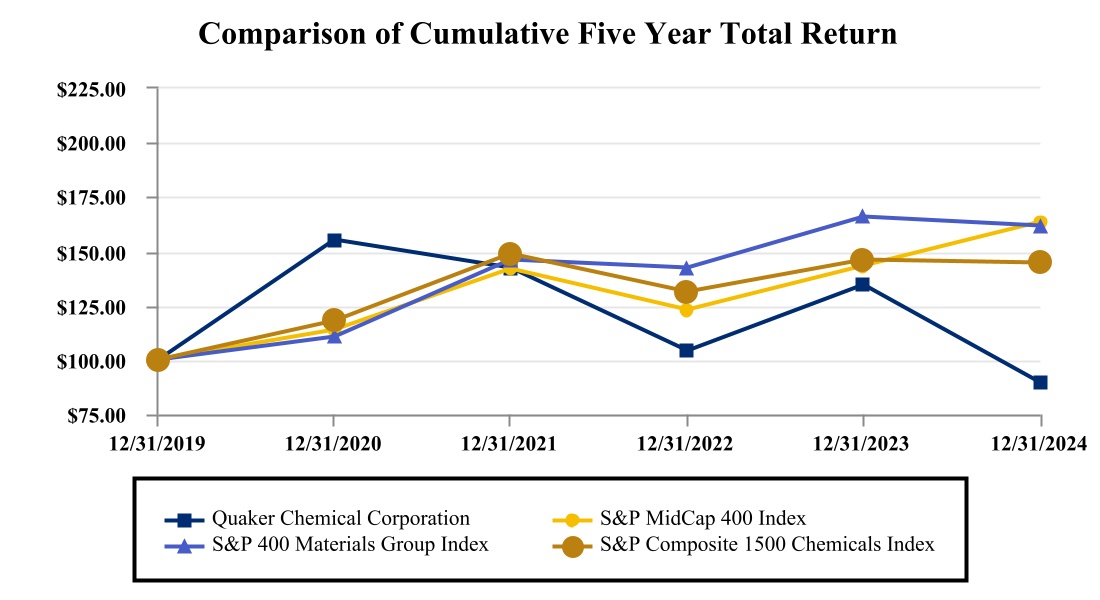
| Company / Index | 12/31/2019 | 12/31/2020 | 12/31/2021 | 12/31/2022 | 12/31/2023 | 12/31/2024 | ||||||||||||||||||||||||||||||||
| Quaker Chemical Corp. | $ | 100.00 | $ | 155.43 | $ | 142.48 | $ | 104.16 | $ | 134.50 | $ | 89.60 | ||||||||||||||||||||||||||
| S&P MidCap 400 Index | 100.00 | 113.66 | 141.80 | 123.28 | 143.54 | 163.54 | ||||||||||||||||||||||||||||||||
| S&P 400 Materials Group Index | 100.00 | 110.65 | 146.30 | 142.31 | 165.83 | 161.74 | ||||||||||||||||||||||||||||||||
| S&P Composite 1500 Chemicals Index | 100.00 | 118.22 | 148.89 | 131.59 | 146.19 | 144.62 | ||||||||||||||||||||||||||||||||
Item 6. Reserved.
24
Item 7. Management’s Discussion and Analysis of Financial Condition and Results of Operations.
As used in this Annual Report on Form 10-K (the “Report”), the terms “Quaker Houghton,” the “Company,” “we,” and “our” refer to Quaker Chemical Corporation (doing business as Quaker Houghton), its subsidiaries, and associated companies, unless the context otherwise requires.
Executive Summary
Quaker Houghton is the global leader in industrial process fluids. With a presence around the world, including operations in over 25 countries, our customers include thousands of the world’s most advanced and specialized steel, aluminum, automotive, aerospace, offshore, container, mining, and metalworking companies. Our high-performing, innovative and sustainable solutions are backed by best-in-class technology, deep process knowledge, and customized services. Quaker Houghton is headquartered in Conshohocken, Pennsylvania, located near Philadelphia in the U.S.
Net sales of $1,839.7 million in 2024 decreased 6% compared to $1,953.3 million in 2023, primarily due to a decrease in selling price and product mix of approximately 4%, a decrease in sales volumes of approximately 2%, and an unfavorable impact from foreign currency translation of approximately 1%, partially offset by an increase in sales from acquisitions of approximately 1%. The decrease in selling price and product mix was attributable to the impact of our index-based customer contracts and the mix of products and services. The decline in sales volumes was primarily a result of the continuation of soft end market conditions compared to the prior year in the Americas and Europe, Middle East and Africa (“EMEA”) segments, partially offset by an increase in sales volumes in the Asia/Pacific segment, continued business wins across all segments and a contribution from acquisitions in the EMEA and Asia/Pacific segments.
The Company generated net income of $116.6 million or $6.51 per diluted share in 2024, compared to a net income of $112.7 million or $6.26 per diluted share in 2023. The increase in current year earnings was primarily driven by lower interest expense and lower foreign exchange losses, partially offset by lower operating income. Excluding non-recurring and non-core items, the Company’s current year non-GAAP net income and non-GAAP earnings per diluted share were $133.5 million and $7.44, respectively, compared to $137.6 million and $7.65, respectively, in 2023. The decrease in current year non-GAAP earnings was primarily driven by a decrease in net sales, partially offset by an improvement in gross margins, lower interest expense, and an increase in other income (expense), net. The Company generated adjusted EBITDA of $310.9 million compared to $320.4 million in 2023, a decrease of 3%. The decrease in adjusted EBITDA was primarily a result of a decrease in net sales, partially offset by an increase in other income (expense), net. See the Non-GAAP Measures section of this Item below.
The Company’s 2024 operating performance in the Americas and EMEA reportable segments reflect similar drivers to that of the Company’s consolidated performance. Operating earnings for the Americas and EMEA segments decreased compared to the prior year, primarily driven by a decrease in net sales, partially offset by an increase in segment operating margins. Asia/Pacific segment operating earnings increased compared to the prior year, primarily driven by an increase in net sales, partially offset by a decrease in segment operating margins. Additional details of each segment’s operating performance are further discussed in the Company’s reportable segments review, in the Operations section of this Item 7, below.
Net cash flows provided by operating activities were $204.6 million in 2024 compared to $279.0 million in 2023. The decrease in net operating cash flows was primarily driven by a reduction in cash inflow from working capital in the current year. The key drivers of the Company’s operating cash flow and overall liquidity are further discussed in the Company’s Liquidity and Capital Resources section of this Item 7, below.
Overall, the Company’s results in 2024 reflect the Company’s continued execution on its financial and operational priorities despite a continuation of soft end market conditions that have impacted the Company’s customers. Looking ahead to 2025, we believe Quaker Houghton is well positioned to continue to deliver above market growth rates through new business wins, by delivering value-added solutions and services to its customers. The Company expects to continue to advance its enterprise growth strategy, including investing in its long-term growth initiatives, further strengthening its focus on customer intimacy, progressing with its sustainability program and positioning the Company to deliver earnings growth in 2025 and beyond.
Critical Accounting Policies and Estimates
Quaker Houghton’s discussion and analysis of its financial condition and results of operations are based on its consolidated financial statements which have been prepared in accordance with accounting principles generally accepted in the United States (“U.S. GAAP”). The preparation of these financial statements requires the Company to make estimates and judgments that affect the reported amounts of assets, liabilities, revenues and expenses, and related disclosure of contingent assets and liabilities. On an ongoing basis, the Company evaluates its estimates, including those related to customer sales incentives, product returns, credit losses, inventories, property, plant and equipment (“PP&E”), investments, goodwill, intangible assets, income taxes, business combinations, and restructuring. These estimates reflect historical experience as well as our best judgment about current and/or future economic and market conditions and their effects and various other assumptions that are believed to be reasonable based on currently available information, the results of which form the basis for making judgments about the carrying values of assets and liabilities that are not readily apparent from other sources. However, actual results may differ materially from these estimates under different assumptions or conditions.
25
Quaker Houghton believes the following critical accounting policies describe the more significant judgments and estimates used in the preparation of its consolidated financial statements:
Accounts receivable and inventory exposures: The Company establishes allowances for credit losses for estimated losses resulting from the inability of its customers to make required payments. If the financial condition of the Company’s customers was to deteriorate, resulting in an impairment of their ability to make payments, additional allowances may be required. As part of our terms of trade, we may custom manufacture products for certain large customers and/or may ship products on a consignment basis. Further, a significant portion of our revenue is derived from sales to customers in industries where companies have previously experienced financial difficulties. If a significant customer bankruptcy occurs, then we must judge the amount of proceeds, if any, that may ultimately be received through the bankruptcy or liquidation process. These matters may increase the Company’s exposure should a bankruptcy occur and may require a write down or a disposal of certain inventory as well as the failure to collect receivables. Reserves for customers filing for bankruptcy protection are established based on a percentage of the amount of receivables outstanding at the bankruptcy filing date. However, initially establishing this reserve and the amount thereof is dependent on the Company’s evaluation of likely proceeds to be received from the bankruptcy process, which could result in the Company recognizing minimal or no reserve at the date of bankruptcy. We generally reserve for large and/or financially distressed customers on a specific review basis, while a general reserve is maintained for other customers based on historical experience. The Company’s consolidated allowance for credit losses was $13.6 million and $13.3 million as of December 31, 2024 and 2023, respectively. The Company recorded expense to increase its provision for credit losses by $2.1 million, $1.3 million and $4.3 million for the years ended December 31, 2024, 2023 and 2022, respectively.
Tax exposures, uncertain tax positions and valuation allowances: The Company records expenses and liabilities for taxes based on estimates of amounts that will be determined as deductible or taxable in tax returns filed in various jurisdictions. The filed tax returns are subject to audit, which often occur several years subsequent to the date of the financial statements. Disputes or disagreements may arise during audits over the timing or validity of certain items, such as taxable income or deductions, which may not be resolved for extended periods of time. The Company also evaluates uncertain tax positions on all income tax positions taken on previously filed tax returns or expected to be taken on a future tax return in accordance with FIN 48, which prescribes the recognition threshold and measurement attributes for financial statement recognition and measurement of tax positions taken or expected to be taken on a tax return and, also, whether the benefits of tax positions are probable or if they are more likely than not to be sustained upon audit based upon the technical merits of the tax position. For tax positions that are determined to be more likely than not to be sustained upon audit, the Company recognizes the largest amount of benefit that is greater than 50% likely of being realized upon ultimate settlement in the financial statements. For tax positions that are not determined to be more likely than not sustained upon audit, the Company does not recognize any portion of the benefit in its financial statements. In addition, the Company’s continuing practice is to recognize interest and/or penalties related to income tax matters in income tax expense. Also, the Company nets its liability for unrecognized tax benefits against deferred tax assets related to net operating losses or other tax credit carryforward on the basis that the uncertain tax position is settled for the presumed amount at the balance sheet date.
The Company also records valuation allowances when necessary to reduce its deferred tax assets to the amount that is more likely than not to be realized. While the Company has considered future taxable income and assesses the need for a valuation allowance, in the event Quaker Houghton were to determine that it would be able to realize its deferred tax assets in the future in excess of its net recorded amount, an adjustment to the deferred tax asset would increase income in the period such determination was made. Likewise, should the Company determine that it would not be able to realize all or part of its net deferred tax assets in the future, an adjustment to the deferred tax asset would be charged to income in the period such determination was made. Both determinations could have a material impact on the Company’s financial statements.
Pursuant to the Tax Cuts and Jobs Act (“U.S. Tax Reform”), the Company recorded a $15.5 million transition tax liability for U.S. income taxes on the undistributed earnings of non-U.S. subsidiaries. As of December 31, 2024, $11.6 million in installments have been paid with the remaining $3.9 million to be paid in 2025. However, the Company may also be subject to other taxes, such as withholding taxes and dividend distribution taxes, if certain undistributed earnings are ultimately remitted to the U.S. As of December 31, 2024, the Company has a deferred tax liability of $8.4 million, which primarily represents the estimate of the non-U.S. taxes the Company will incur to remit certain previously taxed earnings to the U.S. It is the Company’s current intention to reinvest its future undistributed earnings of non-U.S. subsidiaries to support working capital needs and certain other growth initiatives outside of the U.S. The amount of such undistributed earnings at December 31, 2024 was approximately $359.8 million. Any tax liability which might result from ultimate remittance of these earnings is expected to be substantially offset by foreign tax credits (subject to certain limitations), however, certain withholding taxes could apply. It is currently impractical to estimate any such incremental tax expense. See Note 10, Income Taxes, to the Consolidated Financial Statements for more information.
26
Goodwill and other intangible assets: The Company accounts for business combinations under the acquisition method of accounting. This method requires the recording of acquired assets, including separately identifiable intangible assets, at their acquisition date fair values. Any excess of the purchase price over the estimated fair value of the identifiable net assets acquired is recorded as goodwill. The determination of the estimated fair value of assets acquired requires management’s judgment and often involves the use of significant estimates and assumptions, including assumptions with respect to projected revenue growth rates, gross margins, and operating margins, the weighted average cost of capital (“WACC”), royalty rates, asset lives and market multiples, among other items. When necessary, the Company consults with external advisors to help determine fair value. For non-observable market values, the Company may determine fair value using acceptable valuation principles, including the excess earnings, relief from royalty, lost profit or cost methods.
The Company amortizes definite-lived intangible assets on a straight-line basis over their useful lives. Goodwill and intangible assets that have indefinite lives are not amortized and are required to be assessed at least annually for impairment. The Company completes its annual goodwill and indefinite-lived intangible asset impairment test during the fourth quarter of each year, or more frequently if triggering events indicate a possible impairment. The Company’s consolidated goodwill at December 31, 2024 and 2023 was $518.9 million and $512.5 million, respectively. As of December 31, 2024 and 2023, the Company had indefinite-lived intangible assets for trademarks and intangibles totaling $185.3 million and $193.2 million, respectively.
During the fourth quarter of 2022, the Company recorded a non-cash impairment charge of $93.0 million to write down the carrying value of the EMEA reporting unit goodwill to its estimated fair values. In connection with the Company’s reorganization and the associated change in reportable segments and reporting units during the first quarter of 2023, the Company performed the required impairment assessments directly before and immediately after the change in reporting units and concluded that it was not more likely than not that the fair values of any of the Company’s previous or new reporting units were less than their respective carrying amounts. Additionally, the Company completed its annual impairment assessment as of October 1, 2023 and October 1, 2024 and concluded in each case that no impairment existed.
In completing the annual impairment assessment, the Company used a WACC assumption of approximately 10.5% and holding all other assumptions constant, the WACC would have to increase by approximately 2.6 percentage points before the Company’s EMEA reporting unit’s remaining goodwill would be impaired. In addition, holding EBITDA margins and all other assumptions constant, the Company’s compound annual revenue growth rate during the entire projection period would need to decline by approximately 1.9 percentage points before the Company’s EMEA reporting unit’s remaining goodwill would be impaired. Similarly, holding revenue growth rates and all other assumptions constant, the Company’s average EBITDA margins throughout the discreet projection period would need to decline by approximately 9.8 percentage points before the Company’s EMEA reporting unit’s remaining goodwill would be impaired.
The Company continually evaluates financial performance, economic conditions and other recent developments in assessing if a triggering event indicates that the carrying value of goodwill, indefinite-lived, or long-lived assets might be impaired. Notwithstanding the results of the Company’s impairment assessments during 2023 and 2024, if the Company is unable to maintain the actions aimed at improving the financial performance of the EMEA reporting unit, or interest rates rise, which leads to an increase in the cost of capital, then these conditions could result in a triggering event for the EMEA reporting unit. This assessment could result in an impairment of the EMEA reporting unit’s remaining goodwill, indefinite-lived intangible assets, or long-lived assets. See Note 15, Goodwill and Other Intangible Assets, to the Consolidated Financial Statements for more information.
Pension and Postretirement benefits: The Company provides certain defined benefit pension and other postretirement benefits to current employees, former employees and retirees. Independent actuaries, in accordance with U.S. GAAP, perform the required valuations to determine benefit expense and, if necessary, non-cash charges to equity for additional minimum pension liabilities. Critical assumptions used in the actuarial valuation include the weighted average discount rate, which is based on applicable yield curve data, including the use of a split discount rate (spot-rate approach) for the U.S. plans and certain foreign plans, rates of increase in compensation levels, and expected long-term rates of return on assets.
Recently Issued Accounting Standards
See Note 3, Recently Issued Accounting Standards, to the Consolidated Financial Statements for more information for a discussion regarding recently adopted accounting standards and recently issued accounting standards not yet adopted.
Liquidity and Capital Resources
The Company had cash and cash equivalents of $188.9 million and $194.5 million at December 31, 2024 and 2023, respectively. Cash held by subsidiaries in foreign countries was approximately $180.6 million and $177.1 million at December 31, 2024 and 2023, respectively. The $5.6 million decrease in cash and cash equivalents was the net result of $204.6 million of cash provided by operating activities, largely offset by $122.7 million of cash used in financing activities, $76.4 million of cash used in investing activities, and an unfavorable impact of foreign currency translation of approximately $11.1 million.
27
Net cash flows provided by operating activities were $204.6 million in 2024 compared to $279.0 million in 2023. The decrease in net operating cash flow year-over-year reflects a decrease in cash inflow from working capital, notably due to an approximately $53.0 million decrease in cash flow associated with inventory, as inventory purchases returned to normalized levels after inventory reductions in 2023 due to customer destocking.
Net cash flows used in investing activities were $76.4 million in 2024 compared to $27.6 million in 2023. The increase in cash used in investing activities year-over-year is primarily the result of $39.3 million of payments in the current year related to the acquisitions of the Sutai Group (“Sutai”) and I.K.V. Tribologie IKVT and its subsidiaries (“IKV”), a $3.0 million increase in capital expenditures, and a reduction of proceeds from asset dispositions of $6.5 million. See Note 2, Business Combinations, to the Consolidated Financial Statements for further information about business acquisitions.
Net cash flows used in financing activities were $122.7 million in 2024 compared to $238.6 million in 2023. The decrease in net cash outflows was primarily related to $17.9 million of net borrowings on the Company’s revolving credit facility in the current year compared to $164.8 million of net repayments in the prior year. This was offset by payments of approximately $49.2 million for repurchases of the Company’s common stock under its share repurchase program in the current year and payments of $57.2 million to reduce long-term debt in the current year, an $18.3 million increase compared to the prior year. In addition, the Company paid $33.2 million of cash dividends to shareholders during 2024, a $1.5 million increase compared to the prior year.
During June 2022, the Company, and its wholly owned subsidiary, Quaker Houghton B.V., as borrowers, Bank of America, N.A., as administrative agent, U.S. Dollar swing line lender and letter of credit issuer, Bank of America Europe Designated Active Company, as Euro Swing Line Lender, certain guarantors and other lenders entered into an amendment to its primary credit facility (the “ Original Credit Facility”). The amended credit facility (“Credit Facility”) established (A) a new $150.0 million Euro equivalent senior secured term loan (the “Euro Term Loan”), (B) a new $600.0 million senior secured term loan (the “U.S. Term Loan”), and (C) a new $500.0 million senior secured revolving credit facility (the “Revolver”), each maturing in June 2027. The Company has the right to increase the amount of the Credit Facility by an aggregate amount not to exceed the greater of $300.0 million or 100% of Consolidated EBITDA, subject to certain conditions including the agreement to provide financing by any lender providing such increase. In addition, the Credit Facility also:
(i) eliminated the requirement that material foreign subsidiaries must guaranty the Original Euro Term Loan;
(ii) replaced the U.S. Dollar borrowings reference rate from LIBOR to SOFR;
(iii) extended the maturity date of the Original Credit Facility from August 2024 to June 2027; and
(iv) effected other less significant changes to the Original Credit Facility.
As of December 31, 2024, the Company had Credit Facility borrowings outstanding of $696.5 million. The Company’s other debt obligations are primarily industrial development bonds, bank lines of credit and municipality-related loans, which totaled $11.8 million as of December 31, 2024. Total unused capacity under these arrangements as of December 31, 2024 was approximately $32.9 million. The Company’s total net debt as of December 31, 2024 was $519.4 million, which consists of total borrowings of $708.3 million less cash and cash equivalents of $188.9 million. The Credit Facility contains affirmative and negative covenants, financial covenants and events of default. Financial covenants contained in the Credit Facility include a consolidated interest coverage ratio test and a consolidated net leverage ratio test. As of December 31, 2024, the Company was in compliance with all of the Credit Facility covenants. Refer to the description of the Company’s primary Credit Facility in Note 19, Debt, to the Consolidated Financial Statements for more information about the covenants and events of default.
The weighted average variable interest rate incurred on the outstanding borrowings under the Credit Facility during the twelve months ended December 31, 2024 was approximately 6.1%. As of December 31, 2024, the interest rate on the outstanding borrowings under the Credit Facility was approximately 5.2%. As part of the Credit Facility, the Company is required to pay an annual commitment fee ranging from 0.150% to 0.275% related to unutilized commitments under the Revolver, depending on the Company’s consolidated net leverage ratio. The Company had unused capacity under the Revolver of approximately $448.7 million, which is net of bank letters of credit of approximately $2.4 million, as of December 31, 2024.
In order to manage the Company’s exposure to variable interest rate risk associated with the Credit Facility, in the first quarter of 2023, the Company entered into $300.0 million notional amounts of three-year interest rate swaps to convert a portion of the Company’s variable rate borrowings into an average fixed rate obligation of 3.64% plus an applicable margin as provided in the Credit Facility based on the Company’s consolidated net leverage ratio. As of December 31, 2024, the aggregate interest rate on the swaps, including the fixed base rate plus the applicable margin, was 4.9%. See Note 24, Hedging Activities, to the Consolidated Financial Statements for more information.
28
In connection with executing the Credit Facility, the Company recorded a loss on extinguishment of debt of approximately $6.8 million in Other income (expense), net on the Consolidated Statement of Operations during the year ended December 31, 2022. The loss on extinguishment of debt included the write-off of certain previously unamortized deferred financing costs as well as a portion of the third-party and creditor debt issuance costs incurred to execute the Credit Facility. The Company capitalized third-party and credit debt issuance costs attributed to the Euro Term Loan, U.S. Term Loan and Revolver in connection to the amended Credit Facility during the second quarter of 2022. Capitalized costs attributed to the Euro Term Loan and U.S. Term Loan are recorded as a direct offset to Long-term debt on the Consolidated Balance Sheets. Capitalized costs attributed to the Revolver are recorded within Other assets on the Consolidated Balance Sheets. These capitalized costs will collectively be amortized into Interest expense over the five year term of the Credit Facility. As of December 31, 2024 and 2023, the Company had $1.1 million and $1.5 million, respectively, of debt issuance costs recorded as a reduction of Long-term debt and $2.4 million and $3.3 million, respectively, of debt issuance costs recorded within Other assets.
The Company uses foreign exchange forward contracts to economically hedge the impact of the variability in exchange rates on certain assets and/or liabilities denominated in certain foreign currencies. During the year ended December 31, 2024, the Company entered into and settled forward contracts resulting in other expense of $2.0 million compared to other income of $2.1 million in the prior year. See Note 24, Hedging Activities, to the Consolidated Financial Statements for more information.
During 2022, the Company’s management initiated a global cost and optimization program to improve its cost structure and drive a more profitable and productive organization. The Company has achieved its initial full run-rate cost savings goal from the global cost and optimization program of approximately $20 million. In the first quarter of 2025, the Company approved additional actions under the program, which are expected to generate additional run-rate cost savings of at least $20 million. The program is expected to be substantially complete in the first half of 2025. The Company recognized $6.5 million, $7.6 million and $3.2 million of restructuring and related charges for the years ended December 31, 2024, 2023 and 2022, respectively, as a result of these programs and other facility closure actions. The Company made cash payments related to the settlement of restructuring liabilities under the program of $7.6 million and $9.8 million during the years ended December 31, 2024 and 2023, respectively. The Company expects total one-time cash costs of this program to be approximately 1 to 1.5 times annualized savings. See Note 7, Restructuring and Related Activities, to the Consolidated Financial Statements for more information.
As of December 31, 2024, the Company’s gross liability for uncertain tax positions, including interest and penalties, was $17.3 million. The Company cannot determine a reliable estimate of the timing of cash flows by period related to its uncertain tax position liability. However, should the entire liability be paid, the amount of the payment may be reduced by up to $5.6 million as a result of offsetting benefits in other tax jurisdictions. See Note 10, Income Taxes, to the Consolidated Financial Statements for more information.
On February 28, 2024, the Board approved a new share repurchase program (“2024 Share Repurchase Program”), authorizing the Company to repurchase up to an aggregate of $150 million of the Company’s outstanding common stock and replacing the prior share repurchase program, under which no repurchases were made in 2024. The 2024 Share Repurchase Program was effective immediately upon approval and has no expiration date. The Company made certain repurchases under the 2024 Repurchase Program during the year ended December 31, 2024, as mentioned above. As of December 31, 2024, there was approximately $100.8 million of capacity remaining under the 2024 Share Repurchase Program. See Note 8, Equity, to the Consolidated Financial Statements for more information.
The Company previously disclosed in its 2023 Form 10-K that one of its North American production facilities experienced an electrical fire in 2021 that resulted in property damage and the temporary shutdown of production. The Company and its insurance carrier reviewed the impact of the electrical fire on the production facility’s operations as it relates to a potential business interruption insurance claim. In July 2024, the Company and its insurance carrier settled this claim for $1.0 million. See Note 25, Commitments and Contingencies, to the Consolidated Financial Statements for more information.
The Company believes that its existing cash, anticipated cash flows from operations and available liquidity will be sufficient to support its operating requirements and fund its business objectives for at least the next twelve months, including but not limited to, payments of dividends to shareholders, share repurchases, capital expenditures, other growth opportunities (including potential acquisitions), pension plan contributions, implementing actions to achieve the Company’s sustainability goals and other potential known or anticipated contingencies. The Company also believes it has sufficient additional liquidity to support its operating requirements and to fund its business obligations for the period beyond the next twelve months, including the aforementioned items which are expected to recur annually, as well as future principal and interest payments on the Company’s Credit Facility, tax obligations and other long-term liabilities. The Company’s liquidity is affected by many factors, some based on normal operations of our business and others related to the impact of global events on our business and on global economic conditions as well as industry uncertainties, which we cannot predict. We also cannot predict economic conditions and industry downturns or the timing, strength or duration of recoveries. We may seek, as we believe appropriate, additional debt or equity financing that would provide capital for corporate purposes, working capital funding, additional liquidity needs or to fund future growth opportunities, including possible acquisitions and organic investments. The timing and amount of potential capital requirements cannot be determined at this time and will depend on a number of factors, including the actual and projected demand for our products, specialty chemical industry conditions, competitive factors, and the condition of financial markets, among others.
29
The following table summarizes the Company’s contractual obligations as of December 31, 2024, and the effect such obligations are expected to have on its liquidity and cash flows in future periods. Pension and postretirement plan contributions beyond 2025 are not determinable since the amount of any contribution is heavily dependent on the future economic environment and investment returns on pension trust assets. The timing of payments related to other long-term liabilities which consists primarily of deferred compensation agreements and environmental reserves, also cannot be readily determined due to their uncertainty. Interest obligations on the Company’s long-term debt and capital leases assume the current debt levels will be outstanding for the entire respective period and apply the interest rates in effect as of December 31, 2024.
| Payments due by period | |||||||||||||||||||||||||||||||||||||||||
| (dollars in thousand) | 2030 and Beyond | ||||||||||||||||||||||||||||||||||||||||
| Contractual Obligations | Total | 2025 | 2026 | 2027 | 2028 | 2029 | |||||||||||||||||||||||||||||||||||
| Long-term debt (See Note 19 of Notes to Consolidated Financial Statements) | $ | 707,214 | $ | 34,318 | $ | 34,285 | $ | 628,342 | $ | 10,269 | $ | — | $ | — | |||||||||||||||||||||||||||
| Interest obligations (See Note 19 of Notes to Consolidated Financial Statements) | 90,902 | 38,204 | 35,739 | 16,784 | 175 | — | — | ||||||||||||||||||||||||||||||||||
| Capital lease obligations (See Note 6 of Notes to Consolidated Financial Statements) | 1,053 | 447 | 352 | 231 | 23 | — | — | ||||||||||||||||||||||||||||||||||
| Operating leases (See Note 6 of Notes to Consolidated Financial Statements) | 116,061 | 12,753 | 11,597 | 9,619 | 7,594 | 6,460 | 68,038 | ||||||||||||||||||||||||||||||||||
| Purchase obligations | 480 | 480 | — | — | — | — | — | ||||||||||||||||||||||||||||||||||
| Income taxes payable (See Note 10 and Note 21 of Notes to Consolidated Financial Statements) | 4,770 | 4,648 | 122 | — | — | — | — | ||||||||||||||||||||||||||||||||||
| Pension and other postretirement plan contributions (See Note 20 of Notes to Consolidated Financial Statements) | 6,165 | 6,165 | — | — | — | — | — | ||||||||||||||||||||||||||||||||||
| Other long-term liabilities (See Note 21 of Notes to Consolidated Financial Statements) | 7,188 | — | — | — | — | — | 7,188 | ||||||||||||||||||||||||||||||||||
| Total contractual cash obligations | $ | 933,833 | $ | 97,015 | $ | 82,095 | $ | 654,976 | $ | 18,061 | $ | 6,460 | $ | 75,226 | |||||||||||||||||||||||||||
Non-GAAP Measures
The information in this Report includes non-GAAP (unaudited) financial information that includes EBITDA, adjusted EBITDA, adjusted EBITDA margin, non-GAAP operating income, non-GAAP operating margin, non-GAAP net income and non-GAAP earnings per diluted share. The Company believes these non-GAAP financial measures provide meaningful supplemental information as they enhance a reader’s understanding of the financial performance of the Company, facilitate a comparison among fiscal periods, and exclude items that management believes are not indicative of future operating performance or core to the Company’s operations. Non-GAAP results are presented for supplemental informational purposes only and should not be considered a substitute for the financial information presented in accordance with GAAP. In addition, our definitions of EBITDA, adjusted EBITDA, adjusted EBITDA margin, non-GAAP operating income, non-GAAP operating margin, non-GAAP net income, and non-GAAP earnings per share, as discussed and reconciled below to the most comparable GAAP measures, may not be comparable to similarly named measures reported by other companies.
The Company presents EBITDA which is calculated as net income attributable to the Company before depreciation and amortization, interest expense, net, and taxes on income before equity in net income of associated companies. The Company also presents adjusted EBITDA which is calculated as EBITDA plus or minus certain items that management believes are not indicative of future operating performance or not considered core to the Company’s operations. In addition, the Company presents non-GAAP operating income which is calculated as operating income plus or minus certain items that management believes are not indicative of future operating performance or considers core to the Company’s operations. Adjusted EBITDA margin and non-GAAP operating margin are calculated as the percentage of adjusted EBITDA and non-GAAP operating income to consolidated net sales, respectively. The Company believes these non-GAAP measures provide transparent and useful information and are widely used by analysts, investors, and competitors in our industry as well as by management in assessing the operating performance of the Company on a consistent basis.
30
Additionally, the Company presents non-GAAP net income and non-GAAP earnings per diluted share as additional performance measures. Non-GAAP net income is calculated as adjusted EBITDA, defined above, less depreciation and amortization, interest expense, net, and taxes on income before equity in net income of associated companies, in each case adjusted, as applicable, for any depreciation, amortization, interest or tax impacts resulting from the non-core items identified in the reconciliation of net income attributable to the Company to adjusted EBITDA. Non-GAAP earnings per diluted share is calculated as non-GAAP net income per diluted share as accounted for under the “two-class share method.” The Company believes that non-GAAP net income and non-GAAP earnings per diluted share provide transparent and useful information and are widely used by analysts, investors, and competitors in our industry as well as by management in assessing the performance of the Company on a consistent basis.
Certain of the prior period non-GAAP financial measures presented in the following tables have been adjusted to conform with current period presentation. The following tables reconcile the Company’s non-GAAP financial measures (unaudited) to their most directly comparable GAAP financial measures (dollars in thousands, unless otherwise noted, except per share amounts):
| Non-GAAP Operating Income and Margin Reconciliations | For the years ended December 31, | ||||||||||||||||
| 2024 | 2023 | 2022 | |||||||||||||||
| Operating income | $ | 194,706 | $ | 214,495 | $ | 52,304 | |||||||||||
| Acquisition-related expenses (a) | 1,854 | — | 8,812 | ||||||||||||||
| Restructuring and related charges, net (b) | 6,530 | 7,588 | 3,163 | ||||||||||||||
| Strategic planning (credits) expenses (c) | (290) | 4,704 | 14,446 | ||||||||||||||
| Executive transition costs (d) | 7,288 | 688 | 2,813 | ||||||||||||||
| Customer insolvency costs (e) | 3,213 | — | — | ||||||||||||||
| Impairment charges (k) | — | — | 93,000 | ||||||||||||||
| Russia-Ukraine conflict related expenses (l) | — | — | 2,487 | ||||||||||||||
| Other charges (n) | 399 | 299 | 866 | ||||||||||||||
| Non-GAAP operating income | $ | 213,700 | $ | 227,774 | $ | 177,891 | |||||||||||
| Non-GAAP operating margin (%) (r) | 11.6 | % | 11.7 | % | 9.2 | % | |||||||||||
31
| EBITDA, Adjusted EBITDA, Adjusted EBITDA Margin and Non-GAAP Net Income Reconciliations | For the years ended December 31, | ||||||||||||||||
| 2024 | 2023 | 2022 | |||||||||||||||
| Net income (loss) attributable to Quaker Chemical Corporation | $ | 116,644 | $ | 112,748 | $ | (15,931) | |||||||||||
| Depreciation and amortization (p) | 85,108 | 83,020 | 81,514 | ||||||||||||||
| Interest expense, net | 41,002 | 50,699 | 32,579 | ||||||||||||||
| Taxes on income (loss) before equity in net income of associated companies (q) | 49,300 | 55,585 | 24,925 | ||||||||||||||
| EBITDA | 292,054 | 302,052 | 123,087 | ||||||||||||||
| Equity (income) loss in a captive insurance company (h) | (2,930) | (2,090) | 1,427 | ||||||||||||||
| Acquisition-related expenses (credits) (a) | 1,454 | (475) | 10,990 | ||||||||||||||
| Restructuring and related charges, net (b) | 6,530 | 7,588 | 3,163 | ||||||||||||||
| Strategic planning (credits) expenses (c) | (290) | 4,704 | 14,446 | ||||||||||||||
| Executive transition costs (d) | 7,288 | 688 | 2,813 | ||||||||||||||
| Customer insolvency costs (e) | 3,213 | — | — | ||||||||||||||
| Facility remediation recoveries, net (f) | — | (2,141) | (1,804) | ||||||||||||||
| Product liability claim costs, net (g) | 2,040 | — | — | ||||||||||||||
| Business interruption insurance proceeds (i) | (1,000) | — | — | ||||||||||||||
| Currency conversion impacts of hyper-inflationary economies (j) | 811 | 7,849 | 1,617 | ||||||||||||||
| Impairment charges (k) | — | — | 93,000 | ||||||||||||||
| Russia-Ukraine conflict related expenses (l) | — | — | 2,487 | ||||||||||||||
| Loss on extinguishment of debt (m) | — | — | 6,763 | ||||||||||||||
| Other charges (credits) (n) | 1,748 | 2,204 | (839) | ||||||||||||||
| Adjusted EBITDA | $ | 310,918 | $ | 320,379 | $ | 257,150 | |||||||||||
| Adjusted EBITDA margin (%) (r) | 16.9 | % | 16.4 | % | 13.2 | % | |||||||||||
| Adjusted EBITDA | $ | 310,918 | $ | 320,379 | $ | 257,150 | |||||||||||
| Less: Depreciation and amortization - adjusted (p) | 85,108 | 83,020 | 81,514 | ||||||||||||||
| Less: Interest expense, net | 41,002 | 50,699 | 32,579 | ||||||||||||||
| Less: Taxes on income (loss) before equity in net income of associated companies - adjusted (o)(q) | 51,352 | 49,017 | 37,737 | ||||||||||||||
| Non-GAAP net income | $ | 133,456 | $ | 137,643 | $ | 105,320 | |||||||||||
32
| Non-GAAP Earnings per Diluted Share Reconciliations | For the years ending December 31, | ||||||||||||||||
| 2024 | 2023 | 2022 | |||||||||||||||
| GAAP earnings (loss) per diluted share attributable to Quaker Chemical Corporation common shareholders | $ | 6.51 | $ | 6.26 | $ | (0.89) | |||||||||||
| Equity (income) loss in a captive insurance company per diluted share (h) | (0.16) | (0.12) | 0.08 | ||||||||||||||
| Acquisition-related expenses (credits) per diluted share (a) | 0.06 | (0.03) | 0.49 | ||||||||||||||
| Restructuring and related charges, net per diluted share (b) | 0.28 | 0.32 | 0.13 | ||||||||||||||
| Strategic planning (credits) expenses per diluted share (c) | (0.01) | 0.21 | 0.63 | ||||||||||||||
| Executive transition costs per diluted share (d) | 0.31 | 0.03 | 0.12 | ||||||||||||||
| Customer insolvency costs per diluted share (e) | 0.13 | — | — | ||||||||||||||
| Facility remediation recoveries, net per diluted share (f) | — | (0.09) | (0.08) | ||||||||||||||
| Product liability claim costs, net per diluted share (g) | 0.09 | — | — | ||||||||||||||
| Business interruption insurance proceeds per diluted share (i) | (0.04) | — | — | ||||||||||||||
| Currency conversion impacts of hyper-inflationary economies per diluted share (j) | 0.05 | 0.44 | 0.09 | ||||||||||||||
| Impairment charges per diluted share (k) | — | — | 5.19 | ||||||||||||||
| Russia-Ukraine conflict related expenses per diluted share (l) | — | — | 0.12 | ||||||||||||||
| Loss on extinguishment of debt per diluted share (m) | — | — | 0.29 | ||||||||||||||
| Other charges (credits) per diluted share (n) | 0.05 | 0.09 | (0.04) | ||||||||||||||
| Impact of certain discrete tax items per diluted share (o) | 0.17 | 0.54 | (0.26) | ||||||||||||||
| Non-GAAP earnings per diluted share (s) | $ | 7.44 | $ | 7.65 | $ | 5.87 | |||||||||||
(a)Acquisition-related expenses (credits) include expense associated with the Company's recent and potential acquisitions, including legal, financial, consulting and other costs. For the year ended December 31, 2022, these amounts also include costs incurred in connection with integration activities relating to the Houghton acquisition. See Note 2, Business Combinations, to the Consolidated Financial Statements for additional information.
(b)Restructuring and related charges, net represent the costs incurred by the Company associated with the Company’s restructuring program and facility closures. During 2024, 2023 and 2022, the Company recorded restructuring and related charges of $6.5 million, $7.6 million and $3.2 million, respectively. See Note 7, Restructuring and Related Activities, to the Consolidated Financial Statements for additional information.
(c)Strategic planning (credits) expenses include certain consultant and advisory expenses for the Company's long-term strategic planning, as well as process optimization and the next phase of the Company's long-term integration to further optimize its footprint, processes and other functions.
(d)Executive transition costs represent the costs related to the Company’s transition of executive officers.
(e)Customer insolvency costs represent charges associated with specific reserves for trade accounts receivable within the Company’s EMEA and America’s reportable segments related to two specific customers that filed for bankruptcy protection.
(f)Facility remediation recoveries, net represent insurance recoveries received for remediation and restoration of property damage to certain of the Company’s facilities and are recorded in Other income (expense). There were no gains recognized during the year ended December 31, 2024. See Note 25, Commitments and Contingencies, to the Consolidated Financial Statements for additional information.
(g)Product liability claim costs, net represents expenses related to the payments by the Company in connection with product liability disputes with customers, net of insurance recoveries during 2024. See Note 9, Other Income (Expense), net to the Consolidated Financial Statements for additional information.
(h)Equity income (loss) in a captive insurance company represents the after-tax income attributable to the Company’s equity interest in Primex, Ltd. (“Primex”), a captive insurance company. The Company holds a 32% investment in and has significant influence over Primex, and therefore accounts for this investment under the equity method of accounting. See Note 16, Investments in Associated Companies, to the Consolidated Financial Statements for additional information.
(i)Business interruption insurance proceeds reflects an insurance claim settlement receipt for the for the year ended December 31, 2024 related to production losses due to an electrical fire in 2021 that resulted in the temporary shutdown of production at one of the Company’s production facilities. See Note 25, Commitments and Contingencies, to the Consolidated Financial Statements for additional information.
33
(j)Currency conversion impacts of hyper-inflationary economies represent the foreign currency remeasurement impacts associated with the Company’s affiliates in Argentina and Türkiye whose local economies are designated as hyper-inflationary under U.S. GAAP. These pre-tax foreign currency remeasurement impacts are not deductible for tax purposes for each of the years ended December 31, 2024 and 2023 and 2022. The charges incurred related to the immediate recognition of foreign currency remeasurement in the Consolidated Statements of Operations. See Note 1, Basis of Presentation and Significant Accounting Policies, to the Consolidated Financial Statements for additional information.
(k)Impairment charges represent the non-cash charges taken to write down the value of goodwill for the year ended December 31, 2022. See Note 15, Goodwill and Other Intangible Assets, to the Consolidated Financial Statements for additional information.
(l)Expenses related to the Russia-Ukraine conflict represent the direct costs associated with the Company's exit of operations in Russia during 2022. These costs included employee separation benefits, as well as costs associated with reserves for trade accounts receivable within the Company's EMEA reportable segment, where certain customers were impacted by the conflict between Russia and Ukraine or the Company's decision to end operations in Russia.
(m)In connection with executing the Credit Facility, the Company recorded a loss on extinguishment of debt of approximately $6.8 million which includes the write-off of certain previously unamortized deferred financing costs as well as a portion of the third-party and creditor debt issuance costs incurred to execute the Credit Facility. See Note 19, Debt, to the Consolidated Financial Statements for additional information.
(n)Other charges (credits) include charges incurred by an inactive subsidiary of the Company as a result of the termination of restrictions on insurance settlement reserves, non-service components of the Company’s pension and postretirement net periodic benefit income and expense and net gains recognized for the sale of certain facilities previously classified as held-for-sale. See Note 1, Basis of Presentation and Significant Accounting Policies, Note 7, Restructuring and Related Activities, and Note 20, Pension and Other Postretirement Benefits, to the Consolidated Financial Statements for additional information.
(o)The impacts of certain discrete tax items include certain impacts of tax law changes, valuation allowance adjustments, uncertain tax positions, provision to return and other adjustments, and the impact of certain intercompany asset transfers. For the year ended December 31, 2023, the impacts also included $6.7 million of withholding taxes for the repatriation of non-U.S. earnings. See Note 10, Income Taxes, to the Consolidated Financial Statements for additional information.
(p)Depreciation and amortization includes $1.0 million for each of the years ended December 31, 2024, 2023 and 2022, respectively, of amortization expense recorded within equity in net income of associated companies in the Company’s Consolidated Statements of Operations, which is attributable to amortization of the fair value purchase accounting step-up in connection with acquisition of the Company’s 50% equity interest in Korea Houghton Corporation.
(q)Taxes on income before equity in net income of associated companies – adjusted presents the impact of any current and deferred income tax expense (benefit), as applicable, of the reconciling items presented in the reconciliation of net income attributable to Quaker Chemical Corporation to adjusted EBITDA and was determined utilizing the applicable rates in the taxing jurisdictions in which these adjustments occurred, subject to deductibility.
(r)The Company calculates adjusted EBITDA margin and non-GAAP operating margin as the percentage of adjusted EBITDA and non-GAAP operating income, respectively, to consolidated net sales.
(s)The Company calculates non-GAAP earnings per diluted share as non-GAAP net income attributable to the Company per weighted average diluted shares outstanding using the “two-class share method” to calculate such in each given period.
Off-Balance Sheet Arrangements
The Company had approximately $6 million of bank letters of credit and guarantees as of December 31, 2024. The bank letters of credit and guarantees are not significant to the Company’s liquidity or capital resources.
34
Operations
Consolidated Operations Review – Comparison of 2024 with 2023
The following table summarizes the sales variances by reportable segment and consolidated operations from the prior year:
| Sales volumes | Selling price & product mix | Foreign currency | Acquisition & other | Total | |||||||||||||||||||||||||
| Americas | (5) | % | (4) | % | (1) | % | — | % | (10) | % | |||||||||||||||||||
| EMEA | (5) | % | (4) | % | — | % | 3 | % | (6) | % | |||||||||||||||||||
| Asia/Pacific | 7 | % | (3) | % | (2) | % | 2 | % | 4 | % | |||||||||||||||||||
| Consolidated | (2) | % | (4) | % | (1) | % | 1 | % | (6) | % | |||||||||||||||||||
Net sales of $1,839.7 million in 2024 decreased 6% compared to $1,953.3 million in 2023, primarily due to a decrease in selling price and product mix of approximately 4%, a decrease in sales volumes of approximately 2%, and unfavorable impacts from foreign currency translation of approximately 1%, partially offset by an increase in sales from acquisitions of approximately 1%. The decrease in selling price and product mix was primarily attributable to the impact of our index-based customer contracts and the mix of products and services. The decline in sales volumes was primarily a result of continuation of soft end market conditions compared to the prior year, primarily in the Americas and EMEA segments, partially offset by an increase in sales volumes in the Asia/Pacific segment, continued business wins across all segments and a contribution from acquisitions in the EMEA and Asia/Pacific segments.
Cost of goods sold (“COGS”) were $1,153.7 million in 2024 compared to $1,247.7 million in 2023. The decrease of COGS of $94.0 million, or 8%, reflects lower spend on the decline in current year sales volumes and a modest decline in the Company’s global raw material costs.
Gross profit was $686.0 million in 2024 compared to $705.6 million in 2023, a decrease of approximately $19.6 million, or 3%, primarily as a result of the decline in sales mentioned above, partially offset by a modest reduction in the Company’s global raw material costs. The Company’s reported gross margin in 2024 was 37.3% compared to 36.1% in 2023. The Company’s current year improvement in gross margin was primarily driven by our value-based pricing model and modest improvements in raw material costs.
SG&A was $484.8 million in 2024 compared to $483.6 million in 2023, an increase of $1.2 million, or 0.3%, primarily as a result of higher executive transition costs, higher customer insolvency costs, and SG&A relating to the IKV and Sutai acquisitions, partially offset by lower strategic planning expenses and favorable foreign currency translation compared to the prior year.
The Company incurred Restructuring and related charges of $6.5 million and $7.6 million during 2024 and 2023, respectively, related to reductions in headcount and facility closure costs under the Company’s restructuring program. See the Non-GAAP Measures section of this Item above and Note 7, Restructuring and Related Activities, to the Consolidated Financial Statements for additional information.
Operating income in 2024 was $194.7 million compared to $214.5 million in 2023. Excluding non-core items that are not indicative of future operating performance, as detailed above, the Company’s current year non-GAAP operating income was $213.7 million compared to $227.8 million in the prior year. The decrease in non-GAAP operating income was primarily due to lower gross profit, as described above.
The Company had Other income, net of $1.4 million in 2024 compared to Other expense, net of $10.7 million in 2023 due to lower foreign exchange losses of $1.8 million in the current year compared to losses of $14.8 million in the prior year. Additionally, the Company had higher non-income tax refunds of $3.7 million in the current year compared to non-income tax refunds of $1.3 million in the prior year. Other income, net in 2024 also included a business interruption insurance recovery of $1.0 million, other income of $0.4 million relating to adjustments to the earnout provisions for the Sutai acquisition, and $2.0 million of product liability claim costs. Prior year’s Other expense, net included $2.1 million of facility remediation recoveries, net.
Interest expense, net, of $41.0 million decreased $9.7 million in 2024 compared to $50.7 million in 2023, primarily as a result of lower outstanding borrowings and decreases in interest rates.
35
The Company’s effective tax rates for 2024 and 2023 were 31.8% and 36.3%, respectively. The Company’s current year effective tax rate was primarily impacted by the mix of pre-tax earnings, certain one-time charges related to an intercompany intangible asset transfer, provision to return and other adjustments, and withholding taxes, offset by changes in uncertain tax positions. The Company’s 2023 effective tax rate was primarily impacted by changes to the valuation allowance for and the usage of certain foreign tax credits, withholding taxes and deferred taxes on unremitted earnings, and the mix of pre-tax earnings. Excluding the impact of all non-core items in each year, described in the Non-GAAP Measures section of this Item, above, the Company estimates that the 2024 and 2023 effective tax rates would have been approximately 29% and 28%, respectively. In 2023, the Company recognized $6.7 million of withholding taxes for the repatriation of non-U.S. earnings that the Company does not believe is core or indicative of future performance and has adjusted these withholding taxes as a Non-GAAP measure. The Company may experience continued volatility in its effective tax rates due to several factors, including the timing of tax audits and the expiration of applicable statutes of limitations as they relate to uncertain tax positions, the unpredictability of the timing and amount of certain incentives in various tax jurisdictions, and the timing and amount of certain share-based compensation-related tax benefits, among other factors. In addition, the foreign tax credit valuation allowance, or absence thereof, is based on a number of variables, including forecasted earnings, which may vary.
Equity in net income of associated companies was $11.0 million in 2024 compared to $15.3 million in 2023. The decrease of $4.3 million was primarily due to lower current year income from the Company’s 50% equity interest in a joint venture in Korea offset by higher current year income from the Company’s equity interest in Primex.
Net income attributable to noncontrolling interest was approximately $0.1 million for both 2024 and 2023.
Consolidated Operations Review – Comparison of 2023 with 2022
The following table summarizes sales variances by segment and consolidated operations from the prior year:
| Sales volumes | Selling price & product mix | Foreign currency | Acquisition & other | Total | ||||||||||||||||||||||||||||
| Americas | (6) | % | 8 | % | 1 | % | — | % | 3 | % | ||||||||||||||||||||||
| EMEA | (9) | % | 9 | % | 2 | % | — | % | 2 | % | ||||||||||||||||||||||
| Asia/Pacific | (7) | % | 4 | % | (4) | % | — | % | (7) | % | ||||||||||||||||||||||
| Consolidated | (7) | % | 7 | % | 1 | % | — | % | 1 | % | ||||||||||||||||||||||
Net sales were a record $1,953.3 million in 2023 compared to $1,943.6 million in 2022. The increase in net sales of approximately $9.7 million or 1% year-over-year was primarily due to an increase in selling price and product mix of 7% and approximately 1% favorable impact of foreign currency translations, partially offset by a decline in sales volumes of approximately 7%. The increase in selling price and product mix was primarily driven by year-over-year impact of our value-based pricing initiatives. The decline in sales volumes was primarily attributable to softer end market conditions across all regions, including the direct and indirect impacts of the UAW strike, the Company’s value-based pricing initiatives and customer order patterns, as well as the impacts of the ongoing war in Ukraine in the EMEA segment, and the wind-down of the tolling agreement for products previously divested related to the Quaker combination with Houghton International, Inc. (“Houghton”), partially offset by new business wins in all segments, as mentioned above.
COGS were $1,247.7 million in 2023 compared to $1,330.9 million in 2022. The decrease in COGS of 6% reflects lower spend on the decline in current year sales volumes, which more than offset higher costs due to inflationary pressures in the Company’s global raw material, manufacturing and supply chain and logistics costs compared to the prior year.
Gross profit in 2023 of $705.6 million increased $93.0 million or approximately 15% from 2022. The Company’s reported gross margin in 2023 was 36.1% compared to 31.5% in 2022. The Company’s current year improvement in gross margin was primarily driven by the year-over-year impact of our value-based pricing and margin improvement initiatives.
SG&A in 2023 increased $28.2 million compared to 2022 driven by higher labor-related costs including year-over-year inflationary increases and higher levels of incentive compensation on improved Company performance, partially offset by lower SG&A due to foreign currency translation compared to the prior year.
During 2022, the Company incurred $8.8 million of Acquisition-related expenses (credits). See the Non-GAAP Measures section of this Item, above. There were no similar costs incurred during 2023.
The Company incurred Restructuring and related charges of $7.6 million and $3.2 million during 2023 and 2022, respectively, related to the Company’s previous and current restructuring programs. See the Non-GAAP Measures section of this Item, above.
In 2022, the Company recorded a $93.0 million non-cash impairment charge to write down the value of goodwill associated with the Company’s EMEA reportable segment. This non-cash impairment charge was the result of the Company’s trigger based fourth quarter of 2022 impairment assessment. There were no similar impairment charges in 2023. See the Critical Accounting Policies and Estimates section as well as the Non-GAAP Measures section, of this Item, above.
36
Operating income in 2023 was $214.5 million compared to $52.3 million in 2022. Excluding the non-cash impairment charge, as well as other non-core items that are not indicative of future operating performance, the Company’s current year non-GAAP operating income was $227.8 million compared to $177.9 million in the prior year. The increase in non-GAAP operating income was primarily due to higher gross profit partially offset by higher SG&A, as described above.
The Company had Other expense, net of $10.7 million in 2023 compared to $12.6 million in 2022. The 2023 and 2022 results include $2.1 million and $1.8 million, respectively of facility remediation recoveries, net, while prior year’s Other expense, net also includes $6.8 million of loss on extinguishment of debt related to the Company’s refinancing the Original Credit Facility and $2.4 million of expense related to an indemnification asset. Also, there were higher foreign currency transaction losses in 2023 compared to 2022.
Interest expense, net, increased $18.1 million compared to 2022, primarily driven by increases in the average borrowings outstanding coupled with an increase in interest rates year-over-year as the weighted average interest rate incurred on borrowings under the Company’s primary credit facility was approximately 6.2% during 2023 compared to approximately 3.0% during 2022.
The Company’s effective tax rates for 2023 and 2022 were an expense of 36.3% and 350.2%, respectively. The Company’s 2023 effective tax rate was primarily impacted by changes to the valuation allowance for and the usage of certain foreign tax credits, withholding taxes and deferred taxes on unremitted earnings, and the mix of pre-tax earnings. The Company’s 2022 effective tax rate was driven by the non-cash impairment charge, the mix of pre-tax earnings, foreign tax inclusions and withholding taxes, partially offset by a reduction in reserves for uncertain tax positions and changes in the valuation allowance for foreign tax credits. Excluding the impact of all non-core items in each year, described in the Non-GAAP Measures section of this Item, above, the Company estimates that the 2023 and 2022 effective tax rates would have been approximately 28% and 27%, respectively. In 2023, the Company recognized $6.7 million of withholding taxes for the repatriation of non-U.S. earnings that the Company does not believe is core or indicative of future performance and has adjusted these withholding taxes as a Non-GAAP measure. The Company may experience continued volatility in its effective tax rates due to several factors, including the timing of tax audits and the expiration of applicable statutes of limitations as they relate to uncertain tax positions, the unpredictability of the timing and amount of certain incentives in various tax jurisdictions, and the timing and amount of certain share-based compensation-related tax benefits, among other factors. In addition, the foreign tax credit valuation allowance, or absence thereof, is based on a number of variables, including forecasted earnings, which may vary.
Equity in net income of associated companies increased $13.4 million in 2023 compared to 2022, primarily due to higher current year income from the Company’s interest in a captive insurance company (see the Non-GAAP Measures section of this Item, above) due to higher market performance on equity investments and from the Company’s 50% interest in a joint venture in Korea due to overall market improvement.
Net income attributable to noncontrolling interest was approximately $0.1 million for both 2023 and 2022.
Reportable Segments Review - Comparison of 2024 with 2023
The Company’s reportable segments reflect the structure of the Company’s internal organization, the method by which the Company’s resources are allocated and the manner by which the Chief Operating Decision Maker of the Company assesses its performance. During the first quarter of 2023, the Company reorganized certain of its executive management team to align with its new business structure, which reflects the method by which the Company currently assesses its performance and allocates its resources. The Company has three reportable segments: (i) Americas; (ii) EMEA; and (iii) Asia/Pacific. See Notes 1, 4, 5, and 15 of Notes to Consolidated Financial Statements in Item 8 of this Report.
Segment operating earnings for each of the Company’s reportable segments are comprised of the segment’s net sales less directly related product costs and other operating expenses. Operating expenses not directly attributable to the net sales of each respective segment, such as certain corporate and administrative costs, impairment charges, and restructuring charges, are not included in segment operating earnings. Other items not specifically identified with the Company’s reportable segments include Interest expense, net and Other income (expense), net.
Americas
Americas represented approximately 48% of the Company’s consolidated net sales in 2024. The segment’s net sales were $882.1 million, a decrease of $95.0 million or 10% compared to 2023. This was driven by a decline in sales volumes of 5%, a decline in selling price and product mix of 4% and unfavorable foreign currency impacts of 1%. The decline in sales volumes was primarily driven by softer market conditions broadly across the portfolio, partially offset by new business wins. The decline in selling price and product mix was primarily attributable to the impact of our index-based customer contacts and the mix of products and services. The unfavorable foreign exchange impact was primarily due to the strengthening of the U.S. dollar against the Mexican peso and Brazilian real. Segment operating earnings in the Americas were $244.0 million, a decrease of $22.1 million or 8% compared to 2023 primarily driven by the decrease in net sales, partially offset by an improvement in segment operating margins driven by the Company’s margin improvement initiatives.
37
EMEA
EMEA represented approximately 29% of the Company’s consolidated net sales in 2024. The segment’s net sales were $536.4 million, a decrease of $34.9 million or 6% compared to 2023. This was driven by a decline in sales volumes of 5% and a decline in selling price and product mix of 4%, partially offset by a contribution of sales from the acquisition of IKV of 3%. The decline in sales volumes was driven by the continuation of soft end market conditions in the region, partially offset by new business wins. The decline in selling price and product mix was primarily attributable to the impact of our index-based customer contracts and the mix of products and services. Segment operating earnings in EMEA were $99.4 million, a decrease of $5.4 million or 5% compared to 2023 primarily driven by the decrease in net sales, partially offset by an improvement in segment operating margins driven by the Company’s margin improvement initiatives.
Asia/Pacific
Asia/Pacific represented approximately 23% of the Company’s consolidated net sales in 2024. The segment’s net sales were $421.1 million, an increase of 4% or approximately $16.2 million compared to 2023. This was driven by an increase in sales volumes of 7%, a contribution of sales from the acquisition of Sutai of 2%, partially offset by a decline in selling price and product mix of 3% and unfavorable impact from foreign currency translation of 2%. The increase in sales volumes was primarily driven by new business wins coupled with a modest improvement in the end market environment. The decline in selling price and product mix was primarily attributable to the impact of our index-based customer contracts and mix of products and services. The unfavorable foreign currency translation was primarily due to the strengthening of the U.S. dollar against the Chinese renminbi. Segment operating earnings in Asia/Pacific were $122.7 million, an increase of $4.3 million, or 4%, compared to 2023 as a result of improvement in net sales, partially offset by a decrease in segment operating margins.
Reportable Segments Review – Comparison of 2023 with 2022
Americas
Americas represented approximately 50% of the Company’s consolidated net sales in 2023. The segment’s net sales were $977.1 million, an increase of $30.6 million or 3% compared to 2022. The increase in net sales was due to higher selling price and product mix of 8% and favorable foreign currency impacts of 1%, partially offset by a decrease in sales volumes of approximately 6%. The decline in sales volumes was primarily driven by softer market conditions, customer order patterns, the direct and indirect impacts of the UAW strike, and the Company’s value-based pricing initiatives, partially offset by new business wins. The increase in selling price and product mix was primarily driven by value-based price increases implemented to offset the significant increases in raw material, manufacturing and other input costs. The favorable foreign exchange impact was primarily due to the weakening of the U.S. dollar against the Mexican peso. This segment’s operating earnings were $266.0 million, an increase of $42.4 million or 19% compared to 2022 primarily driven by an increase in net sales and an improvement in segment operating margins driven by the Company’s ongoing margin improvement initiatives.
EMEA
EMEA represented approximately 29% of the Company’s consolidated net sales in 2023. The segment’s net sales were $571.3 million, an increase of $8.8 million or 2% compared to 2022. The increase in net sales was a result of a 9% increase in selling price and a favorable impact from foreign currency translation of 2%, which was partially offset by a decrease in sales volumes of approximately 9%. The increase in selling price and product mix was primarily driven by value-based price increases implemented to offset the significant increases in raw material, manufacturing and other input costs. The favorable foreign currency translation impact was primarily due to the weakening of the U.S. dollar against the Euro. The decrease in sales volumes was primarily driven by softer market conditions, the Company’s value-based pricing initiatives, customer order patterns and the impacts of the wind-down of the tolling agreement for products previously divested related to the Combination as well as the ongoing war in Ukraine, partially offset by new business wins. This segment’s operating earnings were $104.8 million, an increase of $28.4 million or 37% compared to 2022. The increase in segment operating earnings was primarily driven by an increase in net sales and an improvement in segment operating margins driven by the Company’s ongoing margin improvement initiatives.
Asia/Pacific
Asia/Pacific represented approximately 21% of the Company’s consolidated net sales in 2023. The segment’s net sales were $404.9 million, a decrease of 7% or approximately $29.7 million compared to 2022. The decrease in net sales was a result of lower sales volumes of 7% and an unfavorable impact from foreign currency translation of 4%, partially offset by a 4% increase in selling price and product mix. The decrease in sales volumes was primarily driven by softer end market conditions and the impacts of the Company’s value-based pricing initiatives, partially offset by new business wins. The increase in selling price and product mix was primarily driven by value-based price increases implemented to offset the significant increases in raw material, manufacturing and other input costs. The unfavorable foreign exchange impact was primarily due to the strengthening of the U.S. dollar against the Chinese renminbi. This segment’s operating earnings were $118.5 million, an increase of $12.6 million or 12% compared to 2022 as a result of higher gross margins reflecting the Company’s value-based pricing initiatives and the Company’s ongoing margin improvement initiatives.
38
Environmental Clean-up Activities
The Company is involved in environmental clean-up activities in connection with an existing plant location and former waste disposal sites. This includes certain soil and groundwater contamination the Company identified in 1992 at AC Products, Inc. (“ACP”), a wholly owned subsidiary. In voluntary coordination with the Santa Ana California Regional Water Quality Board, ACP has been remediating the contamination, the principal contaminant of which is perchloroethylene (“PERC”). In 2004, the Orange County Water District (“OCWD”) filed a civil complaint against ACP and other parties seeking to recover compensatory and other damages related to the investigation and remediation of the contamination in the groundwater. Pursuant to a settlement agreement with OCWD, ACP agreed, among other things, to operate the two groundwater treatment systems to hydraulically contain groundwater contamination emanating from ACP’s site until the concentrations of PERC released by ACP fell below the current Federal maximum contaminant level for four consecutive quarterly sampling events. In 2014, ACP ceased operation at one of its two groundwater treatment systems, as it had met the above condition for closure. In 2020, the Santa Ana Regional Water Quality Control Board asked that ACP conduct some additional indoor and outdoor soil vapor testing on and near the ACP site to confirm that ACP continues to meet the applicable local standards. ACP began to perform such testing program work in 2022, and an additional round of testing is expected to commence in 2025. As of December 31, 2024, ACP believes it is close to meeting the conditions for closure of the remaining groundwater treatment system but continues to operate this system while in discussions with the relevant authorities.
As of December 31, 2024, the Company believes that the range of potential-known liabilities associated with the balance of the ACP water remediation program is approximately $0.1 million to $1.0 million. The low and high ends of the range are based on the length of operation of the treatment system as determined by groundwater modeling. Costs of operation include the operation and maintenance of the extraction well, groundwater monitoring, program management, and soil vapor testing.
The Company is also party to other environmental matters related to certain domestic and foreign properties. These environmental matters primarily require the Company to perform ongoing monitoring and maintenance at each of the applicable sites. During the year ended December 31, 2024, there have been no significant changes to the facts or circumstances of these matters. Based on the Company’s current obligations, historical costs incurred, and projected costs to be incurred over the next 24 years, the Company estimated the present value range of costs for all of these environmental matters, on a discounted basis, to be between approximately $3.5 million and $6.0 million as of December 31, 2024, for which $3.6 million is accrued within other accrued liabilities and other non-current liabilities on the Company’s Consolidated Balance Sheets as of December 31, 2024. Comparatively, as of December 31, 2023, the Company had $5.1 million accrued for these matters. These accrued amounts are inclusive of the Brazilian environmental matter discussed below.
The Company’s Sao Paulo, Brazil site was required under Brazilian environmental, health and safety regulations to perform an environmental assessment as part of a permit renewal process. Initial investigations identified soil and ground water contamination in select areas of the site. The site has conducted a multi-year soil and groundwater investigation and corresponding risk assessments based on the result of the investigations. In 2017, the site had to submit a new 5-year permit renewal request and was asked to complete additional investigations to further delineate the site based on review of the technical data by the local regulatory agency, Companhia Ambiental do Estado de São Paulo (“CETESB”). Based on review of the updated investigation data, CETESB issued a Technical Opinion regarding the investigation and remedial actions taken to date. The site developed an action plan and submitted it to CETESB in 2018 based on CETESB requirements. The site intervention plan primarily requires the site, amongst other actions, to conduct periodic monitoring for methane in soil vapors, source zone delineation, groundwater plume delineation, bedrock aquifer assessment, update the human health risk assessment, develop a current site conceptual model and conduct a remedial feasibility study and provide a revised intervention plan. In 2020, the site submitted a report on the activities completed including the revised site conceptual model and results of the remedial feasibility study and recommended remedial strategy for the site.
The Company believes that it has made adequate accruals for costs associated with other environmental matters of which it is aware. Approximately $0.6 million and $0.2 million were accrued as of December 31, 2024 and 2023, respectively, to provide for such anticipated future environmental assessments and remediation costs.
Notwithstanding the foregoing, the Company cannot be certain that future liabilities in the form of remediation expenses and damages will not exceed amounts reserved. See Note 25, Commitments and Contingencies, to the Consolidated Financial Statements for additional details.
General
See Item 7A of this Report, below, for further discussion of certain quantitative and qualitative disclosures about market risk.
Item 7A. Quantitative and Qualitative Disclosures About Market Risk.
Quaker Houghton’s earnings, cash flows and financial position are exposed to the impact of fluctuations in interest rates, foreign currency exchange rates, and commodity prices, as well as credit risk. Except as otherwise disclosed below, the market risks discussed below did not change materially from December 31, 2023.
39
Interest Rate Risk. During June 2022, the Company entered into an amendment to its primary credit facility (the “Credit Facility”). See Note 19, Debt, to the Consolidated Financial Statements for additional details. As of December 31, 2024, borrowings under the Credit Facility bear interest at either term SOFR or a base rate, in each case, plus an applicable margin based upon the Company’s consolidated net leverage ratio, and, in the case of term SOFR, a spread adjustment equal to 0.10% per annum. As a result of the variable interest rates applicable under the Credit Facility, if interest rates rise significantly, the cost of debt to the Company will increase. This may have an adverse effect on the Company, depending on the extent of the Company’s borrowings outstanding throughout a given year. As of December 31, 2024, the Company had outstanding borrowings under the Credit Facility of approximately $696.5 million. The interest rate applicable on outstanding borrowings under the Credit Facility was approximately 5.2% as of December 31, 2024. An interest rate change of 100 basis points would result in an approximate $7.0 million increase or decrease to interest expense for the year ended December 31, 2024.
In order to manage the Company’s exposure to variable interest rate risk associated with the Credit Facility in the first quarter of 2023, the Company entered into $300.0 million notional amounts of three year interest rate swaps to convert a portion of the Company’s variable rate borrowings into an average fixed rate obligation of 3.64% plus an applicable margin as provided in the Credit Facility based on the Company’s consolidated net leverage ratio. As of December 31, 2024, the aggregate interest rate on the swaps, including the fixed base rate plus the applicable margin, was 4.9%. These interest rate swaps are designated and qualify as cash flow hedges.
Foreign Exchange Risk. A significant portion of the Company’s revenues and earnings are generated by its foreign operations. During the past three years, sales by its non-U.S. subsidiaries accounted for approximately 63% to 65% of its consolidated net sales. These foreign operations also represent a significant portion of Quaker Houghton’s assets and liabilities. In addition, the Company occasionally sources inventory among its worldwide operations. This practice can give rise to foreign exchange risk resulting from the varying cost of inventory to the receiving location, as well as from the revaluation of intercompany balances. The Company primarily mitigates this risk through local sourcing efforts.
Generally, these foreign operations use the local currency as their functional currency. Accordingly, Quaker Houghton’s financial results are affected by foreign currency fluctuations, particularly between the U.S. dollar and the euro, the British pound sterling, the Brazilian real, the Mexican peso, the Chinese renminbi and the Indian rupee. Quaker Houghton’s results can be materially affected depending on the volatility and magnitude of foreign exchange rate changes. If the euro, the British pound sterling, the Brazilian real, the Mexican peso, the Chinese renminbi and the Indian rupee had all weakened or strengthened by 10% against the U.S. dollar, the Company’s 2024 revenues would have correspondingly decreased or increased by approximately $97.6 million. Similarly, pre-tax earnings would increase or decrease by approximately $14.3 million.
Commodity Price Risk. Many of the raw materials used by Quaker Houghton are derivatives of commodity chemicals, which can experience significant price volatility, and therefore Quaker Houghton’s earnings can be materially affected by market changes in raw material prices. At times, the Company has entered into fixed-price purchase contracts to manage this risk. These contracts provide protection to Quaker Houghton if the prices for the contracted raw materials rise; however, in certain circumstances, the Company may not realize the benefit if such prices decline. A gross margin change of one percentage point would correspondingly have increased or decreased the Company’s pre-tax earnings by approximately $18.4 million.
Credit Risk. Quaker Houghton establishes allowances for credit losses for estimated losses resulting from the inability of its customers to make required payments. If the financial condition of Quaker Houghton’s customers were to deteriorate, resulting in an impairment of their ability to make payments, additional allowances might be required. Downturns in the overall economic climate may also exacerbate specific customer financial issues. A significant portion of the Company’s revenues are derived from sales to customers in the steel and automotive industries, including some of our larger customers, where bankruptcies have occurred in the past and where companies have experienced past financial difficulties. Though infrequent, when a bankruptcy occurs, Quaker Houghton must judge the amount of proceeds, if any, that may ultimately be received through the bankruptcy or liquidation process.
In addition, as part of its terms of trade, Quaker Houghton may custom manufacture products for certain large customers and may also ship products on a consignment basis. These practices may increase the Company’s exposure to customer credit risk, including bankruptcy and may require a write-down or disposal of inventory due to obsolescence or limited marketability as well as a reserve for accounts receivable. Customer product returns or disputes may also result in similar issues related to the realizability of accounts receivable or inventory. The Company recorded expense to increase its provision for credit losses by $2.1 million, $1.3 million and $4.3 million for the years ended December 31, 2024, 2023 and 2022, respectively. A change of 10% to the expense recorded to the Company’s provision would have increased or decreased the Company’s pre-tax earnings by $0.2 million, $0.1 million and $0.4 million for the years ended December 31, 2024, 2023 and 2022, respectively.
40
Item 8. Financial Statements and Supplementary Data.
Quaker Chemical Corporation
Index to Consolidated Financial Statements
| Page | |||||
| Financial Statements | |||||
41
Report of Independent Registered Public Accounting Firm
To the Board of Directors and Shareholders of Quaker Chemical Corporation
Opinions on the Financial Statements and Internal Control over Financial Reporting
We have audited the accompanying consolidated balance sheets of Quaker Chemical Corporation and its subsidiaries (the "Company") as of December 31, 2024 and 2023, and the related consolidated statements of operations, of comprehensive income (loss), of changes in equity and of cash flows for each of the three years in the period ended December 31, 2024, including the related notes (collectively referred to as the "consolidated financial statements"). We also have audited the Company's internal control over financial reporting as of December 31, 2024, based on criteria established in Internal Control - Integrated Framework (2013) issued by the Committee of Sponsoring Organizations of the Treadway Commission (COSO).
In our opinion, the consolidated financial statements referred to above present fairly, in all material respects, the financial position of the Company as of December 31, 2024 and 2023, and the results of its operations and its cash flows for each of the three years in the period ended December 31, 2024 in conformity with accounting principles generally accepted in the United States of America. Also in our opinion, the Company maintained, in all material respects, effective internal control over financial reporting as of December 31, 2024, based on criteria established in Internal Control - Integrated Framework (2013) issued by the COSO.
Basis for Opinions
The Company's management is responsible for these consolidated financial statements, for maintaining effective internal control over financial reporting, and for its assessment of the effectiveness of internal control over financial reporting, included in Management’s Report on Internal Control over Financial Reporting appearing under Item 9A. Our responsibility is to express opinions on the Company’s consolidated financial statements and on the Company's internal control over financial reporting based on our audits. We are a public accounting firm registered with the Public Company Accounting Oversight Board (United States) (PCAOB) and are required to be independent with respect to the Company in accordance with the U.S. federal securities laws and the applicable rules and regulations of the Securities and Exchange Commission and the PCAOB.
We conducted our audits in accordance with the standards of the PCAOB. Those standards require that we plan and perform the audits to obtain reasonable assurance about whether the consolidated financial statements are free of material misstatement, whether due to error or fraud, and whether effective internal control over financial reporting was maintained in all material respects.
Our audits of the consolidated financial statements included performing procedures to assess the risks of material misstatement of the consolidated financial statements, whether due to error or fraud, and performing procedures that respond to those risks. Such procedures included examining, on a test basis, evidence regarding the amounts and disclosures in the consolidated financial statements. Our audits also included evaluating the accounting principles used and significant estimates made by management, as well as evaluating the overall presentation of the consolidated financial statements. Our audit of internal control over financial reporting included obtaining an understanding of internal control over financial reporting, assessing the risk that a material weakness exists, and testing and evaluating the design and operating effectiveness of internal control based on the assessed risk. Our audits also included performing such other procedures as we considered necessary in the circumstances. We believe that our audits provide a reasonable basis for our opinions.
Definition and Limitations of Internal Control over Financial Reporting
A company’s internal control over financial reporting is a process designed to provide reasonable assurance regarding the reliability of financial reporting and the preparation of financial statements for external purposes in accordance with generally accepted accounting principles. A company’s internal control over financial reporting includes those policies and procedures that (i) pertain to the maintenance of records that, in reasonable detail, accurately and fairly reflect the transactions and dispositions of the assets of the company; (ii) provide reasonable assurance that transactions are recorded as necessary to permit preparation of financial statements in accordance with generally accepted accounting principles, and that receipts and expenditures of the company are being made only in accordance with authorizations of management and directors of the company; and (iii) provide reasonable assurance regarding prevention or timely detection of unauthorized acquisition, use, or disposition of the company’s assets that could have a material effect on the financial statements.
Because of its inherent limitations, internal control over financial reporting may not prevent or detect misstatements. Also, projections of any evaluation of effectiveness to future periods are subject to the risk that controls may become inadequate because of changes in conditions, or that the degree of compliance with the policies or procedures may deteriorate.
Critical Audit Matters
The critical audit matter communicated below is a matter arising from the current period audit of the consolidated financial statements that was communicated or required to be communicated to the audit committee and that (i) relates to accounts or disclosures that are material to the consolidated financial statements and (ii) involved our especially challenging, subjective, or complex judgments. The communication of critical audit matters does not alter in any way our opinion on the consolidated financial statements, taken as a whole, and we are not, by communicating the critical audit matter below, providing a separate opinion on the critical audit matter or on the accounts or disclosures to which it relates.
42
Annual Goodwill Impairment Assessment for the EMEA Reporting Unit
As described in Notes 1, 15, and 23 to the consolidated financial statements, the Company’s consolidated goodwill balance was $519 million as of December 31, 2024, of which $80 million relates to the EMEA reporting unit. Management completes its annual goodwill impairment test during the fourth quarter of each year, or more frequently if triggering events indicate a possible impairment in one or more of its reporting units. In completing a quantitative goodwill impairment test, management compares the reporting unit’s fair value, primarily based on future discounted cash flows, to its carrying value in order to determine if an impairment charge is warranted. The determination of the estimated fair value requires management’s judgment and involves the use of significant estimates and assumptions, including revenue growth rates, gross margin levels, operating expenses, and weighted average cost of capital, among other items. Management completed its annual impairment assessment as of October 1, 2024, and concluded no impairment existed.
The principal considerations for our determination that performing procedures relating to the annual goodwill impairment assessment for the EMEA reporting unit is a critical audit matter are (i) the significant judgment by management when developing the fair value estimate of the EMEA reporting unit; (ii) a high degree of auditor judgment, subjectivity, and effort in performing procedures and evaluating management’s significant assumptions related to revenue growth rates and gross margin levels; and (iii) the audit effort involved the use of professionals with specialized skill and knowledge.
Addressing the matter involved performing procedures and evaluating audit evidence in connection with forming our overall opinion on the consolidated financial statements. These procedures included testing the effectiveness of controls relating to management’s goodwill impairment assessment, including controls over the valuation of the EMEA reporting unit. These procedures also included, among others, (i) testing management’s process for developing the fair value estimate of the EMEA reporting unit; (ii) evaluating the appropriateness of the discounted cash flow model used by management; (iii) testing the completeness and accuracy of underlying data used in the discounted cash flow model; and (iv) evaluating the reasonableness of significant assumptions used by management related to the revenue growth rates and gross margin levels. Evaluating management’s assumptions related to the revenue growth rates and gross margin levels, involved evaluating whether the assumptions used by management were reasonable considering (i) the current and past performance of the EMEA reporting unit; (ii) whether the assumptions were consistent with evidence obtained in other areas of the audit; and (iii) for revenue growth rates, whether the assumptions were consistent with external market and industry data. Professionals with specialized skill and knowledge were used to assist in evaluating the appropriateness of the Company’s discounted cash flow model.
/s/PricewaterhouseCoopers LLP
February 24, 2025
We have served as the Company’s auditor since at least 1972. We have not been able to determine the specific year we began serving as auditor of the Company.
43
QUAKER CHEMICAL CORPORATION
CONSOLIDATED STATEMENTS OF OPERATIONS
(Dollars in thousands, except per share data)
| Year Ended December 31, | |||||||||||||||||
| 2024 | 2023 | 2022 | |||||||||||||||
| Net sales | $ | $ | $ | ||||||||||||||
| Cost of goods sold (excluding amortization expense - See Note 15) | |||||||||||||||||
| Gross profit | |||||||||||||||||
| Selling, general and administrative expenses | |||||||||||||||||
| Impairment charges | |||||||||||||||||
| Restructuring and related charges, net | |||||||||||||||||
| Operating income | |||||||||||||||||
| Other income (expense), net | ( | ( | |||||||||||||||
| Interest expense, net | ( | ( | ( | ||||||||||||||
| Income before taxes and equity in net income of associated companies | |||||||||||||||||
| Taxes on income before equity in net income of associated companies | |||||||||||||||||
| Income (loss) before equity in net income of associated companies | ( | ||||||||||||||||
| Equity in net income of associated companies | |||||||||||||||||
| Net income (loss) | ( | ||||||||||||||||
| Less: Net income attributable to noncontrolling interest | |||||||||||||||||
| Net income (loss) attributable to Quaker Chemical Corporation | $ | $ | $ | ( | |||||||||||||
| Per share data: | |||||||||||||||||
| Net income (loss) attributable to Quaker Chemical Corporation common shareholders – basic | $ | $ | $ | ( | |||||||||||||
| Net income (loss) attributable to Quaker Chemical Corporation common shareholders – diluted | $ | $ | $ | ( | |||||||||||||
The accompanying notes are an integral part of these consolidated financial statements.
44
QUAKER CHEMICAL CORPORATION
CONSOLIDATED STATEMENTS OF COMPREHENSIVE INCOME (LOSS)
(Dollars in thousands)
| Year Ended December 31, | |||||||||||||||||
| 2024 | 2023 | 2022 | |||||||||||||||
| Net income (loss) | $ | $ | $ | ( | |||||||||||||
| Other comprehensive (loss) income, net of tax | |||||||||||||||||
| Currency translation adjustments | ( | ( | |||||||||||||||
| Defined benefit retirement plans | |||||||||||||||||
| Net gain (loss) arising during the period, other | ( | ||||||||||||||||
| Amortization of actuarial loss (gain) | ( | ||||||||||||||||
| Amortization of prior service cost (gain) | ( | ||||||||||||||||
| Current period change in fair value of derivatives | ( | ||||||||||||||||
| Unrealized (loss) gain on available-for-sale securities | ( | ( | |||||||||||||||
| Other comprehensive (loss) income | ( | ( | |||||||||||||||
| Comprehensive income (loss) | ( | ||||||||||||||||
| Less: Comprehensive income attributable to noncontrolling interest | ( | ( | ( | ||||||||||||||
| Comprehensive income (loss) attributable to Quaker Chemical Corporation | $ | $ | $ | ( | |||||||||||||
The accompanying notes are an integral part of these consolidated financial statements.
45
QUAKER CHEMICAL CORPORATION
CONSOLIDATED BALANCE SHEETS
(Dollars in thousands, except par value)
| December 31, | |||||||||||
| 2024 | 2023 | ||||||||||
| ASSETS | |||||||||||
| Current assets | |||||||||||
| Cash and cash equivalents | $ | $ | |||||||||
| Accounts receivable, net | |||||||||||
| Inventories | |||||||||||
| Prepaid expenses and other current assets | |||||||||||
| Total current assets | |||||||||||
| Property, plant and equipment, net | |||||||||||
| Right-of-use lease assets | |||||||||||
| Goodwill | |||||||||||
| Other intangible assets, net | |||||||||||
| Investments in associated companies | |||||||||||
| Deferred tax assets | |||||||||||
| Other non-current assets | |||||||||||
| Total assets | $ | $ | |||||||||
| LIABILITIES AND EQUITY | |||||||||||
| Current liabilities | |||||||||||
| Short-term borrowings and current portion of long-term debt | $ | $ | |||||||||
| Accounts payable | |||||||||||
| Dividends payable | |||||||||||
| Accrued compensation | |||||||||||
| Accrued restructuring | |||||||||||
| Accrued pension and postretirement benefits | |||||||||||
| Other accrued liabilities | |||||||||||
| Total current liabilities | |||||||||||
| Long-term debt | |||||||||||
| Long-term lease liabilities | |||||||||||
| Deferred tax liabilities | |||||||||||
| Non-current accrued pension and postretirement benefits | |||||||||||
| Other non-current liabilities | |||||||||||
| Total liabilities | |||||||||||
| Commitments and contingencies (Note 25) | |||||||||||
| Equity | |||||||||||
Common stock, $ | |||||||||||
| Capital in excess of par value | |||||||||||
| Retained earnings | |||||||||||
| Accumulated other comprehensive loss | ( | ( | |||||||||
| Total Quaker shareholders’ equity | |||||||||||
| Noncontrolling interest | |||||||||||
| Total equity | |||||||||||
| Total liabilities and equity | $ | $ | |||||||||
The accompanying notes are an integral part of these consolidated financial statements.
46
QUAKER CHEMICAL CORPORATION
CONSOLIDATED STATEMENTS OF CASH FLOWS
(Dollars in thousands)
| Year Ended December 31, | |||||||||||||||||
| 2024 | 2023 | 2022 | |||||||||||||||
| Cash flows from operating activities | |||||||||||||||||
| Net income (loss) | $ | $ | $ | ( | |||||||||||||
| Adjustments to reconcile net income (loss) to net cash provided by operating activities: | |||||||||||||||||
| Amortization of debt issuance costs | |||||||||||||||||
| Depreciation and amortization | |||||||||||||||||
| Equity in undistributed earnings of associated companies, net of dividends | ( | ( | |||||||||||||||
| Deferred income taxes | ( | ( | ( | ||||||||||||||
| Uncertain tax positions (non-deferred portion) | ( | ( | ( | ||||||||||||||
| Deferred compensation and other, net | |||||||||||||||||
| Share-based compensation | |||||||||||||||||
| Loss on extinguishment of debt | |||||||||||||||||
| Gain on disposal of property, plant, equipment and other assets | ( | ( | ( | ||||||||||||||
| Impairment charges | |||||||||||||||||
| Restructuring and related charges | |||||||||||||||||
| Pension and other postretirement benefits | ( | ( | ( | ||||||||||||||
| Increase (decrease) in cash from changes in current assets and current liabilities, net of acquisitions: | |||||||||||||||||
| Accounts receivable | ( | ||||||||||||||||
| Inventories | ( | ( | |||||||||||||||
| Prepaid expenses and other current assets | ( | ( | |||||||||||||||
| Accrued restructuring | ( | ( | ( | ||||||||||||||
| Accounts payable and accrued liabilities | ( | ( | |||||||||||||||
| Estimated taxes on income (loss) | ( | ( | |||||||||||||||
| Net cash provided by operating activities | |||||||||||||||||
| Cash flows from investing activities | |||||||||||||||||
| Investments in property, plant and equipment | ( | ( | ( | ||||||||||||||
| Payments related to acquisitions, net of cash acquired | ( | ( | |||||||||||||||
| Proceeds from disposition of assets | |||||||||||||||||
| Net cash used in investing activities | ( | ( | ( | ||||||||||||||
| Cash flows from financing activities | |||||||||||||||||
| Payments of long-term debt | ( | ( | ( | ||||||||||||||
| Proceeds from long-term debt | |||||||||||||||||
| Borrowings (payments) on revolving credit facilities, net | ( | ( | |||||||||||||||
| Borrowings (payments) on other debt, net | ( | ( | |||||||||||||||
| Financing-related debt issuance costs | ( | ||||||||||||||||
| Dividends paid | ( | ( | ( | ||||||||||||||
| Shares purchased under share repurchase program | ( | ||||||||||||||||
| Other stock related activity | ( | ( | ( | ||||||||||||||
| Net cash (used in) provided by financing activities | ( | ( | |||||||||||||||
| Effect of foreign exchange rate changes on cash | ( | ( | |||||||||||||||
| Net (decrease) increase in cash and cash equivalents | ( | ||||||||||||||||
| Cash and cash equivalents at the beginning of the period | |||||||||||||||||
| Cash and cash equivalents at the end of the period | $ | $ | $ | ||||||||||||||
| Supplemental cash flow disclosures: | |||||||||||||||||
| Cash paid during the year for: | |||||||||||||||||
| Income taxes, net of refunds | $ | $ | $ | ||||||||||||||
| Interest | |||||||||||||||||
| Non-cash activities: | |||||||||||||||||
| Change in accrued purchases of property, plant and equipment, net | $ | $ | ( | $ | |||||||||||||
The accompanying notes are an integral part of these consolidated financial statements.
47
QUAKER CHEMICAL CORPORATION
CONSOLIDATED STATEMENTS OF CHANGES IN EQUITY
(Dollars in thousands, except per share amounts)
| Common stock | Capital in excess of par value | Retained earnings | Accumulated other comprehensive loss | Noncontrolling interest | Total | ||||||||||||||||||||||||||||||
| Balance as of December 31, 2021 | $ | $ | $ | $ | ( | $ | $ | ||||||||||||||||||||||||||||
| Net (loss) income | — | — | ( | — | ( | ||||||||||||||||||||||||||||||
| Amounts reported in other comprehensive (loss) income | — | — | — | ( | ( | ( | |||||||||||||||||||||||||||||
Dividends declared ($ | — | — | ( | — | — | ( | |||||||||||||||||||||||||||||
| Share issuance and equity-based compensation plans, net | — | — | — | ||||||||||||||||||||||||||||||||
| Balance as of December 31, 2022 | ( | ||||||||||||||||||||||||||||||||||
| Net income | — | — | — | ||||||||||||||||||||||||||||||||
| Amounts reported in other comprehensive income (loss) | — | — | — | ( | |||||||||||||||||||||||||||||||
Dividends declared ($ | — | — | ( | — | — | ( | |||||||||||||||||||||||||||||
| Distributions to noncontrolling interest affiliate shareholders | — | — | — | — | ( | ( | |||||||||||||||||||||||||||||
| Share issuance and equity-based compensation plans, net | — | — | — | ||||||||||||||||||||||||||||||||
| Balance as of December 31, 2023 | ( | ||||||||||||||||||||||||||||||||||
| Net income | — | — | — | ||||||||||||||||||||||||||||||||
| Amounts reported in other comprehensive (loss) income | — | — | — | ( | ( | ( | |||||||||||||||||||||||||||||
Dividends declared ($ | — | — | ( | — | — | ( | |||||||||||||||||||||||||||||
| Shares purchased under share repurchase program, net of excise taxes | ( | ( | — | — | — | ( | |||||||||||||||||||||||||||||
| Share issuance and equity-based compensation plans, net | ( | — | — | — | |||||||||||||||||||||||||||||||
| Balance as of December 31, 2024 | $ | $ | $ | $ | ( | $ | $ | ||||||||||||||||||||||||||||
The accompanying notes are an integral part of these consolidated financial statements.
48
QUAKER CHEMICAL CORPORATION
NOTES TO CONSOLIDATED FINANCIAL STATEMENTS
(Dollars in thousands, except per share amounts, unless otherwise stated)
| Page | ||||||||
Basis of Presentation and Significant Accounting Policies | ||||||||
Income Taxes | ||||||||
49
QUAKER CHEMICAL CORPORATION
NOTES TO CONSOLIDATED FINANCIAL STATEMENTS
(Dollars in thousands, except per share amounts, unless otherwise stated)
Note 1 – Basis of Presentation and Significant Accounting Policies
As used in these Notes to Consolidated Financial Statements, the terms “Quaker,” “Quaker Houghton,” the “Company,” “we,” and “our” refer to Quaker Chemical Corporation (doing business as Quaker Houghton), its subsidiaries, and associated companies, unless the context otherwise requires.
Basis of presentation: The accompanying consolidated financial statements were prepared in accordance with generally accepted accounting principles in the United States (“U.S. GAAP”) and include the accounts of Quaker Houghton and its controlled subsidiaries.
Principles of consolidation: We consolidate all entities we control, which generally applies to entities in which we own a majority of the voting interests. Intercompany transactions and balances are eliminated in consolidation. For consolidated subsidiaries in which the Company’s ownership is less than 100%, the outside shareholders’ interests are reflected as non-controlling interests within the consolidated financial statements. The Company is not the primary beneficiary of any variable interest entities (“VIEs”) and therefore the Company’s consolidated financial statements do not include the accounts of any VIEs.
Accounting estimates: The preparation of financial statements in conformity with U.S. GAAP requires management to make estimates and assumptions that affect the amounts reported in the consolidated financial statements and the accompanying notes. Actual results could differ from such estimates.
Hyper-inflationary accounting: Economies that have a cumulative three-year rate of inflation exceeding 100 % are considered hyper-inflationary. A legal entity that operates within an economy deemed to be hyper-inflationary is required to remeasure its monetary assets and liabilities to the applicable published exchange rates and record the associated gains or losses resulting from the remeasurement directly to the Consolidated Statements of Operations.
Argentina’s and Türkiye’s economies were considered hyper-inflationary effective July 1, 2018 and April 1, 2022, respectively. As of, and for the year ended December 31, 2024, the Company's Argentine and Turkish subsidiaries represented a combined 1 % and 2 % of the Company’s consolidated total assets and net sales, respectively. For the years ended December 31, 2024, 2023 and 2022, the Company recorded $0.8 million, $7.8 million, and $1.6 million, respectively, of remeasurement losses associated with the applicable currency conversions related to Argentina and Türkiye. These losses were recorded within foreign exchange losses, net, which is a component of Other income (expense), net, in the Company’s Consolidated Statements of Operations.
Segments: The Company’s operating segments, which are consistent with its reportable segments, reflect the structure of the Company’s internal organization, the method by which the Company’s resources are allocated and the manner by which the Chief Operating Decision Maker assesses the Company’s performance.
50
QUAKER CHEMICAL CORPORATION
NOTES TO CONSOLIDATED FINANCIAL STATEMENTS - Continued
(Dollars in thousands, except per share amounts, unless otherwise stated)
During the first quarter of 2023, the Company reorganized its executive management team to align with its new business structure. The Company’s new structure includes three reportable segments: (i) Americas; (ii) Europe, Middle East and Africa (“EMEA”); and (iii) Asia/Pacific. Prior to the Company’s reorganization, the Company’s historical reportable segments were: (i) Americas; (ii) EMEA; (iii) Asia/Pacific; and (iv) Global Specialty Businesses. Prior period information has been recast to align with the Company’s business structure as of January 1, 2023, including reportable segments and customer industry disaggregation. As a result of the Company’s new organizational structure effective January 1, 2023, the Company reallocated goodwill previously held by the former Global Specialty Businesses segment to the remaining business segments as of January 1, 2023. However, the Company did not recast the carrying amount of goodwill for the year ended December 31, 2022. See Notes 4, 5, and 15 for additional information.
Reclassifications: Certain information has been reclassified to conform to the current year presentation.
Revenue recognition: The Company recognizes revenue in an amount that reflects the consideration to which the Company expects to be entitled in exchange for goods or services transferred to its customers. To do this, the Company applies a five-step model, which requires the Company to: (i) identify the contract with a customer; (ii) identify the performance obligations in the contract; (iii) determine the transaction price; (iv) allocate the transaction price to the performance obligations in the contract; and (v) recognize revenue when, or as, the Company satisfies the performance obligation.
The Company identifies a contract with a customer when a sales agreement indicates approval and commitment of the parties; identifies the rights of the parties; identifies the payment terms; has commercial substance; and it is probable that the Company will collect the consideration to which it will be entitled in exchange for the goods or services that will be transferred to the customer.
The Company identifies a performance obligation in a contract for each promised good or service that is separately identifiable from other obligations in the contract and for which the customer can benefit from the good or service either on its own or together with other resources that are readily available to the customer. The Company determines the transaction price as the amount of consideration it expects to be entitled to in exchange for fulfilling the performance obligations, including the effects of any variable consideration, significant financing elements, amounts payable to the customer or noncash consideration. For any contracts that have more than one performance obligation, the Company allocates the transaction price to each performance obligation in an amount that depicts the amount of consideration to which the Company expects to be entitled in exchange for satisfying each performance obligation.
In accordance with the last step of the five-step model, the Company recognizes revenue when, or as, it satisfies the performance obligation in a contract by transferring control of a promised good or providing the service to the customer. The Company typically satisfies its performance obligations and recognizes revenue at a point in time for product sales, generally when products are shipped or delivered to the customer, depending on the terms underlying each arrangement. In circumstances where the Company’s products are on consignment, revenue is generally recognized upon usage or consumption by the customer. For any FluidcareTM or other services provided by the Company to the customer, the Company typically satisfies its performance obligations and recognizes revenue over time, as the promised services are performed. The Company uses input methods to recognize revenue over time related to these services, including labor costs and time incurred. The Company believes that these input methods represent the most indicative measure of the FluidcareTM or other service work performed by the Company.
The Company does not have standard payment terms for all customers; however, the Company’s general payment terms require customers to pay for products or services once the performance obligation is satisfied. The Company does not have significant financing arrangements with its customers.
In addition, the Company expenses costs to obtain a contract as incurred when the expected period of benefit, and therefore the amortization period, is one year or less. In addition, the Company excludes from the measurement of the transaction price all taxes assessed by a governmental authority that are both imposed on and concurrent with a specific revenue-producing transaction and collected by the entity from a customer, including sales, use, value added, excise and various other taxes. Lastly, the Company has elected to account for shipping and handling costs incurred after the customer has obtained control of a good as a fulfillment cost, rather than an additional promised service. The Company does not have significant amounts of variable consideration in its contracts with customers.
51
QUAKER CHEMICAL CORPORATION
NOTES TO CONSOLIDATED FINANCIAL STATEMENTS - Continued
(Dollars in thousands, except per share amounts, unless otherwise stated)
The Company records license fees received from third-parties in Other income (expense), net, in its Consolidated Statements of Operations, which generally include sales-based royalties in exchange for the license of intellectual property. These license fees are recognized in accordance with their agreed-upon terms and when performance obligations are satisfied, which is generally when the third party has a subsequent sale.
The Company recognizes a contract asset or receivable on its Consolidated Balance Sheet when the Company performs a service or transfers a good in advance of receiving consideration. A receivable is the Company’s right to consideration that is unconditional and only the passage of time is required before payment of that consideration is due. A contract asset is the Company’s right to consideration in exchange for goods or services that the Company has transferred to a customer.
A contract liability is recognized when the Company receives consideration, or if it has the unconditional right to receive consideration, in advance of performance. A contract liability is the Company’s obligation to transfer goods or services to a customer for which the Company has received consideration, or a specified amount of consideration is due, from the customer.
See Note 5, Net Sales and Revenue Recognition, for additional information.
Right-of-use lease assets and lease liabilities: The Company determines if an arrangement is a lease at its inception. This determination generally depends on whether the arrangement conveys the right to control the use of an identified asset for a period of time in exchange for consideration. Control of an underlying asset is conveyed if the Company obtains the right to direct the use of the asset, and obtains substantially all of the economic benefits from its use. Lease expense for variable leases and short-term leases is recognized when the obligation is incurred.
The lease term for all of the Company’s leases includes the non-cancellable period of the lease, adjusted for any renewal and termination options that the Company is reasonably certain it will exercise. Operating leases are included in right-of-use lease assets, other accrued liabilities and long-term lease liabilities on the Consolidated Balance Sheet. Right-of-use lease assets and liabilities are recognized on the lease commencement date based on the present value of lease payments over the respective lease term. Operating lease expense is recognized on a straight-line basis over the lease term.
Share-based compensation: The Company has long-term incentive programs (“LTIP”) for key employees which provides for the granting of stock options, restricted stock units (“RSU”), restricted stock awards (“RSAs”), and performance-based stock awards (“PSUs”). Share-based awards may also be granted under other equity compensation plans. Share-based compensation cost for awards under LTIP and equity compensation plans is measured at the grant date based on the fair value and is recognized as expense over the requisite service period, which is the vesting period.
The fair value of stock options granted is determined using the Black-Scholes option valuation model on the grant date. The fair value of time-based RSAs, time-based RSUs, and performance-based PSUs, for which the performance measure is return on investment capital (“ROIC”), is based on the trading price of the Company’s common stock on the date of grant. The fair value of market-based PSUs, for which the performance measure is total shareholder return (“TSR”), is determined using a Monte Carlo simulation model.
Prior to 2023, the Company elected to assume an estimated forfeiture rate of 13 % based on historical experience. Beginning in 2023, the Company elected to account for forfeitures on new awards as they occur.
See Note 8, Equity, for additional information.
52
QUAKER CHEMICAL CORPORATION
NOTES TO CONSOLIDATED FINANCIAL STATEMENTS - Continued
(Dollars in thousands, except per share amounts, unless otherwise stated)
Income taxes and uncertain tax positions: The provision for income taxes is determined using the asset and liability approach of accounting for income taxes. Under this approach, deferred taxes represent the future tax consequences expected to occur when the reported amounts of assets and liabilities are recovered or paid. The provision for income taxes represents income taxes paid or payable for the current year and the change in deferred taxes during the year. Deferred taxes result from differences between the financial and tax bases of the Company’s assets and liabilities and are adjusted for changes in tax rates and tax laws when changes are enacted. Valuation allowances are recorded to reduce deferred tax assets when it is more likely than not that a tax benefit will not be realized. The Company accounts for uncertainty in income taxes by applying the recognition threshold and measurement attributes for financial statement recognition and measurement of tax positions taken or expected to be taken on a tax return. The Company determines whether the benefits of tax positions are probable or more likely than not sustained upon audit based upon the technical merits of the tax position. For tax positions that are determined to be more likely than not sustained upon audit, the Company recognizes the largest amount of benefit that is greater than 50 % likely of being realized upon ultimate settlement in the financial statements. For tax positions that are not determined to be more likely than not sustained upon audit, the Company does not recognize any portion of the benefit in the financial statements. Additionally, the Company monitors and adjusts for derecognition, classification, and penalties and interest in interim periods, with appropriate disclosure and transition thereto. Also, the amount of interest expense and income related to uncertain tax positions is computed by applying the applicable statutory rate of interest to the difference between the tax position recognized, including timing differences, and the amount previously taken or expected to be taken in a tax return. The Company recognizes interest and/or penalties related to income tax matters in income tax expense. Finally, when applicable, the Company nets its liability for unrecognized tax benefits against deferred tax assets related to net operating losses or other tax credit carryforwards that would apply if the uncertain tax position were settled for the presumed amount at the balance sheet date.
Cash and cash equivalents: The Company invests temporary and excess funds in money market securities and financial instruments having maturities within 90 days. The Company considers all highly liquid investments with original maturities of three months or less to be cash equivalents. The Company has not experienced losses from the aforementioned investments.
53
QUAKER CHEMICAL CORPORATION
NOTES TO CONSOLIDATED FINANCIAL STATEMENTS - Continued
(Dollars in thousands, except per share amounts, unless otherwise stated)
The Company capitalizes costs incurred with the implementation of a cloud computing arrangement that is a service contract, consistent with its policy for software for internal use. The capitalized costs are reflected in "Other non-current assets" on its Consolidated Balance Sheets and expensed over the term of the related hosting arrangement.
Goodwill and other intangible assets: The Company records goodwill, definite-lived intangible assets and indefinite-lived intangible assets at fair value at the date of acquisition. Goodwill and indefinite-lived intangible assets are not amortized but tested for impairment at least annually. These tests will be performed more frequently if triggering events indicate potential impairment. In completing a quantitative goodwill impairment test, the Company compares a reporting unit’s fair value, primarily based on future discounted cash flows, to its carrying value in order to determine if an impairment charge is warranted.
See Note 15, Goodwill and Other Intangible Assets, and Note 23, Fair Value Measures, for additional information.
Fair value measurements: Fair value is defined as an exit price, or the price that would be received to sell an asset or paid to transfer a liability in an orderly transaction between market participants at the measurement date. The Company utilizes a fair value hierarchy that prioritizes the inputs to valuation techniques used to measure fair value into three broad levels. See Notes 20, 23 and 24 for additional information. The following briefly describes those three levels:
•Level 1: Observable inputs such as quoted prices (unadjusted) in active markets for identical assets or liabilities.
•Level 2: Inputs other than quoted prices that are observable for the asset or liability, either directly or indirectly, for sustainability the full term of the asset or liability. These include quoted prices for similar assets or liabilities in active markets and quoted prices for identical or similar assets or liabilities in markets that are not active.
•Level 3: Unobservable inputs for the asset or liability that reflect the reporting entity's own assumptions about the assumptions that market participants would use in pricing the asset or liability.
Pension and other postretirement benefits: The Company maintains various noncontributory retirement plans, covering a portion of its employees in the U.S. and certain other countries, including the Netherlands, the United Kingdom (“U.K.”), Mexico, Sweden, Germany and France. The plans of the remaining non-U.S. subsidiaries are, for the most part, either fully insured or integrated with the local governments’ plans. The Company recognizes the funded status of defined benefit pension and other postretirement plans on its Consolidated Balance Sheets and also, recognizes as a component of AOCI, net of tax, the gains or losses and prior service costs that arise during the period but are not recognized as components of net periodic benefit cost. In addition, the Company recognizes a settlement charge in its Consolidated Statements of Operations when certain events occur, including plan termination or the settlement of certain plan liabilities. A settlement charge represents the immediate recognition into expense of a portion of the unrecognized loss within AOCI on the balance sheet in proportion to the share of the projected benefit obligation that was settled. The measurement date for the Company’s postretirement benefits plan is December 31.
54
QUAKER CHEMICAL CORPORATION
NOTES TO CONSOLIDATED FINANCIAL STATEMENTS - Continued
(Dollars in thousands, except per share amounts, unless otherwise stated)
The Company’s global pension investment policies are designed to ensure that pension assets are invested in a manner consistent with meeting the future benefit obligations of the pension plans and maintaining compliance with various laws and regulations including the Employee Retirement Income Security Act of 1974. The Company establishes strategic asset allocation percentage targets and benchmarks for significant asset classes with the aim of achieving a prudent balance between return and risk. The Company’s investment horizon is generally long term, and, accordingly, the target asset allocations encompass a long-term perspective of capital markets, expected risk and return and perceived future economic conditions while also considering the profile of plan liabilities. To the extent feasible, the short-term investment portfolio is managed to match the short-term obligations, the intermediate portfolio duration is matched to reduce the risk of volatility in intermediate plan distributions, and the total return portfolio is managed to maximize the long-term real growth of plan assets. The critical investment principles of diversification, assessment of risk and targeting the optimal expected returns for given levels of risk are applied. The Company’s investment guidelines prohibit the use of securities such as letter stock and other unregistered securities, commodities or commodity contracts, short sales, margin transactions, private placements (unless specifically addressed by addendum), or any derivatives, options or futures for the purpose of portfolio leveraging.
The target asset allocation is reviewed periodically and is determined based on a long-term projection of capital market outcomes, inflation rates, fixed income yields, returns, volatilities and correlation relationships. The interaction between plan assets and benefit obligations is periodically studied to assist in establishing such strategic asset allocation targets. Asset performance is monitored with an overall expectation that plan assets will meet or exceed benchmark performance over rolling five-year periods. The Company’s pension committee, as authorized by the Company’s Board, has discretion to manage the assets within established asset allocation ranges approved by senior management of the Company. See Note 20, Pension and Other Postretirement Benefits, for additional information.
Derivatives: The Company uses interest rate swap agreements to manage risk, including exposure to variability in interest payments associated with its variable rate debt. Interest rate swaps are designated as cash flow hedges and, as such, the contracts are marked-to-market at each reporting date and any unrealized gains or losses are included in AOCI to the extent effective and reclassified to interest expense in the period during which the transaction affects earnings or it becomes probable that the forecasted transaction will not occur.
Note 2 – Business Combinations
Recent Acquisition Activity
Subsequent to the date of these financial statements, in February 2025, the Company acquired Chemical Solutions & Innovations (Pty) Ltd. (“CSI”), for approximately $3.9 million, subject to routine and customary post-closing adjustments. CSI is based in South Africa and is a supplier of metalworking fluids and lubricants to the South African market. CSI will be reported as part of the EMEA reportable segment. This acquisition strengthens Quaker Houghton’s position in South Africa and expands the Company’s presence in that region. As of the date of this Report, purchase accounting has not been finalized.
55
QUAKER CHEMICAL CORPORATION
NOTES TO CONSOLIDATED FINANCIAL STATEMENTS - Continued
(Dollars in thousands, except per share amounts, unless otherwise stated)
In July 2024, the Company acquired the Sutai Group (“Sutai”), for approximately $16.2 million, including an initial cash payment of $14.6 million, subject to routine and customary post-closing adjustments related to working capital and net indebtedness levels, as well as earn-out provisions with an initial estimated payout of $1.6 million related to the finalization of 2024 and 2025 earnings. Assets acquired included cash and cash equivalents of $5.5 million. The Company recorded incremental income of $0.4 million during the year ended December 31, 2024 relating to adjustments to these earnout provisions in Other income (expense), net on the Consolidated Statements of Operations. As of December 31, 2024, the Company has remaining earnout liabilities recorded on its Consolidated Balance Sheets of $1.2 million. Sutai is based in Japan and provides impregnation treatment products and services to the automotive and other industries. Sutai is reported as part of the Asia/Pacific reportable segment. This acquisition strengthens Quaker Houghton’s technology portfolio, enabling the Company to better support and optimize production processes for customers across the Japanese, Asia Pacific and global markets. The Company allocated $3.1 million of the purchase price to intangible assets and recognized $5.5 million of goodwill in the Asia/Pacific segment, none of which is deductible for tax purposes. The goodwill is primarily attributable to expected synergies. As of December 31, 2024, the allocation of the purchase price has not been finalized.
During February 2024, the Company acquired I.K.V. Tribologie IKVT and its subsidiaries (“IKV”) for $35.2 million, including an initial cash payment of $29.7 million, subject to routine and customary post-closing adjustments related to working capital and net indebtedness levels as well as earn-out provisions related to the finalization of 2023 earnings. Assets acquired included approximately $4.8 million of cash and cash equivalents. IKV, which is part of the Company’s EMEA segment, specializes in high-performance lubricants and greases, including original equipment manufacturer first-fill greases that are primarily used in the automotive, aerospace, electronics and other industrial markets. The acquisition of IKV strengthens the Company’s position in first-fill greases. The Company allocated $15.0 million of the purchase price to intangible assets, comprised of approximately $11.1 million of customer relationships to be amortized over 16 years; $3.2 million of product technologies to be amortized over 14 years; and $0.7 million of trademarks to be amortized over 5 years. In addition, the Company recognized $16.4 million of goodwill in the EMEA segment, none of which is deductible for tax purposes. The goodwill is primarily attributable to expected cost and growth synergies. In July 2024, the 2023 earnings were finalized and the Company made a payment of $5.5 million in connection with the post-closing adjustments and earn-out provision. As of December 31, 2024, the allocation of the purchase price has been finalized.
The results of operations of Sutai and IKV subsequent to the acquisition dates are included in the Consolidated Statements of Operations for the year ended December 31, 2024.
Previous Acquisitions
In October 2022, the Company acquired a business that provides pickling and rinsing products and services, which is part of the EMEA reportable segment, for approximately $3.5 million. The Company allocated $2.8 million of the purchase price to intangible assets, comprised of $2.3 million of customer relationships to be amortized over 10 years; $0.2 million of existing product technologies to be amortized over 10 years; and $0.3 million of licensed trademarks to be amortized over 10 years. In addition, the Company recorded $0.8 million of goodwill related to expected value not allocated to other acquired assets.
In January 2022, the Company acquired a business that provides pickling inhibitor technologies, drawing lubricants and stamping oil, and various other lubrication, rust preventative, and cleaner applications, which is part of the Americas reportable segment for approximately $8.0 million. The Company allocated $5.6 million of the purchase price to intangible assets, comprised of $5.1 million of customer relationships to be amortized over 14 years; and $0.5 million of existing product technologies to be amortized over 14 years. In addition, the Company recorded $1.8 million of goodwill related to expected value not allocated to other acquired assets, all of which is expected to be tax deductible in various jurisdictions in which the Company operates.
In January 2022, the Company acquired a business related to the sealing and impregnation of metal castings for the automotive sector, as well as impregnation resin and impregnation systems for metal parts, which is part of the EMEA reportable segment for approximately $1.4 million.
The results of operations of each acquisition completed prior to December 31, 2024 and subsequent to the respective acquisition dates are included in the Consolidated Statements of Operations. Applicable transaction expenses associated with these acquisitions are included in SG&A in the Company’s Consolidated Statements of Operations. Certain pro forma and other information is not presented, as the operations of the acquired assets and businesses are not considered material to the overall operations of the Company for the periods presented.
56
QUAKER CHEMICAL CORPORATION
NOTES TO CONSOLIDATED FINANCIAL STATEMENTS - Continued
(Dollars in thousands, except per share amounts, unless otherwise stated)
Note 3 – Recently Issued Accounting Standards
Recently Adopted Accounting Standards
The Company adopted Accounting Standards Update (“ASU”) 2023-07, Segment Reporting (Topic 280): Improvements to Reportable Segment Disclosures in this Report and will adopt the interim reportable segment disclosure requirements in the first quarter of 2025. This ASU expands reportable segment disclosure requirements, primarily through enhanced disclosures about significant segment expenses, defined as those expenses that are regularly provided to the Chief Operating Decision Maker (“CODM”) and included in the reported measure of segment profit or loss. The Company disclosed that the CODM, which is the Chief Executive Officer, assesses segment performance and makes decisions about allocating resources to its operating segments using segment operating earnings. Based on the Company’s assessment, the Company determined that product costs are significant segment expenses that are regularly provided to the CODM and included in segment operating earnings. The Company disclosed product costs and other operating expenses included in segment operating earnings by reportable segment. See Note 4, Business Segments, for additional information.
Recently Issued Accounting Standards Not Yet Adopted
The FASB issued ASU 2023-09, Income Taxes (Topic 740): Improvements to Income Tax Disclosures in December 2023. This ASU requires public business entities to disclose additional information in specified categories with respect to the reconciliation of the effective tax rate to the statutory rate (the “rate reconciliation”) for federal, state, and foreign income taxes, requiring greater detail about individual reconciling items in the rate reconciliation to the extent the impact of those items exceeds a specified threshold. The ASU also requires public business entities to disclose income taxes paid disaggregated by federal, state, and foreign taxes. Further disaggregation is also required in jurisdictions where income taxes paid exceeds a certain threshold. ASU 2023-09 is effective for fiscal years beginning after December 15, 2024. The Company is currently evaluating the disclosure requirements of this standard and the impact on its consolidated financial statements.
The FASB issued ASU 2024-03, Income Statement- Reporting Comprehensive Income- Expense Disaggregation Disclosures (Subtopic 220-40): Disaggregation of Income Statement Expenses in November 2024. This ASU requires public business entities (“PBEs”) to disclose, in interim and annual reporting periods, additional information about certain expenses in the notes to the financial statements, including disclosing the amounts of purchases of inventory, employee compensation, depreciation, and intangible asset amortization in each relevant expense caption. It also requires PBEs to disclose a qualitative description of the amounts remaining in relevant expense captions that are not separately disaggregated quantitatively and to disclose the total amount of selling expenses, and in the annual reporting periods, an entity’s definition of selling expenses. ASU 2024-03 is effective for fiscal years beginning after December 15, 2026, with early adoption permitted. The Company is currently evaluating the disclosure requirements of this standard and the impact on its consolidated financial statements.
Note 4 – Business Segments
The Company’s operating segments, which are consistent with its reportable segments, reflect the structure of the Company’s internal organization and the manner by which the Chief Operating Decision Maker, which is the Company’s Chief Executive Officer, allocates resources and assesses performance.
The Chief Operating Decision Maker evaluates performance for the Company’s operating segments based on segment operating earnings. Segment operating earnings for each of the Company’s reportable segments are comprised of the segment’s net sales less directly related product costs and other operating expenses. Operating expenses not directly attributable to the net sales of each respective segment, such as certain corporate and administrative costs, impairment charges, and restructuring charges, are not included in segment operating earnings. Other items not specifically identified with the Company’s reportable segments include Interest expense, net and Other income (expense), net.
The Chief Operating Decision Maker uses segment operating earnings to allocate resources for each segment predominantly in the annual budget and forecasting process. The Chief Operating Decision Maker considers budget-to-actual variances on a monthly basis for segment operating earnings when making decisions about allocating capital and personnel to the segments. The Chief Operating Decision Maker also uses segment operating earnings to assess the performance for each segment and in the compensation of certain employees.
57
QUAKER CHEMICAL CORPORATION
NOTES TO CONSOLIDATED FINANCIAL STATEMENTS - Continued
(Dollars in thousands, except per share amounts, unless otherwise stated)
The following table presents information about the performance of the Company’s reportable segments for the years ended December 31, 2024, 2023 and 2022.
| Americas | EMEA | Asia/Pacific | Totals | ||||||||||||||||||||
| 2024 | |||||||||||||||||||||||
| Net sales | $ | $ | $ | $ | |||||||||||||||||||
| Significant segment expenses | |||||||||||||||||||||||
Product costs (1) | |||||||||||||||||||||||
Other operating expenses (2) | |||||||||||||||||||||||
| Segment operating earnings | $ | $ | $ | $ | |||||||||||||||||||
| 2023 | |||||||||||||||||||||||
| Net sales | $ | $ | $ | $ | |||||||||||||||||||
| Significant segment expenses | |||||||||||||||||||||||
Product costs (1) | |||||||||||||||||||||||
Other operating expenses (2) | |||||||||||||||||||||||
| Segment operating earnings | $ | $ | $ | $ | |||||||||||||||||||
| 2022 | |||||||||||||||||||||||
| Net sales | $ | $ | $ | $ | |||||||||||||||||||
| Significant segment expenses | |||||||||||||||||||||||
Product costs (1) | |||||||||||||||||||||||
Other operating expenses (2) | |||||||||||||||||||||||
| Segment operating earnings | $ | $ | $ | $ | |||||||||||||||||||
(1) Product costs include the costs of raw materials and are recorded in Cost of goods sold in the Company’s Consolidated Statements of Operations.
(2) Other operating expenses include overhead costs of operating the Company’s production facilities and providing chemical management services to customers and direct SG&A costs.
The following table presents a reconciliation of the Company’s segment operating earnings to income before taxes and equity in net income of associated companies in the Company’s Consolidated Statements of Operations for the years ended December 31, 2024, 2023 and 2022.
| 2024 | 2023 | 2022 | |||||||||||||||
| Segment operating earnings | $ | $ | $ | ||||||||||||||
| Restructuring and related charges, net | ( | ( | ( | ||||||||||||||
| Impairment charges | ( | ||||||||||||||||
| Non-operating and administrative expenses | ( | ( | ( | ||||||||||||||
| Depreciation of corporate assets and amortization | ( | ( | ( | ||||||||||||||
| Operating income | $ | $ | $ | ||||||||||||||
| Other income (expense), net | ( | ( | |||||||||||||||
| Interest expense, net | ( | ( | ( | ||||||||||||||
| Income before taxes and equity in net income of associated companies | $ | $ | $ | ||||||||||||||
The following tables present information regarding the Company’s reportable segments’ assets and long-lived assets, excluding goodwill, as of December 31, 2024, 2023 and 2022. Management does not use goodwill by segment to evaluate performance or allocate resources.
| Segment assets, excluding goodwill | 2024 | 2023 | 2022 | |||||||||||||||||
| Americas | $ | $ | $ | |||||||||||||||||
| EMEA | ||||||||||||||||||||
| Asia/Pacific | ||||||||||||||||||||
| Total segment assets | $ | $ | $ | |||||||||||||||||
58
QUAKER CHEMICAL CORPORATION
NOTES TO CONSOLIDATED FINANCIAL STATEMENTS - Continued
(Dollars in thousands, except per share amounts, unless otherwise stated)
| Segment long-lived assets | 2024 | 2023 | 2022 | |||||||||||||||||
| Americas | $ | $ | $ | |||||||||||||||||
| EMEA | ||||||||||||||||||||
| Asia/Pacific | ||||||||||||||||||||
| Total segment long-lived assets | $ | $ | $ | |||||||||||||||||
The following tables present information regarding the Company’s reportable segments’ capital expenditures and depreciation for identifiable assets for the years ended December 31, 2024, 2023 and 2022:
| Capital expenditures | 2024 | 2023 | 2022 | |||||||||||||||||
| Americas | $ | $ | $ | |||||||||||||||||
| EMEA | ||||||||||||||||||||
| Asia/Pacific | ||||||||||||||||||||
| Total segment capital expenditures | $ | $ | $ | |||||||||||||||||
| Depreciation | 2024 | 2023 | 2022 | |||||||||||||||||
| Americas | $ | $ | $ | |||||||||||||||||
| EMEA | ||||||||||||||||||||
| Asia/Pacific | ||||||||||||||||||||
| Total segment depreciation | $ | $ | $ | |||||||||||||||||
The following tables summarize net sales and long-lived assets attributable to U.S. and non-U.S. domiciled operations for the years ended December 31, 2024, 2023 and 2022:
| Net sales | 2024 | 2023 | 2022 | |||||||||||||||||
| United States | $ | $ | $ | |||||||||||||||||
| China | ||||||||||||||||||||
| Other foreign operations | ||||||||||||||||||||
| Total net sales | $ | $ | $ | |||||||||||||||||
| Long-lived assets | 2024 | 2023 | 2022 | |||||||||||||||||
| United States | $ | $ | $ | |||||||||||||||||
| Foreign operations | ||||||||||||||||||||
| Total long-lived assets | $ | $ | $ | |||||||||||||||||
Total net sales and operating earnings by segment include inter-segment sales which are generally recorded at cost-plus a specified fee or at a negotiated fixed price. All inter-segment transactions have been eliminated from each reportable segment’s net sales and earnings for all periods presented in the above tables. The following table summarizes inter-segment revenues for the years ended December 31, 2024, 2023 and 2022:
| Inter-segment revenues | 2024 | 2023 | 2022 | |||||||||||||||||
| Americas | $ | $ | $ | |||||||||||||||||
| EMEA | ||||||||||||||||||||
| Asia/Pacific | ||||||||||||||||||||
Note 5 – Net Sales and Revenue Recognition
Arrangements Resulting in Net Reporting
As part of the Company’s FluidcareTM business, certain third-party product sales to customers are managed by the Company. The Company transferred third-party products under arrangements recognized on a net reporting basis of $75.5 million, $81.8 million and $83.8 million for the years ended December 31, 2024, 2023 and 2022, respectively.
59
QUAKER CHEMICAL CORPORATION
NOTES TO CONSOLIDATED FINANCIAL STATEMENTS - Continued
(Dollars in thousands, except per share amounts, unless otherwise stated)
Customer Concentration
A significant portion of the Company’s revenues are realized from the sale of process fluids and services to manufacturers of steel, aluminum, automotive, aerospace, industrial and agricultural equipment, and durable goods. During the year ended December 31, 2024, the Company’s five largest customers (each composed of multiple subsidiaries or divisions with semiautonomous purchasing authority) accounted for approximately 12 % of consolidated net sales, with its largest customer accounting for approximately 3 % of consolidated net sales.
Contract Assets and Liabilities
The Company had no material contract assets recorded on its Consolidated Balance Sheets as of December 31, 2024 and 2023.
The Company had approximately $4.2 million and $4.5 million of deferred revenue as of December 31, 2024 and 2023, respectively. During the years ended December 31, 2024 and 2023, the Company satisfied materially all of the associated performance obligations and recognized into revenue the advance payments received and recorded as of December 31, 2023 and 2022, respectively.
Disaggregated Revenue
The Company sells its industrial process fluids, specialty chemicals and technical expertise as a global product portfolio. The Company generally manages and evaluates its performance by reportable segment first, and then by customer industries. Net sales of each of the Company’s major product lines are generally spread throughout all three of the Company’s segments, and in most cases, approximately proportionate to the level of total sales in each segment.
The following tables present disaggregated information regarding the Company’s net sales, first by major product lines that represent more than 10 % of the Company’s consolidated net sales for the years ended December 31, 2024, 2023 and 2022, and followed then by a disaggregation of the Company’s net sales by segment and customer industry for the years ended December 31, 2024, 2023 and 2022.
| Major Product Line | 2024 | 2023 | 2022 | |||||||||||||||||
| Metal removal fluids | % | % | % | |||||||||||||||||
| Rolling lubricants | % | % | % | |||||||||||||||||
| Hydraulic fluids | % | % | % | |||||||||||||||||
| Net sales for the year ending December 31, 2024 | ||||||||||||||||||||||||||
| Americas | EMEA | Asia/Pacific | Consolidated Total | |||||||||||||||||||||||
| Customer Industries | ||||||||||||||||||||||||||
| Metals | $ | $ | $ | $ | ||||||||||||||||||||||
| Metalworking and other | ||||||||||||||||||||||||||
| $ | $ | $ | $ | |||||||||||||||||||||||
| Net sales for the year ending December 31, 2023 | ||||||||||||||||||||||||||
| Americas | EMEA | Asia/Pacific | Consolidated Total | |||||||||||||||||||||||
| Customer Industries | ||||||||||||||||||||||||||
| Metals | $ | $ | $ | $ | ||||||||||||||||||||||
| Metalworking and other | ||||||||||||||||||||||||||
| $ | $ | $ | $ | |||||||||||||||||||||||
| Net sales for the year ending December 31, 2022 | ||||||||||||||||||||||||||
| Americas | EMEA | Asia/Pacific | Consolidated Total | |||||||||||||||||||||||
| Customer Industries | ||||||||||||||||||||||||||
| Metals | $ | $ | $ | $ | ||||||||||||||||||||||
| Metalworking and other | ||||||||||||||||||||||||||
| $ | $ | $ | $ | |||||||||||||||||||||||
Note 6 – Leases
The Company has operating leases for facilities, vehicles, and machinery and equipment with remaining lease terms up to 10 years. In addition, the Company has land use leases with remaining lease terms up to 90 years.
60
QUAKER CHEMICAL CORPORATION
NOTES TO CONSOLIDATED FINANCIAL STATEMENTS - Continued
(Dollars in thousands, except per share amounts, unless otherwise stated)
The Company’s finance leases are included in PP&E in the Consolidated Balance Sheets. See Note 14, Property, Plant and Equipment, for additional information. The Company has no
During the year ended December 31, 2024, the Company entered into a new lease agreement for office and laboratory space in Radnor, PA for the purposes of relocating its global headquarters. The lease is expected to commence in the third quarter of 2025 with a total lease commitment of $79.7 million.
The components of the Company’s lease expense for the years ended December 31, 2024, 2023 and 2022 are as follows:
| December 31, 2024 | December 31, 2023 | December 31, 2022 | |||||||||||||||
| Operating lease expense | $ | $ | $ | ||||||||||||||
| Short-term lease expense | |||||||||||||||||
Supplemental cash flow information related to the Company’s leases is as follows:
| December 31, 2024 | December 31, 2023 | December 31, 2022 | |||||||||||||||
| Cash paid for amounts included in the measurement of lease liabilities | |||||||||||||||||
| Operating cash flows from operating leases | $ | $ | $ | ||||||||||||||
| Non-cash lease liabilities activity | |||||||||||||||||
| Leased right-of-use assets obtained in exchange for new operating lease liabilities | |||||||||||||||||
Supplemental balance sheet information related to the Company’s leases is as follows:
| December 31, 2024 | December 31, 2023 | ||||||||||
| Right-of-use lease assets | $ | $ | |||||||||
| Long-term lease liabilities | |||||||||||
| Total operating lease liabilities | $ | $ | |||||||||
| Weighted average remaining lease term (years) | |||||||||||
| Weighted average discount rate | % | % | |||||||||
Maturities of operating lease liabilities as of December 31, 2024 were as follows:
| For the year ended December 31, 2025 | $ | ||||
| For the year ended December 31, 2026 | |||||
| For the year ended December 31, 2027 | |||||
| For the year ended December 31, 2028 | |||||
| For the year ended December 31, 2029 | |||||
| For the year ended December 31, 2030 and beyond | |||||
| Total lease payments | |||||
| Less: imputed interest | ( | ||||
Present value of lease liabilities (1) | $ | ||||
(1) The $79.7 million of future lease commitments for the office and laboratory lease that is expected to commence in the third quarter of 2025 was not included in the lease liabilities balance as of December 31, 2024.
61
QUAKER CHEMICAL CORPORATION
NOTES TO CONSOLIDATED FINANCIAL STATEMENTS - Continued
(Dollars in thousands, except per share amounts, unless otherwise stated)
Note 7 – Restructuring and Related Activities
In 2022, the Company initiated a global cost and optimization program to improve its cost structure and drive a more profitable and productive organization. As of December 31, 2024, the program included restructuring and associated severance costs to reduce headcount by approximately 200 positions globally. These actions are expected to be substantially complete in the first half of 2025.
Employee separation benefits vary depending on local regulations within certain foreign countries and include severance and other benefits. The exact timing to complete, and final costs associated with, all actions will depend on a number of factors and are subject to change. In addition to the global cost and optimization program described above, the Company continues to take actions to optimize its facilities’ footprint. Restructuring costs incurred during the years ended December 31, 2024, 2023 and 2022 include employee severance, asset related and facility closure costs, including non-cash asset write-offs, that are recorded in Restructuring and related charges, net in the Company’s Consolidated Statements of Operations.
Activity in the Company’s accrual for its restructuring program and facility closure actions for the years ended December 31, 2024 and 2023 are as follows:
| Accrued restructuring as of December 31, 2022 | $ | ||||
Severance costs | |||||
| Asset-related charges | |||||
| Cash payments | ( | ||||
| Currency translation adjustments | |||||
| Accrued restructuring as of December 31, 2023 | |||||
| Severance costs | |||||
Asset-related charges | |||||
| Cash payments | ( | ||||
| Currency translation adjustments | |||||
| Accrued restructuring as of December 31, 2024 | $ | ||||
Note 8 – Equity
Share-based Compensation
The Company recognized the following share-based compensation expense in its Consolidated Statements of Operations for the years ended December 31, 2024, 2023 and 2022:
| 2024 | 2023 | 2022 | |||||||||||||||
| Stock options | $ | $ | $ | ||||||||||||||
| Non-vested stock awards and restricted stock units | |||||||||||||||||
| Director stock ownership plan | |||||||||||||||||
| Performance stock units | |||||||||||||||||
| Before-tax share-based compensation expense | $ | $ | $ | ||||||||||||||
| Income tax benefit | ( | ( | ( | ||||||||||||||
| After-tax share-based compensation expense | $ | $ | $ | ||||||||||||||
Before-tax share-based compensation expense is primarily included in SG&A in the Consolidated Statements of Operations. No cost was capitalized during the years ended December 31, 2024, 2023 and 2022.
62
QUAKER CHEMICAL CORPORATION
NOTES TO CONSOLIDATED FINANCIAL STATEMENTS - Continued
(Dollars in thousands, except per share amounts, unless otherwise stated)
Stock Options
Stock options granted under the LTIP program are subject to time vesting and generally become exercisable within three years after the date of the grant for a period of time determined by the Company, but not to exceed seven years from the date of grant. The Company has not granted stock options since fiscal year 2022. Share-based compensation for stock options is recognized using the graded vesting method over the vesting periods.
Stock option activity under all plans is as follows:
| Number of Options | Weighted Average Exercise Price (per option) | Weighted Average Remaining Contractual Term (years) | Aggregate Intrinsic Value | ||||||||||||||||||||
| Options outstanding as of January 1, 2024 | $ | ||||||||||||||||||||||
| Options exercised | |||||||||||||||||||||||
| Options forfeited | |||||||||||||||||||||||
| Options outstanding as of December 31, 2024 | $ | $ | |||||||||||||||||||||
| Options expected to vest after December 31, 2024 | $ | $ | |||||||||||||||||||||
| Options exercisable as of December 31, 2024 | $ | $ | |||||||||||||||||||||
The total intrinsic value of stock options exercised during the years ended December 31, 2024, 2023 and 2022 was approximately $0.1 million, $3.6 million and $0.8 million, respectively. The intrinsic value is calculated as the difference between the current market price of the underlying security and the strike price of a related option.
As of December 31, 2024, unrecognized compensation expense related to stock options was an inconsequential amount to be recognized over a weighted average period of 0.2 years.
The Company used a Black-Scholes option pricing model to determine the fair value of stock option awards and used the assumptions set forth in the table below:
| July 2022 Grant | March 2022 Grant | ||||||||||
| Number of stock options granted | |||||||||||
| Dividend yield | % | % | |||||||||
| Expected volatility | % | % | |||||||||
| Risk-free interest rate | % | % | |||||||||
| Expected term (years) | |||||||||||
Restricted Stock Awards
RSAs granted under the LTIP program are subject to time vesting generally over a to three-year period. In addition, as part of the Company’s Annual Incentive Plan, non-vested shares may be issued to key employees, which generally would vest over a period of -to five-years . Share-based compensation for RSAs is recognized using the graded vesting method over the vesting periods.
Activity of restricted stock awards granted under the Company’s LTIP plan is shown below:
| Number of Shares | Weighted Average Grant Date Fair Value (per share) | ||||||||||
| Non-vested restricted stock awards, December 31, 2023 | $ | ||||||||||
| Granted | |||||||||||
| Vested | |||||||||||
| Forfeited | |||||||||||
| Non-vested restricted stock awards, December 31, 2024 | $ | ||||||||||
63
QUAKER CHEMICAL CORPORATION
NOTES TO CONSOLIDATED FINANCIAL STATEMENTS - Continued
(Dollars in thousands, except per share amounts, unless otherwise stated)
The fair value of the non-vested stock is based on the trading price of the Company’s common stock on the date of grant. As of December 31, 2024, unrecognized compensation expense related to these awards was $1.1 million, to be recognized over a weighted average remaining period of 0.8 years.
Restricted Stock Units
As a component of its LTIP, the Company granted RSUs subject to time vesting generally over a to three year period. Share-based compensation for time-based RSUs is recognized on a graded basis over the vesting periods.
Additionally, during the fourth quarter of 2024, the Company granted 9,820 time-based RSUs subject to a performance modifier based on the Company’s relative TSR compared to the S&P 1500 Chemicals Index that vest on the third anniversary of the grant. The target number of RSUs that vest may range from 75 % to 125 % of the target number of RSUs depending on the achievement of the relative TSR performance criteria measured at the end of the three-year performance period. Share-based compensation expense for these awards is recognized on a straight-line basis over the vesting period.
Activity of restricted stock units granted under the Company’s LTIP plan is shown below:
| Number of Units | Weighted Average Grant Date Fair Value (per unit) | ||||||||||
| Non-vested restricted stock units, December 31, 2023 | $ | ||||||||||
| Granted | |||||||||||
| Vested | |||||||||||
| Forfeited | |||||||||||
| Non-vested restricted stock units, December 31, 2024 | $ | ||||||||||
The fair value of the time-based non-vested RSUs is based on the trading price of the Company’s common stock on the date of grant. The fair value of RSUs subject to a performance modifier is valued using a Monte Carlo simulation on the grant date and used the following assumptions set below:
| December 2024 Grant | |||||
| Risk-free interest rate | % | ||||
| Dividend yield | |||||
| Expected term (years) | |||||
As of December 31, 2024, unrecognized compensation expense related to RSUs was $6.9 million, to be recognized over a weighted average remaining period of 1.5 years.
Performance Stock Units
The Company grants PSUs as a component of its LTIP and other equity compensation plans. The number of shares that may ultimately be issued as settlement for each award may range from 0 % up to 200 % of the target award, subject to the achievement of the Company’s market-based TSR relative to the performance of a selected peer group, and separately the achievement of a performance-based return on invested capital (“ROIC”) measure. The service period required for the PSUs is generally three years and the measurement period of the market-based and performance objectives is generally from January 1 of the year of grant through December 31 of the year prior to issuances of the shares. Share-based compensation for PSUs subject to time vesting is recognized on a straight-line basis over the vesting period.
64
QUAKER CHEMICAL CORPORATION
NOTES TO CONSOLIDATED FINANCIAL STATEMENTS - Continued
(Dollars in thousands, except per share amounts, unless otherwise stated)
Activity of performance stock units granted under the Company’s LTIP plan is shown below:
| Number of Units | Weighted Average Grant Date Fair Value (per unit) | ||||||||||
| Non-vested performance stock units, December 31, 2023 | $ | ||||||||||
| Granted | |||||||||||
| Vested | |||||||||||
| Forfeited | |||||||||||
| Non-vested performance stock units, December 31, 2024 | $ | ||||||||||
The fair value of PSUs granted with a ROIC condition is based on the trading price of the Company’s common stock on the date of grant. PSUs granted with a relative TSR condition are valued using a Monte Carlo simulation on the grant date. The grant-date fair value of the PSUs valued using a Monte Carlo simulation included the following assumptions set forth in the table below:
| March 2024 Grant | March 2023 Grant | March 2022 Grant | |||||||||||||||
| Risk-free interest rate | % | % | % | ||||||||||||||
| Dividend yield | % | % | % | ||||||||||||||
| Expected term (years) | |||||||||||||||||
As of December 31, 2024, there was approximately $4.5 million of total unrecognized compensation cost related to PSUs which the Company expects to recognize over a weighted-average period of 1.7 years.
2023 Director Stock Ownership Plan
In March 2023, the Company adopted the 2023 Director Stock Ownership Plan (the “Plan”), to encourage the Directors to increase their individual investment in the Company, which was approved at the Company’s May 2023 shareholders’ meeting. The Plan authorizes the issuance of up to 75,000 shares of Quaker common stock in accordance with the terms of the Plan in payment of all or a portion of the annual cash retainer payable to each of the Company’s non-employee directors in 2023 and subsequent years during the term of the Plan. Under the Plan, each director who, on May 1 of the applicable calendar year, owns less than 500 % of the annual cash retainer for the applicable calendar year, divided by the average of the closing price of a share of Quaker Common Stock as reported by the composite tape of the New York Stock Exchange for the previous calendar year (the “Threshold Amount”), is required to receive 75 % of the annual cash retainer in Quaker common stock and 25 % of the retainer in cash, unless the director elects to receive a greater percentage of Quaker common stock, up to 100 % of the annual cash retainer for the applicable year. Each director who owns more than the Threshold Amount may elect to receive common stock in payment of a percentage (up to 100 %) of the annual cash retainer. The annual retainer is approximately $0.1 million and the retainer payment date is June 1.
Common Stock and Preferred Stock
The Company has 30,000,000 1.00 17,673,607 17,991,988 312,997 shares repurchased by the Company under the share repurchase program described below, 12,784 shares surrendered from employees in payment of the vesting of restricted stock awards or units, 7,294 shares forfeited by employees under equity compensation plans, offset by 14,694 share issuances relating to equity compensation plans.
The Company is authorized to issue 10,000,000 shares of preferred stock with $1.00 par value, subject to approval by the Board. The Board may designate one or more series of preferred stock and the number of shares, rights, preferences, and limitations of each series. As of December 31, 2024, no preferred stock had been issued.
65
QUAKER CHEMICAL CORPORATION
NOTES TO CONSOLIDATED FINANCIAL STATEMENTS - Continued
(Dollars in thousands, except per share amounts, unless otherwise stated)
Share Repurchase Program
On February 28, 2024, the Board approved a new share repurchase program (“2024 Share Repurchase Program”), authorizing the Company to repurchase up to an aggregate of $150 million of the Company’s outstanding common stock and replacing the prior share repurchase program, under which no repurchases were made in 2024. The 2024 Share Repurchase Program was effective immediately upon approval and has no expiration date. The number of shares to be repurchased and the timing of such transactions depend on a variety of factors, including market conditions. As of December 31, 2024, there was approximately $100.8 million of capacity remaining under the 2024 Share Repurchase Program. The Company repurchased 312,997 shares under the 2024 Share Repurchase Program for the year ended December 31, 2024. The Company did not
Under the 2024 Share Repurchase Program, the Company is authorized to repurchase shares through open market purchases, privately-negotiated transactions, accelerated share repurchases or otherwise in accordance with applicable federal securities laws, including through Rule 10b5-1 and under Rule 10b-18 of the Securities Exchange Act of 1934, as amended. The Company currently expects to employ trading plans for the repurchase of shares pursuant to the 2024 Share Repurchase Program, which would permit the Company to purchase shares, at predetermined price targets, when it may otherwise be precluded from doing so. The repurchases may be suspended or discontinued at any time. The specific timing and amount of repurchases will vary based on available capital resources and other financial and operational performance, market conditions, securities law limitations, and other factors.
Note 9 – Other Income (Expense), net
Other income (expense), net for the years ended December 31, 2024, 2023 and 2022 are as follows:
| 2024 | 2023 | 2022 | |||||||||||||||
| Income from third party license fees | $ | $ | $ | ||||||||||||||
| Foreign exchange losses, net | ( | ( | ( | ||||||||||||||
| Gain on disposals of property, plant, equipment and other assets, net | |||||||||||||||||
| Non-income tax refunds and other related credits (expense) | ( | ||||||||||||||||
| Pension and postretirement benefit (costs) income, non-service components | ( | ( | |||||||||||||||
| Loss on extinguishment of debt | ( | ||||||||||||||||
| Facility remediation recoveries, net | |||||||||||||||||
| Business interruption insurance proceeds | |||||||||||||||||
| Product liability claim costs, net | ( | ||||||||||||||||
| Earnout liability adjustment | |||||||||||||||||
| Other non-operating income, net | |||||||||||||||||
| Total other income (expense), net | $ | $ | ( | $ | ( | ||||||||||||
Foreign exchange losses, net, during the years ended December 31, 2024, 2023 and 2022, include foreign currency transaction losses of approximately $0.8 million, $7.8 million and $1.6 million, respectively, related to hyper-inflationary accounting. See Note 1, Basis of Presentation and Significant Accounting Policies, for additional information.
Gain on disposals of property, plant, equipment and other assets, net, includes losses related to certain fixed asset disposals resulting from the property damage caused by flooding of the Company’s Conshohocken, Pennsylvania headquarters in 2022, as described in Note 25, Commitments and Contingencies. This caption also includes gains recognized in 2024, 2023 and 2022 for the sale of certain facilities previously classified as held-for-sale, as described in Note 7, Restructuring and Related Activities.
Business interruption insurance proceeds for the year ended December 31, 2024 reflects an insurance recovery of $1.0 million related to production losses due to an electrical fire in 2021 that resulted in temporary shutdown of production at one of the Company’s production facilities. See Note 25, Commitments and Contingencies, for additional discussion regarding the Company’s business interruption claims.
Product liability claim costs, net represents expense related to payments by the Company in connection with product liability disputes with customers, net of insurance recoveries during the year ended December 31, 2024.
Facility remediation recoveries, net, for the years ended December 31, 2023 and 2022 reflects insurance recoveries of costs for remediation and restoration of property damage. See Note 25, Commitments and Contingencies, for additional discussion regarding the Company’s insurance recoveries for facility remediation and property damage.
66
QUAKER CHEMICAL CORPORATION
NOTES TO CONSOLIDATED FINANCIAL STATEMENTS - Continued
(Dollars in thousands, except per share amounts, unless otherwise stated)
Loss on extinguishment of debt during the year ended December 31, 2022 includes the write-off of certain previously unamortized deferred financing costs as well as a portion of the third-party and creditor debt issuance costs incurred to execute an amendment to the Company’s primary credit facility. See Note 19, Debt, for additional information.
Note 10 – Income Taxes
On December 22, 2017, the U.S. government enacted comprehensive tax legislation which we refer to as U.S. Tax Reform. U.S. Tax Reform implemented a new system of taxation for non-U.S. earnings which eliminated U.S. federal income taxes on dividends from certain foreign subsidiaries and imposed a one-time transition tax on the deemed repatriation of undistributed earnings of certain foreign subsidiaries that is payable over eight years. Accordingly, the Company had initially recorded a $15.5 million transition tax liability for U.S. income taxes on undistributed earnings of non-U.S. subsidiaries. As of December 31, 2024, $11.6 million in installments have been paid with the remaining $3.9 million to be paid in 2025. The Company may also be subject to other taxes, such as withholding taxes and dividend distribution taxes, if these undistributed earnings are ultimately remitted to the U.S.
Taxes on income before equity in net income of associated companies for the years ended December 31, 2024, 2023 and 2022 are as follows:
| 2024 | 2023 | 2022 | |||||||||||||||
| Current: | |||||||||||||||||
| Federal | $ | $ | $ | ( | |||||||||||||
| State | |||||||||||||||||
| Foreign | |||||||||||||||||
| Total | |||||||||||||||||
| Deferred: | |||||||||||||||||
| Federal | ( | ( | |||||||||||||||
| State | ( | ( | ( | ||||||||||||||
| Foreign | ( | ( | ( | ||||||||||||||
| Total | $ | ( | $ | ( | $ | ( | |||||||||||
Taxes on income before equity in net income of associated companies | $ | $ | $ | ||||||||||||||
The components of income before taxes and equity of associated companies for the years ended December 31, 2024, 2023 and 2022 are as follows:
| 2024 | 2023 | 2022 | |||||||||||||||
| U.S. | $ | $ | $ | ( | |||||||||||||
| Foreign | |||||||||||||||||
| Total | $ | $ | $ | ||||||||||||||
67
QUAKER CHEMICAL CORPORATION
NOTES TO CONSOLIDATED FINANCIAL STATEMENTS - Continued
(Dollars in thousands, except per share amounts, unless otherwise stated)
Total deferred tax assets and liabilities are composed of the following as of December 31, 2024 and 2023:
| 2024 | 2023 | ||||||||||
| Pension and other postretirement benefits | $ | $ | |||||||||
| Allowance for credit losses | |||||||||||
| Insurance and litigation reserves | |||||||||||
| Performance incentives | |||||||||||
| Equity-based compensation | |||||||||||
| Prepaid expense | |||||||||||
| Operating loss carryforward | |||||||||||
| Foreign tax credit and other credits | |||||||||||
| Interest | |||||||||||
| Restructuring reserves | |||||||||||
| Right-of-use lease assets | |||||||||||
| Inventory reserves | |||||||||||
| Research and development | |||||||||||
| Other | |||||||||||
| Total deferred tax assets, gross | |||||||||||
| Valuation allowance | ( | ( | |||||||||
| Total deferred tax assets, net | $ | $ | |||||||||
| Depreciation | |||||||||||
| Intangibles | |||||||||||
| Lease liabilities | |||||||||||
| Outside basis in equity investment | |||||||||||
| Unremitted earnings | |||||||||||
| Total deferred tax liabilities | $ | $ | |||||||||
| Total net deferred tax liabilities | $ | ( | $ | ( | |||||||
The Company’s net deferred tax assets and liabilities are classified in the Consolidated Balance Sheets as of December 31, 2024 and 2023 as follows:
| 2024 | 2023 | ||||||||||
| Non-current deferred tax assets | $ | $ | |||||||||
| Non-current deferred tax liabilities | |||||||||||
| Total net deferred tax liabilities | $ | ( | $ | ( | |||||||
As of December 31, 2024, the Company has a deferred tax liability of $8.4 million on certain undistributed foreign earnings, which primarily represents the Company’s estimate of the non-U.S. income taxes the Company will incur to ultimately remit certain earnings to the U.S. Otherwise, it is the Company’s current intention to reinvest its additional undistributed earnings of certain non-U.S. subsidiaries to support working capital needs and certain other growth initiatives outside of the U.S. The amount of such undistributed earnings at December 31, 2024 was approximately $359.8 million. Any tax liability which might result from ultimate remittance of these earnings is expected to be substantially offset by foreign tax credits (subject to certain limitations); however, certain withholding taxes could apply. It is currently impractical to estimate any such incremental tax expense.
The Company has $6.1 million of deferred tax assets related to state net operating losses. Management analyzed the expected impact of the reversal of existing taxable temporary differences, considered expiration dates, analyzed current state tax laws, and determined that $1.4 million of state net operating loss carryforwards is expected to be realized as a future benefit. Accordingly, a partial valuation allowance of $4.7 million has been established. These state net operating losses are subject to various carryforward periods of 5 years to 20 years or an indefinite carryforward period. An additional $0.6 million of valuation allowance was established for other net state deferred tax assets.
68
QUAKER CHEMICAL CORPORATION
NOTES TO CONSOLIDATED FINANCIAL STATEMENTS - Continued
(Dollars in thousands, except per share amounts, unless otherwise stated)
The Company has $18.5 million of deferred tax assets related to foreign net operating loss carryforwards. A partial valuation allowance of $2.8 million has been established against this amount resulting in a net $15.7 million expected future benefit. These foreign net operating losses are subject to various carryforward periods with the majority having an indefinite carryforward period. An additional partial valuation allowance of $2.8 million has been established against certain other foreign deferred tax assets.
Foreign tax credits may be carried forward for 10 years. Management analyzed the expected impact of the utilization of foreign tax credits based on certain assumptions such as projected U.S. taxable income, overall domestic loss recapture, and applicable limitations if any. The Company had a foreign tax credit carry forward of $19.2 million and $13.0 million as of December 31, 2024 and 2023, respectively, with a $17.2 million and $12.5 million valuation allowance as of December 31, 2024 and 2023, respectively, reflecting the amount of credits that are not expected to be utilized before expiration.
The following are the changes in the Company’s deferred tax asset valuation allowance for the years ended December 31, 2024, 2023 and 2022:
| 2024 | 2023 | 2022 | |||||||||||||||
| Balance at January 1, | $ | $ | $ | ||||||||||||||
| Net charges to income tax expense | $ | $ | $ | ||||||||||||||
| Release of valuation allowance | $ | ( | $ | ( | $ | ( | |||||||||||
| Balance at December 31, | $ | $ | $ | ||||||||||||||
The following is a reconciliation of income taxes at the Federal statutory rate with income taxes recorded by the Company for the years ended December 31, 2024, 2023 and 2022:
| 2024 | 2023 | 2022 | |||||||||||||||
| Income tax provision at the Federal statutory tax rate | $ | $ | $ | ||||||||||||||
| Unremitted earnings | ( | ( | |||||||||||||||
| Tax law changes / reform | ( | ||||||||||||||||
| U.S. tax on foreign operations | |||||||||||||||||
| Foreign derived intangible income | ( | ( | ( | ||||||||||||||
| Withholding taxes | |||||||||||||||||
| Foreign tax credits | ( | ( | ( | ||||||||||||||
| Share-based compensation | |||||||||||||||||
| Foreign tax rate differential | |||||||||||||||||
| Research and development credit | ( | ( | ( | ||||||||||||||
| Audit settlements | |||||||||||||||||
| Uncertain tax positions | ( | ( | ( | ||||||||||||||
| State income tax provisions, net | |||||||||||||||||
| Non-deductible expenses | |||||||||||||||||
| Intercompany transfer of intangible assets | ( | ( | |||||||||||||||
| Goodwill impairment | |||||||||||||||||
| Provision to return and other adjustments | ( | ||||||||||||||||
| Miscellaneous items, net | ( | ||||||||||||||||
| Taxes on income before equity in net income of associated companies | $ | $ | $ | ||||||||||||||
For the years ended December 31, 2024 and 2023, the Company’s cumulative liability for gross unrecognized tax benefits were $13.9 million and $15.7 million, respectively. For the years ended December 31, 2024 and 2023, the Company had accrued approximately $0.8 million and $1.1 million, respectively, for cumulative penalties and $2.6 million and $2.9 million, respectively, for cumulative interest.
69
QUAKER CHEMICAL CORPORATION
NOTES TO CONSOLIDATED FINANCIAL STATEMENTS - Continued
(Dollars in thousands, except per share amounts, unless otherwise stated)
The Company continues to recognize interest and penalties associated with uncertain tax positions as a component of tax expense on income before equity in net income of associated companies in its Consolidated Statements of Operations. The Company recognized a benefit of $0.2 million for penalties and a benefit of $0.2 million for interest (net of expirations and settlements) in its Consolidated Statements of Operations for the year ended December 31, 2024, a benefit of $0.4 million for penalties and an expense of $0.1 million for interest (net of expirations and settlements) in its Consolidated Statement of Operations for the year ended December 31, 2023, and a benefit of $1.7 million for penalties and a benefit of $0.3 million for interest (net of expirations and settlements) in its Consolidated Statement of Operations for the year ended December 31, 2022.
The Company estimates that during the year ending December 31, 2024, it will reduce its cumulative liability for gross unrecognized tax benefits by approximately $3.6 million due to the expiration of the statute of limitations with regard to certain tax positions. This estimated reduction in the cumulative liability for unrecognized tax benefits does not consider any increase in liability for unrecognized tax benefits with regard to existing tax positions or any increase in cumulative liability for unrecognized tax benefits with regard to new tax positions for the year ending December 31, 2024.
A reconciliation of the beginning and ending amounts of unrecognized tax benefits for the years ended December 31, 2024, 2023 and 2022, respectively, is as follows:
| 2024 | 2023 | 2022 | |||||||||||||||
| Unrecognized tax benefits as of January 1 | $ | $ | $ | ||||||||||||||
| Decrease in unrecognized tax benefits taken in prior periods | ( | ( | ( | ||||||||||||||
| Increase in unrecognized tax benefits taken in current period | |||||||||||||||||
| Decrease in unrecognized tax benefits due to lapse of statute of limitations | ( | ( | ( | ||||||||||||||
| Decrease in unrecognized tax benefits due to audit settlements | ( | ||||||||||||||||
| (Decrease) increase due to foreign exchange rates | ( | ( | |||||||||||||||
| Unrecognized tax benefits as of December 31 | $ | $ | $ | ||||||||||||||
The amount of net unrecognized tax benefits above that, if recognized, would impact the Company’s tax expense and effective tax rate is $8.3 million, $10.1 million and $10.2 million for the years ended December 31, 2024, 2023 and 2022, respectively.
The Company and its subsidiaries are subject to U.S. Federal income tax, as well as the income tax of various state and foreign tax jurisdictions. Tax years that remain subject to examination by major tax jurisdictions are shown in the table below:
| Jurisdiction | Open Years | |||||||
| Brazil | 2019-2024 | |||||||
| China | 2019-2024 | |||||||
| Germany | 2018-2024 | |||||||
| India | 2019-2024 | |||||||
| Italy | 2019-2024 | |||||||
| Mexico | 2019-2024 | |||||||
| Netherlands | 2018-2024 | |||||||
| Spain | 2018-2024 | |||||||
| U.S. Federal and State | 2020-2024 | |||||||
| United Kingdom | 2021-2024 | |||||||
Positions challenged by the taxing authorities may be settled or applied by the Company. As a result, income tax uncertainties are recognized in the Company’s financial statements in accordance with the accounting for income taxes, when applicable.
70
QUAKER CHEMICAL CORPORATION
NOTES TO CONSOLIDATED FINANCIAL STATEMENTS - Continued
(Dollars in thousands, except per share amounts, unless otherwise stated)
Note 11 – Earnings Per Share
The following table summarizes earnings per share calculations for the years ended December 31, 2024, 2023 and 2022:
| 2024 | 2023 | 2022 | |||||||||||||||
| Basic earnings (loss) per common share | |||||||||||||||||
| Net income (loss) attributable to Quaker Chemical Corporation | $ | $ | $ | ( | |||||||||||||
| Less: (income) loss allocated to participating securities | ( | ( | |||||||||||||||
| Net income (loss) available to common shareholders | $ | $ | $ | ( | |||||||||||||
| Basic weighted average common shares outstanding | |||||||||||||||||
| Basic earnings (loss) per common share | $ | $ | $ | ( | |||||||||||||
| Diluted earnings (loss) per common share | |||||||||||||||||
| Net income (loss) attributable to Quaker Chemical Corporation | $ | $ | $ | ( | |||||||||||||
| Less: (income) loss allocated to participating securities | ( | ( | |||||||||||||||
| Net income (loss) available to common shareholders | $ | $ | $ | ( | |||||||||||||
| Basic weighted average common shares outstanding | |||||||||||||||||
| Effect of dilutive securities | |||||||||||||||||
| Diluted weighted average common shares outstanding | |||||||||||||||||
| Diluted earnings (loss) per common share | $ | $ | $ | ( | |||||||||||||
Note 12 – Accounts Receivable and Allowance for Credit Losses
As of December 31, 2024 and 2023, the Company had gross trade accounts receivable totaling $413.7 million and $458.3 million, respectively. The following are changes in the allowance for credit losses during the years ended December 31, 2024, 2023 and 2022:
| Balance at Beginning of Period | Changes to Costs and Expenses | Write-Offs Charged to Allowance | Exchange Rate Changes and Other Adjustments | Balance at End of Period | |||||||||||||||||||||||||
| Year ended December 31, 2024 | $ | $ | $ | ( | $ | ( | $ | ||||||||||||||||||||||
| Year ended December 31, 2023 | $ | $ | $ | ( | $ | ( | $ | ||||||||||||||||||||||
| Year ended December 31, 2022 | $ | $ | $ | ( | $ | ( | $ | ||||||||||||||||||||||
Note 13 – Inventories
Inventories as of December 31, 2024 and 2023 were as follows:
| 2024 | 2023 | ||||||||||
| Raw materials and supplies | $ | $ | |||||||||
| Work in process, finished goods and reserves | |||||||||||
| Total inventories | $ | $ | |||||||||
71
QUAKER CHEMICAL CORPORATION
NOTES TO CONSOLIDATED FINANCIAL STATEMENTS - Continued
(Dollars in thousands, except per share amounts, unless otherwise stated)
Note 14 – Property, Plant and Equipment
Property, plant and equipment as of December 31, 2024 and 2023 were as follows:
| 2024 | 2023 | ||||||||||
| Land | $ | $ | |||||||||
| Building and improvements | |||||||||||
| Machinery and equipment | |||||||||||
| Construction in progress | |||||||||||
| Property, plant and equipment, at cost | |||||||||||
| Less: accumulated depreciation | ( | ( | |||||||||
| Total property, plant and equipment, net | $ | $ | |||||||||
As of December 31, 2024, includes $1.0 million of finance lease assets and future minimum lease payments. See Note 6, Leases, for additional information.
Note 15 – Goodwill and Other Intangible Assets
Changes in the carrying amount of goodwill for the years ended December 31, 2024 and 2023 were as follows:
| Americas | EMEA | Asia/Pacific | Global Specialty Businesses | Total | |||||||||||||||||||||||||
| Balance as of December 31, 2022 | $ | $ | $ | $ | $ | ||||||||||||||||||||||||
Reallocation of reporting units (1) | ( | ||||||||||||||||||||||||||||
| Balance as of January 1, 2023 | |||||||||||||||||||||||||||||
| Currency translation and other adjustments | ( | ( | ( | ||||||||||||||||||||||||||
| Balance as of December 31, 2023 | |||||||||||||||||||||||||||||
| Goodwill from acquisitions | |||||||||||||||||||||||||||||
| Currency translation and other adjustments | ( | ( | ( | ( | |||||||||||||||||||||||||
| Balance as of December 31, 2024 | $ | $ | $ | $ | $ | ||||||||||||||||||||||||
(1) In connection with the Company’s reorganization and the associated change in reportable segments and reporting units during the first quarter of 2023, the Company reallocated goodwill previously held by the former Global Specialty Businesses segment to the remaining business segments as of January 1, 2023.
| 2024 | 2023 | 2022 | ||||||||||||||||||
| Goodwill, gross | $ | $ | $ | |||||||||||||||||
Accumulated impairment losses (1) | ( | ( | ( | |||||||||||||||||
| Goodwill, net | $ | $ | $ | |||||||||||||||||
72
QUAKER CHEMICAL CORPORATION
NOTES TO CONSOLIDATED FINANCIAL STATEMENTS - Continued
(Dollars in thousands, except per share amounts, unless otherwise stated)
Gross carrying amounts and accumulated amortization for definite-lived intangible assets as of December 31, 2024 and 2023 were as follows:
| Gross Carrying Amount | Accumulated Amortization | Net Book Value | |||||||||||||||||||||||||||||||||
| 2024 | 2023 | 2024 | 2023 | 2024 | 2023 | ||||||||||||||||||||||||||||||
| Customer lists and rights to sell | $ | $ | $ | $ | $ | $ | |||||||||||||||||||||||||||||
| Trademarks, formulations and product technology | |||||||||||||||||||||||||||||||||||
| Other | |||||||||||||||||||||||||||||||||||
| Total definite-lived intangible assets | $ | $ | $ | $ | $ | $ | |||||||||||||||||||||||||||||
The Company recorded $58.2 million, $58.2 million and $57.5 million of amortization expense during the years ended December 31, 2024, 2023 and 2022, respectively. Amortization expense is recorded within SG&A in the Company’s Consolidated Statements of Operations. Estimated annual aggregate amortization expense for the subsequent five years is as follows:
| For the year ended December 31, 2025 | $ | ||||
| For the year ended December 31, 2026 | |||||
| For the year ended December 31, 2027 | |||||
| For the year ended December 31, 2028 | |||||
| For the year ended December 31, 2029 | |||||
The Company completes its annual goodwill and indefinite-lived intangible asset impairment tests during the fourth quarter of each year, or more frequently if triggering events indicate a possible impairment in one or more of its reporting units. During the fourth quarter of 2022, the Company recorded a non-cash impairment charge of $93.0 million to write down the carrying value of the EMEA reporting unit goodwill to its estimated fair values. In connection with the Company’s reorganization and the associated change in reportable segments and reporting units during the first quarter of 2023, the Company performed the required impairment assessments directly before and immediately after the change in reporting units and concluded that it was not more likely than not that the fair values of any of the Company’s previous or new reporting units were less than their respective carrying amounts. Additionally, the Company completed its annual impairment assessment as of October 1, 2023 and October 1, 2024 and concluded in each case that no
The Company continually evaluates financial performance, economic conditions and other recent developments in assessing if a triggering event indicates that the carrying value of goodwill, indefinite-lived, or long-lived assets might be impaired. Notwithstanding the results of the Company’s impairment assessments during 2023 and 2024, if the Company is unable to maintain the actions aimed at improving the financial performance of the EMEA reporting unit, or interest rates rise, which leads to an increase in the cost of capital, then these conditions could result in a triggering event for the EMEA reporting unit. This assessment could result in an impairment of the EMEA reporting unit’s remaining goodwill, indefinite-lived intangible assets, or long-lived assets.
Note 16 – Investments in Associated Companies
As of December 31, 2024, the Company held a 50 32 % investment in and had significant influence over Primex, Ltd. (“Primex”).
The carrying amount of the Company’s equity investments as of December 31, 2024 was $98.0 million, which includes investments of $66.3 million in Houghton Korea; $24.9 million in Primex; $6.3 million in Nippon Japan; and $0.5 million in Kelko Panama. The carrying amount of the Company’s equity investments as of December 31, 2023 was $101.2 million, which includes investments of $72.0 million in Houghton Korea; $22.1 million in Primex; $6.6 million in Nippon Japan; and $0.5 million in Kelko Panama.
Dividends and distributions received from associated companies by investment were $9.1 million, $4.2 million, and $3.0 million in the years ended December 31, 2024, 2023 and 2022.
73
QUAKER CHEMICAL CORPORATION
NOTES TO CONSOLIDATED FINANCIAL STATEMENTS - Continued
(Dollars in thousands, except per share amounts, unless otherwise stated)
The following table is a summary of equity income in associated companies by investment for the years ending December 31, 2024, 2023 and 2022:
| 2024 | 2023 | 2022 | |||||||||||||||
| Houghton Korea | $ | $ | $ | ||||||||||||||
| Nippon Japan | |||||||||||||||||
| Kelko Panama | |||||||||||||||||
| Primex | ( | ||||||||||||||||
| Total equity in net income of associated companies | $ | $ | $ | ||||||||||||||
Note 17 – Other Non-Current Assets
Other non-current assets as of December 31, 2024 and 2023 were as follows:
| 2024 | 2023 | ||||||||||
| Uncertain tax positions (See Note 10) | $ | $ | |||||||||
| Pension assets (See Note 20) | |||||||||||
| Debt issuance costs (See Note 19) | |||||||||||
| Interest rate swap (See Note 24) | |||||||||||
| Long-term note receivable | |||||||||||
| Trust investment | |||||||||||
| Indemnification assets (See Notes 10 and 21) | |||||||||||
| Supplemental retirement income program (See Notes 20 and 23) | |||||||||||
| Other | |||||||||||
| Total other non-current assets | $ | $ | |||||||||
As of December 31, 2024, two of the Company’s foreign pension plans’ fair value of plan assets exceeded its gross benefit obligation and were therefore over-funded, which is represented by the line Pension assets in the table above. As of December 31, 2023, one of the Company’s foreign pension plans’ fair value of plan assets exceeded its gross benefit obligation and was therefore over-funded. Approximately $1.0 million of payments related to the foreign pension plan’s have been made to escrow and are excluded from the plan’s net benefit obligation as of December 31, 2023. No such payments related to this plan has been made to escrow as of December 31, 2024. See Note 20 for additional information.
Note 18 – Other Accrued Liabilities
Other accrued liabilities as of December 31, 2024 and 2023 were as follows:
| 2024 | 2023 | ||||||||||
| Non-income taxes | $ | $ | |||||||||
| Short-term lease liabilities (See Note 6) | |||||||||||
| Selling expenses and freight accruals | |||||||||||
| Current income taxes payable (See Note 10) | |||||||||||
| Professional fees, legal, and acquisition-related accruals | |||||||||||
| Accrued interest (See Note 19) | |||||||||||
| Customer advances and sales return reserves | |||||||||||
| Accrued insurance | |||||||||||
| Earnout liability (See Note 2) | |||||||||||
| Accrued rent and facilities | |||||||||||
| Accrued non-pension benefits | |||||||||||
| Other | |||||||||||
| Total other accrued liabilities | $ | $ | |||||||||
74
QUAKER CHEMICAL CORPORATION
NOTES TO CONSOLIDATED FINANCIAL STATEMENTS - Continued
(Dollars in thousands, except per share amounts, unless otherwise stated)
Note 19 – Debt
Debt as of December 31, 2024 and 2023 includes the following:
| As of December 31, 2024 | As of December 31, 2023 | |||||||||||||||||||
| Interest Rate | Outstanding Balance | Interest Rate | Outstanding Balance | |||||||||||||||||
| Credit Facilities: | ||||||||||||||||||||
| Revolver | ||||||||||||||||||||
| U.S. Term Loan | ||||||||||||||||||||
| EURO Term Loan | ||||||||||||||||||||
| Industrial development bonds | ||||||||||||||||||||
| Bank lines of credit and other debt obligations | Various | Various | ||||||||||||||||||
| Total debt | $ | $ | ||||||||||||||||||
| Less: debt issuance costs | ( | ( | ||||||||||||||||||
| Less: short-term and current portion of long-term debts | ( | ( | ||||||||||||||||||
| Total long-term debt | $ | $ | ||||||||||||||||||
Credit facilities
During June 2022, the Company, and its wholly owned subsidiary, Quaker Houghton B.V., as borrowers, Bank of America, N.A., as administrative agent, U.S. Dollar swing line lender and letter of credit issuer, Bank of America Europe Designated Active Company, as Euro Swing Line Lender, certain guarantors and other lenders entered into an amendment to its primary credit facility (the “ Original Credit Facility”). The amended credit facility (“Credit Facility”) established (A) a new $150.0 million Euro equivalent senior secured term loan (the “Euro Term Loan”), (B) a new $600.0 million senior secured term loan (the “U.S. Term Loan”), and (C) a new $500.0 million senior secured revolving credit facility (the “Revolver”), each maturing in June 2027. The Company has the right to increase the amount of the Credit Facility by an aggregate amount not to exceed the greater of $300.0 million or 100 % of Consolidated EBITDA, subject to certain conditions including the agreement to provide financing by any lender providing such increase. In addition, the Credit Facility also:
(i) eliminated the requirement that material foreign subsidiaries must guaranty the Original Euro Term Loan;
(ii) replaced the U.S. Dollar borrowings reference rate from LIBOR to SOFR;
(iii) extended the maturity date of the Original Credit Facility from August 2024 to June 2027; and
(iv) effected other less significant changes to the Original Credit Facility.
The Company used the proceeds of the Credit Facility to repay all outstanding loans under the Original Credit Facility, unpaid accrued interest and fees on the closing date under the Original Credit Facility and certain expenses and fees. U.S. Dollar-denominated borrowings under the Credit Facility bear interest, at the Company’s election, at the base rate or term SOFR plus an applicable rate ranging from 1.00 % to 1.75 % for term SOFR loans and from 0.00 % to 0.75 % for base rate loans, depending upon the Company’s consolidated net leverage ratio. Loans based on term SOFR also include a spread adjustment equal to 0.10 % per annum. Borrowings under the Credit Facility denominated in currencies other than U.S. Dollars bear interest at the alternative currency term rate plus the applicable rate ranging from 1.00 % to 1.75 %.
The Credit Facility contains affirmative and negative covenants, financial covenants and events of default, including without limitation restrictions on (a) the incurrence of additional indebtedness; (b) investments in and acquisitions of other businesses, lines of business and divisions; (c) the making of dividends or capital stock purchases; and (d) dispositions of assets. Dividends and share repurchases are permitted in annual amounts not exceeding the greater of $75 million annually and 25 % of Consolidated EBITDA if there is no default. If the consolidated net leverage ratio is less than 2.50 to 1.00, then the Company is no longer subject to restricted payments.
75
QUAKER CHEMICAL CORPORATION
NOTES TO CONSOLIDATED FINANCIAL STATEMENTS - Continued
(Dollars in thousands, except per share amounts, unless otherwise stated)
Financial covenants contained in the Credit Facility include a consolidated interest coverage ratio test and a consolidated net leverage ratio test. The consolidated net leverage ratio at the end of a quarter may not be greater than 4.00 to 1.00, subject to a permitted increase during a four-quarter period after certain acquisitions. The Company has the option of replacing the consolidated net leverage ratio test with a consolidated senior net leverage ratio test if the Company issues certain types of unsecured notes, subject to certain limitations. Events of default in the Credit Facility include without limitation defaults for non-payment, breach of representations and warranties, non-performance of covenants, cross-defaults, insolvency, and a change of control in certain circumstances. The occurrence of an event of default under the Credit Facility could result in all loans and other obligations becoming immediately due and payable and the Credit Facility being terminated. As of December 31, 2024 and December 31, 2023, the Company was in compliance with all of the Credit Facility covenants.
The weighted average variable interest rate incurred on the outstanding borrowings under the Credit Facility during the twelve months ended December 31, 2024 was approximately 6.1 %. As of December 31, 2024, the interest rate on the outstanding borrowings under the Credit Facility was approximately 5.2 %. As part of the Credit Facility, the Company is required to pay an annual commitment fee ranging from 0.150 % to 0.275 % related to unutilized commitments under the Revolver, depending on the Company’s consolidated net leverage ratio. The Company had unused capacity under the Revolver of approximately $448.7 million, which is net of bank letters of credit of approximately $2.4 million, as of December 31, 2024.
In order to manage the Company’s exposure to variable interest rate risk associated with the Credit Facility, in the first quarter of 2023, the Company entered into $300.0 million notional amounts of three-year interest rate swaps to convert a portion of the Company’s variable rate borrowings into an average fixed rate obligation of 3.64 % plus an applicable margin as provided in the Credit Facility based on the Company’s consolidated net leverage ratio. As of December 31, 2024, the aggregate interest rate on the swaps, including the fixed base rate plus the applicable margin, was 4.9 %. See Note 24, Hedging Activities, for additional information.
In connection with executing the Credit Facility, the Company recorded a loss on extinguishment of debt of approximately $6.8 million in Other income (expense), net on the Consolidated Statement of Operations during the year ended December 31, 2022. The loss on extinguishment of debt included the write-off of certain previously unamortized deferred financing costs as well as a portion of the third-party and creditor debt issuance costs incurred to execute the Credit Facility. The Company capitalized third-party and credit debt issuance costs attributed to the Euro Term Loan, U.S. Term Loan and Revolver in connection to the amended Credit Facility during the second quarter of 2022. Capitalized costs attributed to the Euro Term Loan and U.S. Term Loan are recorded as a direct offset to Long-term debt on the Consolidated Balance Sheets. Capitalized costs attributed to the Revolver are recorded within Other assets on the Consolidated Balance Sheets. These capitalized costs will collectively be amortized into Interest expense over the five year term of the Credit Facility. As of December 31, 2024 and 2023, the Company had $1.1 million and $1.5 million, respectively, of debt issuance costs recorded as a reduction of Long-term debt and $2.4 million and $3.3 million, respectively, of debt issuance costs recorded within Other assets.
Industrial development bonds
As of December 31, 2024 and 2023, the Company had fixed rate, industrial development authority bonds totaling $10.0
Bank lines of credit and other debt obligations
The Company has certain unsecured bank lines of credit and discounting facilities in certain foreign subsidiaries, which are not collateralized. The Company’s other debt obligations primarily consist of certain domestic and foreign low interest rate or interest-free municipality-related loans, local credit facilities of certain foreign subsidiaries and finance lease obligations. Total unused capacity under these arrangements as of December 31, 2024, was approximately $32.9 million.
In addition to the bank letters of credit described in the “Credit facilities” subsection above, the Company’s other off-balance sheet arrangements include certain financial and other guarantees. The Company’s total bank letters of credit and guarantees outstanding as of December 31, 2024 were approximately $6 million.
The Company incurred the following debt related expenses included within Interest expense, net, in the Consolidated Statements of Operations for the years ended December 31, 2024, 2023 and 2022:
| 2024 | 2023 | 2022 | |||||||||||||||
| Interest expense | $ | $ | $ | ||||||||||||||
| Amortization of debt issuance costs | |||||||||||||||||
| Total | $ | $ | $ | ||||||||||||||
76
QUAKER CHEMICAL CORPORATION
NOTES TO CONSOLIDATED FINANCIAL STATEMENTS - Continued
(Dollars in thousands, except per share amounts, unless otherwise stated)
Based on the variable interest rates associated with the Credit Facility, as of December 31, 2024 and 2023, the amounts at which the Company’s total debt were recorded are not materially different from their fair market value.
As of December 31, 2024, annual principal maturities on long-term borrowings, including the current portion, are as follows:
| For the year ended December 31, 2025 | $ | ||||
| For the year ended December 31, 2026 | |||||
| For the year ended December 31, 2027 | |||||
| For the year ended December 31, 2028 | |||||
| For the year ended December 31, 2029 | |||||
| Total maturities on debt in the next five fiscal years | |||||
Note 20 – Pension and Other Postretirement Benefits
The following table shows the funded status of the Company’s plans’ reconciled with amounts reported in the Consolidated Balance Sheets as of December 31, 2024 and 2023:
| Pension Benefits | Other Post- Retirement Benefits | ||||||||||||||||||||||||||||||||||||||||||||||
| 2024 | 2023 | 2024 | 2023 | ||||||||||||||||||||||||||||||||||||||||||||
| Foreign | U.S. | Total | Foreign | U.S. | Total | U.S. | U.S. | ||||||||||||||||||||||||||||||||||||||||
| Change in benefit obligation | |||||||||||||||||||||||||||||||||||||||||||||||
| Gross benefit obligation at beginning of year | $ | $ | $ | $ | $ | $ | $ | $ | |||||||||||||||||||||||||||||||||||||||
| Service cost | |||||||||||||||||||||||||||||||||||||||||||||||
| Interest cost | |||||||||||||||||||||||||||||||||||||||||||||||
| Effect of plan amendments | ( | ( | |||||||||||||||||||||||||||||||||||||||||||||
| Curtailment (gain) loss | ( | ( | ( | ( | |||||||||||||||||||||||||||||||||||||||||||
| Benefits paid | ( | ( | ( | ( | ( | ( | ( | ( | |||||||||||||||||||||||||||||||||||||||
| Plan expenses and premiums paid | ( | ( | |||||||||||||||||||||||||||||||||||||||||||||
| Actuarial (gain) loss | ( | ( | ( | ( | ( | ||||||||||||||||||||||||||||||||||||||||||
| Translation differences and other | ( | ( | ( | ||||||||||||||||||||||||||||||||||||||||||||
| Gross benefit obligation at end of year | $ | $ | $ | $ | $ | $ | $ | $ | |||||||||||||||||||||||||||||||||||||||
77
QUAKER CHEMICAL CORPORATION
NOTES TO CONSOLIDATED FINANCIAL STATEMENTS - Continued
(Dollars in thousands, except per share amounts, unless otherwise stated)
| Pension Benefits | Other Post- Retirement Benefits | ||||||||||||||||||||||||||||||||||||||||||||||
| 2024 | 2023 | 2024 | 2023 | ||||||||||||||||||||||||||||||||||||||||||||
| Foreign | U.S. | Total | Foreign | U.S. | Total | U.S. | U.S. | ||||||||||||||||||||||||||||||||||||||||
| Change in plan assets | |||||||||||||||||||||||||||||||||||||||||||||||
| Fair value of plan assets at beginning of year | $ | $ | $ | $ | $ | $ | $ | $ | |||||||||||||||||||||||||||||||||||||||
| Actual return on plan assets | ( | ( | |||||||||||||||||||||||||||||||||||||||||||||
| Employer contributions | |||||||||||||||||||||||||||||||||||||||||||||||
| Benefits paid | ( | ( | ( | ( | ( | ( | ( | ( | |||||||||||||||||||||||||||||||||||||||
| Plan expenses and premiums paid | ( | ( | |||||||||||||||||||||||||||||||||||||||||||||
| Translation differences | ( | ( | |||||||||||||||||||||||||||||||||||||||||||||
| Fair value of plan assets at end of year | $ | $ | $ | $ | $ | $ | $ | $ | |||||||||||||||||||||||||||||||||||||||
| Net benefit obligation recognized | $ | ( | $ | ( | $ | ( | $ | ( | $ | ( | $ | ( | $ | ( | $ | ( | |||||||||||||||||||||||||||||||
| Amounts recognized in the balance sheet consist of: | |||||||||||||||||||||||||||||||||||||||||||||||
| Non-current assets | $ | $ | $ | $ | $ | $ | $ | $ | |||||||||||||||||||||||||||||||||||||||
| Current liabilities | ( | ( | ( | ( | ( | ( | ( | ( | |||||||||||||||||||||||||||||||||||||||
| Non-current liabilities | ( | ( | ( | ( | ( | ( | ( | ( | |||||||||||||||||||||||||||||||||||||||
| Net benefit obligation recognized | $ | ( | $ | ( | $ | ( | $ | ( | $ | ( | $ | ( | $ | ( | $ | ( | |||||||||||||||||||||||||||||||
| Amounts not yet reflected in net periodic benefit costs and included in accumulated other comprehensive loss: | |||||||||||||||||||||||||||||||||||||||||||||||
| Prior service cost | ( | ( | ( | ( | |||||||||||||||||||||||||||||||||||||||||||
| Accumulated (loss) gain | ( | ( | ( | ( | |||||||||||||||||||||||||||||||||||||||||||
| AOCI | ( | ( | ( | ( | |||||||||||||||||||||||||||||||||||||||||||
| Cumulative employer contributions in excess of or (below) net periodic benefit cost | ( | ( | ( | ( | ( | ( | |||||||||||||||||||||||||||||||||||||||||
| Net benefit obligation recognized | $ | ( | $ | ( | $ | ( | $ | ( | $ | ( | $ | ( | $ | ( | $ | ( | |||||||||||||||||||||||||||||||
The accumulated benefit obligation for all defined benefit pension plans was $199.9 million ($73.4 million U.S. and $126.5 million Foreign) and $217.5 million ($79.1 million U.S. and $138.4 million Foreign) as of December 31, 2024 and 2023, respectively.
Information for pension plans with an accumulated benefit obligation in excess of plan assets:
| 2024 | 2023 | ||||||||||||||||||||||||||||||||||
| Foreign | U.S. | Total | Foreign | U.S. | Total | ||||||||||||||||||||||||||||||
| Accumulated benefit obligation | |||||||||||||||||||||||||||||||||||
| Fair value of plan assets | |||||||||||||||||||||||||||||||||||
78
QUAKER CHEMICAL CORPORATION
NOTES TO CONSOLIDATED FINANCIAL STATEMENTS - Continued
(Dollars in thousands, except per share amounts, unless otherwise stated)
Information for pension plans with a projected benefit obligation in excess of plan assets:
| 2024 | 2023 | ||||||||||||||||||||||||||||||||||
| Foreign | U.S. | Total | Foreign | U.S. | Total | ||||||||||||||||||||||||||||||
| Projected benefit obligation | $ | $ | $ | $ | $ | $ | |||||||||||||||||||||||||||||
| Fair value of plan assets | |||||||||||||||||||||||||||||||||||
Components of net periodic benefit costs – pension plans:
| 2024 | 2023 | ||||||||||||||||||||||||||||||||||
| Foreign | U.S. | Total | Foreign | U.S. | Total | ||||||||||||||||||||||||||||||
| Service cost | $ | $ | $ | $ | $ | $ | |||||||||||||||||||||||||||||
| Interest cost | |||||||||||||||||||||||||||||||||||
| Expected return on plan assets | ( | ( | ( | ( | ( | ( | |||||||||||||||||||||||||||||
| Curtailment (gain) loss | ( | ( | ( | ( | |||||||||||||||||||||||||||||||
| Actuarial loss amortization | |||||||||||||||||||||||||||||||||||
| Prior service cost amortization | ( | ||||||||||||||||||||||||||||||||||
| Net periodic benefit cost | $ | $ | $ | $ | $ | $ | |||||||||||||||||||||||||||||
| 2022 | |||||||||||||||||
| Foreign | U.S. | Total | |||||||||||||||
| Service cost | $ | $ | $ | ||||||||||||||
| Interest cost | |||||||||||||||||
| Expected return on plan assets | ( | ( | ( | ||||||||||||||
| Settlement gain | ( | ( | |||||||||||||||
| Curtailment charge | |||||||||||||||||
| Actuarial loss amortization | |||||||||||||||||
| Prior service credit amortization | |||||||||||||||||
| Net periodic benefit income | $ | ( | $ | ( | $ | ( | |||||||||||
Other changes recognized in other comprehensive income – pension plans:
| 2024 | 2023 | ||||||||||||||||||||||||||||||||||
| Foreign | U.S. | Total | Foreign | U.S. | Total | ||||||||||||||||||||||||||||||
| Net loss (gain) arising during the period | $ | $ | ( | $ | $ | $ | $ | ||||||||||||||||||||||||||||
| Settlement loss | ( | ( | ( | ( | |||||||||||||||||||||||||||||||
| Prior service cost | ( | ( | |||||||||||||||||||||||||||||||||
| Actuarial loss | ( | ( | ( | ( | ( | ||||||||||||||||||||||||||||||
| Curtailment recognition | ( | ( | ( | ( | |||||||||||||||||||||||||||||||
| Effect of exchange rates on amounts included in AOCI | ( | ( | |||||||||||||||||||||||||||||||||
| Total recognized in other comprehensive loss (income) | ( | ( | |||||||||||||||||||||||||||||||||
| Total recognized in net periodic benefit cost and other comprehensive loss (income) | $ | $ | ( | $ | $ | $ | $ | ||||||||||||||||||||||||||||
79
QUAKER CHEMICAL CORPORATION
NOTES TO CONSOLIDATED FINANCIAL STATEMENTS - Continued
(Dollars in thousands, except per share amounts, unless otherwise stated)
| 2022 | |||||||||||||||||
| Foreign | U.S. | Total | |||||||||||||||
| Net gain arising during period | $ | ( | $ | ( | $ | ( | |||||||||||
| Settlement loss | ( | ( | |||||||||||||||
| Prior service credit (cost) | ( | ||||||||||||||||
| Actuarial (loss) gain | ( | ||||||||||||||||
| Curtailment recognition | ( | ( | |||||||||||||||
| Effect of exchange rates on amounts included in AOCI | ( | ( | |||||||||||||||
| Total recognized in other comprehensive income | ( | ( | ( | ||||||||||||||
| Total recognized in net periodic benefit cost and other comprehensive income | $ | ( | $ | ( | $ | ( | |||||||||||
Components of net periodic benefit costs – other postretirement plan:
| 2024 | 2023 | 2022 | |||||||||||||||
| Service cost | $ | $ | $ | ||||||||||||||
| Interest cost | |||||||||||||||||
| Actuarial gain amortization | ( | ( | ( | ||||||||||||||
| Prior service credit amortization | ( | ( | |||||||||||||||
| Net periodic benefit costs | $ | ( | $ | ( | $ | ( | |||||||||||
Other changes recognized in other comprehensive income – other postretirement benefit plans:
| 2024 | 2023 | 2022 | |||||||||||||||
| Net gain arising during period | $ | ( | $ | ( | $ | ( | |||||||||||
| Recognition of amortizations in net periodic benefit cost | ( | ||||||||||||||||
| Prior service credit | |||||||||||||||||
| Actuarial gain amortization | |||||||||||||||||
| Total recognized in other comprehensive loss (income) | ( | ( | |||||||||||||||
| Total recognized in net periodic benefit cost and other comprehensive loss (income) | $ | $ | ( | $ | ( | ||||||||||||
Weighted-average assumptions used to determine benefit obligations as of December 31, 2024 and 2023:
| Pension Benefits | Other Postretirement Benefits | ||||||||||||||||||||||
| 2024 | 2023 | 2024 | 2023 | ||||||||||||||||||||
| U.S. Plans | |||||||||||||||||||||||
| Discount rate | |||||||||||||||||||||||
| Rate of compensation increase | N/A | N/A | N/A | N/A | |||||||||||||||||||
| Foreign Plans | |||||||||||||||||||||||
| Discount rate | N/A | N/A | |||||||||||||||||||||
| Rate of compensation increase | N/A | N/A | |||||||||||||||||||||
80
QUAKER CHEMICAL CORPORATION
NOTES TO CONSOLIDATED FINANCIAL STATEMENTS - Continued
(Dollars in thousands, except per share amounts, unless otherwise stated)
Weighted-average assumptions used to determine net periodic benefit costs for the years ended December 31, 2024, 2023 and 2022:
| Pension Benefits | Other Postretirement Benefits | ||||||||||||||||||||||||||||||||||
| 2024 | 2023 | 2022 | 2024 | 2023 | 2022 | ||||||||||||||||||||||||||||||
| U.S. Plans | |||||||||||||||||||||||||||||||||||
| Discount rate | % | % | % | % | % | % | |||||||||||||||||||||||||||||
| Expected long-term return on plan assets | % | % | % | N/A | N/A | N/A | |||||||||||||||||||||||||||||
| Rate of compensation increase | N/A | N/A | N/A | N/A | N/A | N/A | |||||||||||||||||||||||||||||
| Foreign Plans | |||||||||||||||||||||||||||||||||||
| Discount rate | % | % | % | N/A | N/A | N/A | |||||||||||||||||||||||||||||
| Expected long-term return on plan assets | % | % | % | N/A | N/A | N/A | |||||||||||||||||||||||||||||
| Rate of compensation increase | % | % | % | N/A | N/A | N/A | |||||||||||||||||||||||||||||
The long-term rates of return on assets were selected from within the reasonable range of rates determined by (a) historical real returns for the asset classes covered by the investment policy and (b) projections of inflation over the long-term period during which benefits are payable to plan participants. See Note 1, Basis of Presentation and Significant Accounting Policies, for additional information.
Assumed health care cost trend rates as of December 31, 2024, 2023 and 2022:
| 2024 | 2023 | 2022 | |||||||||||||||
| Health care cost trend rate for next year | % | % | % | ||||||||||||||
| Rate to which the cost trend rate is assumed to decline (the ultimate trend rate) | % | % | % | ||||||||||||||
| Year that the rate reaches the ultimate trend rate | |||||||||||||||||
Plan Assets and Fair Value
The Company’s pension plan target asset allocation and the weighted-average asset allocations as of December 31, 2024 and 2023 by asset category were as follows:
| Asset Category | Target | 2024 | 2023 | ||||||||||||||
| U.S. Plans | |||||||||||||||||
| Equity securities | % | % | % | ||||||||||||||
| Debt securities | % | % | % | ||||||||||||||
| Other | % | % | % | ||||||||||||||
| Total | % | % | % | ||||||||||||||
| Foreign Plans | |||||||||||||||||
| Equity securities | % | % | % | ||||||||||||||
| Debt securities | % | % | % | ||||||||||||||
| Other | % | % | % | ||||||||||||||
| Total | % | % | % | ||||||||||||||
As of December 31, 2024 and 2023, “Other” consisted principally of cash and cash equivalents, and investments in real estate funds.
The following is a description of the valuation methodologies used for the investments measured at fair value, including the general classification of such instruments pursuant to the fair value hierarchy, where applicable (refer to Note 1, Basis of Presentation and Significant Accounting Policies, for a definition of the levels of the fair value hierarchy):
Cash and Cash Equivalents
Cash and cash equivalents consist of cash and money market funds and are classified as Level 1 investments.
81
QUAKER CHEMICAL CORPORATION
NOTES TO CONSOLIDATED FINANCIAL STATEMENTS - Continued
(Dollars in thousands, except per share amounts, unless otherwise stated)
Commingled Funds
Investments in the U.S. pooled separate accounts consist primarily of mutual funds, each of which follows a separate investment strategy, and are valued based on the reported unit value at year end. Foreign pension plan commingled funds represent pooled institutional investments, including primarily collective investment trusts. These commingled funds are not available on an exchange or in an active market and these investments are valued using their net asset value (“NAV”), which is generally based on the underlying asset values of the investments held in the trusts. As of December 31, 2024, the foreign pension plan commingled funds included approximately 37 percent of investments in equity securities, 48 percent of investments in fixed income securities, and 15 percent of other non-related investments, primarily real estate. As of December 31, 2023, the foreign pension plan commingled funds included approximately 35 percent of investments in equity securities, 50 percent of investments in fixed income securities, and 14 percent of other non-related investments, primarily real estate.
Pooled Separate Accounts
Investments in the U.S. pension plan pooled separate accounts consist of annuity contracts and are valued based on the reported unit value at year end. Units of the pooled separate account are not traded on an exchange or in an active market; however, valuation is based on the underlying investments of each pooled separate account and are classified as Level 2 investments. As of December 31, 2024, the U.S. pension plan pooled separate accounts included approximately 28 percent of investments in equity securities and 72 percent of investments in fixed income securities.
Fixed Income Government Securities
Investments in foreign pension plans fixed income government securities were valued using third party pricing services which are based on a combination of quoted market prices on an exchange in an active market as well as proprietary pricing models and inputs using observable market data and are classified as Level 2 investments.
Insurance Contract
The Company’s foreign pension plans invest in two separate insurance contracts. Investments in the first foreign pension plan insurance contract are valued at the highest value available for the Company at year end, either the reported cash surrender value of the contract or the vested benefit obligation. Both the cash surrender value and the vested benefit obligation are determined based on unobservable inputs, which are contractually or actuarially determined, regarding returns, fees, the present value of the future cash flows of the contract and benefit obligations.
During 2023, one of the Company’s foreign pension plans invested in an insurance contract that is valued at the value available for the Company at year end (i.e. the vested benefit obligation). The vested benefit obligation is determined based on unobservable inputs, which are actuarially determined, regarding returns, the present value of the future cash flows of the contract and benefit obligations. Both this contract and the contract described above are classified as Level 3 investments.
Diversified Equity Securities - Registered Investment Companies
Investments in the foreign pension plans diversified equity securities of registered investment companies are based upon the quoted redemption value of shares in the fund owned by the plan at year end. The shares of the fund are not available on an exchange or in an active market; however, the fair value is determined based on the underlying investments in the fund as traded on an exchange in an active market and are classified as Level 2 investments.
Fixed Income – Foreign Registered Investment Companies
Investments in the foreign pension plans fixed income securities of foreign registered investment companies are based upon the quoted redemption value of shares in the fund owned by the plan at year end. The shares of the fund are not available on an exchange or in an active market; however, the fair value is determined based on the underlying investments in the fund as traded on an exchange in an active market and are classified as Level 2 investments.
Diversified Investment Fund - Registered Investment Companies
Investments in the foreign pension plan diversified investment fund of registered investment companies are based upon the quoted redemption value of shares in the fund owned by the plan at year end. This fund is not available on an exchange or in an active market and this investment is valued using its NAV, which is generally based on the underlying asset values of the investments held. There were no such investments as of December 31, 2024 and 2023.
82
QUAKER CHEMICAL CORPORATION
NOTES TO CONSOLIDATED FINANCIAL STATEMENTS - Continued
(Dollars in thousands, except per share amounts, unless otherwise stated)
Other – Alternative Investments
Investments in the foreign pension plans include certain other alternative investments such as inflation and interest rate swaps. These investments are valued based on unobservable inputs, which are contractually or actuarially determined, regarding returns, fees, the present value of future cash flows of the contract and benefit obligations. These alternative investments are classified as Level 3 investments.
Real Estate
The U.S. and foreign pension plans’ investment in real estate consists of investments in property funds. The funds’ underlying investments consist of real property which are valued using unobservable inputs. These property funds are classified as Level 3 investments.
As of December 31, 2024 and 2023, the U.S. and foreign plans’ investments measured at fair value on a recurring basis were as follows:
| Fair Value Measurements at December 31, 2024 | ||||||||||||||||||||||||||
| Total Fair Value | Using Fair Value Hierarchy | |||||||||||||||||||||||||
| U.S. Pension Assets | Level 1 | Level 2 | Level 3 | |||||||||||||||||||||||
| Pooled separate accounts | $ | $ | $ | $ | ||||||||||||||||||||||
| Real estate | ||||||||||||||||||||||||||
| Subtotal U.S. pension plan assets in fair value hierarchy | $ | $ | $ | $ | ||||||||||||||||||||||
| Total U.S. pension plan assets | $ | |||||||||||||||||||||||||
| Foreign Pension Assets | ||||||||||||||||||||||||||
| Cash and cash equivalents | $ | $ | $ | $ | ||||||||||||||||||||||
| Insurance contract | ||||||||||||||||||||||||||
| Diversified equity securities - registered investment companies | ||||||||||||||||||||||||||
| Fixed income – foreign registered investment companies | ||||||||||||||||||||||||||
| Real estate | ||||||||||||||||||||||||||
| Subtotal foreign pension assets in fair value hierarchy | $ | $ | $ | $ | ||||||||||||||||||||||
| Commingled funds measured at NAV | ||||||||||||||||||||||||||
| Total foreign pension assets | $ | |||||||||||||||||||||||||
| Total pension assets in fair value hierarchy | $ | $ | $ | $ | ||||||||||||||||||||||
| Total pension assets measured at NAV | ||||||||||||||||||||||||||
| Total pension assets | $ | |||||||||||||||||||||||||
83
QUAKER CHEMICAL CORPORATION
NOTES TO CONSOLIDATED FINANCIAL STATEMENTS - Continued
(Dollars in thousands, except per share amounts, unless otherwise stated)
| Fair Value Measurements at December 31, 2023 | ||||||||||||||||||||||||||
| Total Fair Value | Using Fair Value Hierarchy | |||||||||||||||||||||||||
| U.S. Pension Assets | Level 1 | Level 2 | Level 3 | |||||||||||||||||||||||
| Pooled separate accounts | $ | $ | $ | $ | ||||||||||||||||||||||
| Real estate | ||||||||||||||||||||||||||
| Subtotal U.S. pension plan assets in fair value hierarchy | $ | $ | $ | $ | ||||||||||||||||||||||
| Total U.S. pension plan assets | $ | |||||||||||||||||||||||||
| Foreign Pension Assets | ||||||||||||||||||||||||||
| Cash and cash equivalents | $ | $ | $ | $ | ||||||||||||||||||||||
| Insurance contract | ||||||||||||||||||||||||||
| Diversified equity securities - registered investment companies | ||||||||||||||||||||||||||
| Fixed income – foreign registered investment companies | ||||||||||||||||||||||||||
| Real estate | ||||||||||||||||||||||||||
| Subtotal foreign pension assets in fair value hierarchy | $ | $ | $ | $ | ||||||||||||||||||||||
| Commingled funds measured at NAV | ||||||||||||||||||||||||||
| Total foreign pension assets | $ | |||||||||||||||||||||||||
| Total pension assets in fair value hierarchy | $ | $ | $ | $ | ||||||||||||||||||||||
| Total pension assets measured at NAV | ||||||||||||||||||||||||||
| Total pension assets | $ | |||||||||||||||||||||||||
During the third quarter of 2023, one of the Company’s pension plans in the U.K. liquidated approximately $50 million of its invested assets and subsequently funded and entered into an insurance annuity contract, which will provide for the pension plan’s defined benefit obligations to participants.
Certain investments that are measured at fair value using the NAV per share (or its equivalent) have not been classified in the fair value hierarchy. The fair value amounts presented for these investments in the preceding tables are intended to permit reconciliation of the fair value hierarchies to the line items presented in the statements of net assets available for benefits.
Changes in the fair value of the plans’ Level 3 investments during the years ended December 31, 2024 and 2023 were as follows:
| Insurance Contract | Real Estate | Total | ||||||||||||||||||
| Balance as of December 31, 2022 | $ | $ | $ | |||||||||||||||||
| Purchases (Sales) | ( | |||||||||||||||||||
| Unrealized gains (losses) | ( | |||||||||||||||||||
| Currency translation adjustment | ||||||||||||||||||||
| Balance as of December 31, 2023 | ||||||||||||||||||||
| Sales | ( | ( | ( | |||||||||||||||||
| Unrealized losses | ( | ( | ( | |||||||||||||||||
| Currency translation adjustment | ( | ( | ( | |||||||||||||||||
| Balance as of December 31, 2024 | $ | $ | $ | |||||||||||||||||
84
QUAKER CHEMICAL CORPORATION
NOTES TO CONSOLIDATED FINANCIAL STATEMENTS - Continued
(Dollars in thousands, except per share amounts, unless otherwise stated)
The Company contributes to a multiemployer defined benefit pension plan under terms of a collective bargaining union contract (the Cleveland Bakers and Teamsters Pension Fund, Employer Identification Number: 34-0904419-001). The expiration date of the collective bargaining contract is May 1, 2025. As of January 1, 2024, the last valuation date available for the multiemployer plan, total plan liabilities were approximately $555 million. As of December 31, 2023, the multiemployer pension plan had total plan assets of approximately $348 million. The Company’s contribution rate to the multiemployer pension plan is specified in the collective bargaining union contract and contributions are made to the plan based on its union employee payroll. The Company contributed $0.1 million during the year ended December 31, 2024. The Employee Retirement Income Security Act of 1974, as amended by the Multi-Employer Pension Plan Amendments Act of 1980, imposes certain contingent liabilities upon an employer who is a contributor to a multiemployer pension plan if the employer withdraws from the plan or the plan is terminated or experiences a mass withdrawal. In connection with a site closure, the Company intends to withdraw from the multiemployer pension plan during the first half of 2025 and will be charged for its share of the multiemployer pension plan’s unfunded liability. The Company will record a withdrawal liability once an amount is determined and reasonably estimable in 2025. While the Company may also have additional liabilities imposed by law as a result of its participation in the multiemployer defined benefit pension plan, there is no liability as of December 31, 2024.
The Pension Protection Act of 2006 (the “PPA”) also added special funding and operational rules generally applicable to plan years beginning after 2007 for multiemployer plans with certain classifications based on a multitude of factors (including, for example, the plan’s funded percentage, cash flow position and whether the plan is projected to experience a minimum funding deficiency). The plan to which the Company contributes is in “critical” status. Plans in the “critical” status classification must adopt measures to improve their funded status through a funding improvement or rehabilitation plan which may require additional contributions from employers (which may take the form of a surcharge on benefit contributions) and/or modifications to retiree benefits. The amount of additional funds that the Company may be obligated to contribute to the plan in the future cannot be estimated as such amounts will be likely based on future levels of work that require the specific use of those union employees covered by the plan, and the amount of that future work and the number of affected employees that may be needed is not reasonably estimable.
Cash Flows
Contributions
The Company expects to make cash contributions of approximately $6.0 million to its pension plans (approximately $3.3 million U.S. and $2.7 million Foreign) and approximately $0.2 million to its other postretirement benefit plan in 2025.
Estimated Future Benefit Payments
Excluding any impact related to the PPA noted above, the following benefit payments, which reflect expected future service, as appropriate, are expected to be paid:
| Pension Benefits | Other Post- Retirement Benefits | ||||||||||||||||||||||
| Foreign | U.S. | Total | |||||||||||||||||||||
| 2025 | $ | $ | $ | $ | |||||||||||||||||||
| 2026 | |||||||||||||||||||||||
| 2027 | |||||||||||||||||||||||
| 2028 | |||||||||||||||||||||||
| 2029 | |||||||||||||||||||||||
| 2030 to 2034 | |||||||||||||||||||||||
The Company maintains a plan under which supplemental retirement benefits are provided to certain officers. Benefits payable under the plan are based on a combination of years of service and existing postretirement benefits. Included in total pension costs are charges of $0.6 0.7 million for the year ended December 31, 2022, representing the annual accrued benefits under this plan.
85
QUAKER CHEMICAL CORPORATION
NOTES TO CONSOLIDATED FINANCIAL STATEMENTS - Continued
(Dollars in thousands, except per share amounts, unless otherwise stated)
Defined Contribution Plan
The Company sponsors various defined contribution plans in both its U.S. and non-U.S. subsidiaries, under which eligible participants may defer a portion of their compensation up to the allowable amount as determined by the plan. All contributions and Company matches are invested at the direction of the participant. The most significant plan is the Company's primary U.S. 401(k) plan with an employer match covering a majority of its U.S. employees. Beginning in April 2020 and continuing through March 2021, the Company matched both non-elective and elective 401(k) contributions in fully vested shared of the Company’s common stock rather than cash. See Note 8, Equity, for additional information. Total Company contributions under this U.S. 401(k) plan were $6.6 million, $6.1 million and $7.2 million for the years ended December 31, 2024, 2023 and 2022, respectively.
Note 21 – Other Non-Current Liabilities
Other non-current liabilities as of December 31, 2024 and 2023 were as follows:
| 2024 | 2023 | ||||||||||
| Uncertain tax positions, including interest and penalties (See Note 10) | $ | $ | |||||||||
| Non-current income taxes payable (See Note 10) | |||||||||||
| Environmental reserves (See Note 25) | |||||||||||
| Deferred and other long-term compensation | |||||||||||
| Acquisition-related earnout liability (See Note 2) | |||||||||||
| Other | |||||||||||
| Total other non-current liabilities | $ | $ | |||||||||
Note 22 – Accumulated Other Comprehensive Loss
The following table shows the reclassifications from and resulting balances of AOCI for the years ended December 31, 2024, 2023 and 2022:
| Currency Translation Adjustments | Defined Benefit Pension Plans | Unrealized Gain (Loss) in Available-for- Sale Securities | Derivative Instruments | Total | |||||||||||||||||||||||||
| Balance as of December 31, 2021 | $ | ( | $ | ( | $ | $ | ( | $ | ( | ||||||||||||||||||||
| Other comprehensive income (loss) before reclassifications | ( | ( | ( | ||||||||||||||||||||||||||
| Amounts reclassified from AOCI | |||||||||||||||||||||||||||||
| Related tax amounts | ( | ( | |||||||||||||||||||||||||||
| Balance as of December 31, 2022 | ( | ( | ( | ( | |||||||||||||||||||||||||
| Other comprehensive income (loss) before reclassifications | ( | ||||||||||||||||||||||||||||
| Amounts reclassified from AOCI | ( | ||||||||||||||||||||||||||||
| Related tax amounts | ( | ( | |||||||||||||||||||||||||||
| Balance as of December 31, 2023 | ( | ( | ( | ||||||||||||||||||||||||||
| Other comprehensive income (loss) before reclassifications | ( | ( | ( | ( | |||||||||||||||||||||||||
| Amounts reclassified from AOCI | ( | ||||||||||||||||||||||||||||
| Related tax amounts | ( | ( | |||||||||||||||||||||||||||
| Balance as of December 31, 2024 | $ | ( | $ | ( | $ | $ | $ | ( | |||||||||||||||||||||
All reclassifications related to Unrealized (loss) gain on available-for-sale securities relate to the Company’s equity interest in a captive insurance company and are recorded in Equity in net income of associated companies. The amounts reported in Other comprehensive (loss) income for non-controlling interest are related to currency translation adjustments.
Note 23 – Fair Value Measures
Fair value is defined as an exit price, or the price that would be received to sell an asset or paid to transfer a liability in an orderly transaction between market participants at the measurement date. The fair value hierarchy prioritizes the inputs to valuation techniques used to measure fair value into three broad levels as follows:
• Level 1 - Quoted prices (unadjusted) in active markets for identical assets or liabilities.
86
QUAKER CHEMICAL CORPORATION
NOTES TO CONSOLIDATED FINANCIAL STATEMENTS - Continued
(Dollars in thousands, except per share amounts, unless otherwise stated)
• Level 2 - Inputs that are observable for the asset or liability, either directly or indirectly through market corroboration, for substantially the full term of the asset or liability.
• Level 3 - Inputs that are unobservable for the asset or liability based on our own assumptions about the assumptions market participants would use in pricing the asset or liability.
Refer to Note 24, Hedging Activities, for a description of the Company’s derivative instruments including the valuation techniques used to determine fair value and support for their classification within Level 2 of the fair value hierarchy.
The Company values its company-owned life insurance policies at fair value based on quotes for like instruments with similar credit ratings and terms. During June 2023, the Company surrendered and liquidated $1.9 million of these life insurance policies. As a result, the Company owns an immaterial remaining amount of company-owned life insurance policies as of the year ended December 31, 2024.
The Company did not own any Level 3 investments as of December 31, 2024 and 2023, respectively.
Items Measured at Fair Value on Nonrecurring Basis
The Company is also required to measure certain items, including intangible assets and goodwill, at fair value on a nonrecurring basis. For non-observable market values, the Company determines fair value using acceptable valuation principles, including the excess earnings, relief from royalty, lost profit, or cost methods. The determination of the estimated fair values of intangible assets and goodwill requires management’s judgment and involves the use of significant estimates and assumptions, including revenue growth rates, gross margin levels, operating expenses, the weighted average cost of capital (“WACC”), and royalty rates, among other items. Significant unobservable inputs used to estimate the fair values as of the Company’s October 1, 2024 goodwill impairment assessment included WACCs of 10.0 %, 10.5 % and 10.0 % for the Company’s Americas, EMEA and Asia/Pacific reporting units, respectively. See Note 15, Goodwill and Other Intangible Assets, for additional information.
Note 24 – Hedging Activities
The Company’s ongoing business operations expose it to various risks, including fluctuating foreign exchange rates and interest rate risk. To manage these risks, the Company periodically enters into derivative financial instruments, such as foreign exchange forward contracts and interest rate swap agreements. The Company does not hold or enter into derivative financial instruments for trading or speculative purposes.
Foreign Exchange Forward Contracts
The Company uses foreign exchange forward contracts to economically hedge the impact of the variability in exchange rates on certain assets and/or liabilities denominated in foreign currencies. These forward contracts are marked-to-market at each reporting date. Changes in the fair value of the underlying instrument and settlements are recognized in earnings in Other income (expense), net. The fair value of the forward contract is determined from sources independent of the Company, including the financial institutions which are party to the derivative instruments.
Open foreign exchange forward contracts as of December 31, 2024 were entered into as hedges of Japanese yen and Mexican peso against the U.S. dollar and had the following notional U.S. dollar values:
| Currency | December 31, 2024 | |||||||
| Mexican Peso | $ | |||||||
| Japanese Yen | ||||||||
| Total | $ | |||||||
Open foreign exchange forward contracts as of December 31, 2024 had maturities occurring over a period of one month .
Interest Rate Swaps
In order to manage the Company’s exposure to variable interest rate risk associated with the Credit Facility, such as the Secured Overnight Financing Rate (“SOFR”), in the first quarter of 2023, the Company entered into $300.0 million notional amounts of three year interest rate swaps to convert a portion of the Company’s variable rate borrowings into a fixed rate obligation. See Note 19, Debt, for additional information.
87
QUAKER CHEMICAL CORPORATION
NOTES TO CONSOLIDATED FINANCIAL STATEMENTS - Continued
(Dollars in thousands, except per share amounts, unless otherwise stated)
These interest rate swaps are designated as cash flow hedges and, as such, the contracts are marked-to-market at each reporting date and any unrealized gains or losses are included in AOCI to the extent effective and reclassified to interest expense in the period during which the hedged transaction affects earnings or it becomes probable that the forecasted transaction will not occur. Interest rate swaps are entered into with a limited number of counterparties within several tranches, each of which allows for net settlement of all contracts through a single payment to participating counterparties in a single currency in the event of a default or termination of any one contract. As such, in accordance with the Company’s accounting policy, these derivative instruments are recorded on a net basis within the Consolidated Balance Sheets.
The fair value of the Company’s interest rate swaps and forward exchange contracts is determined from sources independent of the Company, including the financial institutions which are party to the derivative instruments, using standard pricing models that consider the value of future cash flows as of the balance sheet date, discounted to a present value using discount factors that match both the time to maturity and currency of the underlying instruments. These standard pricing models utilize inputs that are derived from or corroborated by observable market data such as interest rate yield curves as well as currency spot and forward rates; therefore, the fair value of our derivatives is classified as a Level 2 measurement. The balance sheet classification and fair values of the Company’s derivative instruments are as follows:
| Derivative instruments | Consolidated Balance Sheet Location | December 31, | |||||||||||||||
| 2024 | 2023 | ||||||||||||||||
| Interest rate swaps | Other non-current assets | $ | $ | ||||||||||||||
| Foreign currency forward contracts | Other accrued liabilities | ||||||||||||||||
The following table presents the net unrealized loss deferred to AOCI:
| December 31, | ||||||||||||||
| 2024 | 2023 | |||||||||||||
| Derivatives designated as cash flow hedges | ||||||||||||||
| Interest rate swaps | AOCI | $ | $ | |||||||||||
The following table presents the net gain or loss recognized in the Company’s Consolidated Statements of Operations for the years ended December 31, 2024, 2023 and 2022:
| Derivative instruments | Consolidated Statements of Operations Location | 2024 | 2023 | 2022 | |||||||||||||||||||
| Interest rate swaps | Interest expense, net | $ | $ | $ | |||||||||||||||||||
| Foreign exchange forward contracts | Other (expense) income, net | ( | |||||||||||||||||||||
| Total | $ | $ | $ | ||||||||||||||||||||
Note 25 – Commitments and Contingencies
In the early 1990s, the Company identified certain soil and groundwater contamination at AC Products, Inc. (“ACP”), a wholly owned subsidiary . In voluntary coordination with the Santa Ana California Regional Water Quality Board, ACP has been remediating the contamination, the principal contaminant of which is perchloroethylene (“PERC”). In 2004, the Orange County Water District (“OCWD”) filed a civil complaint against ACP and other parties seeking to recover compensatory and other damages related to the investigation and remediation of the contamination in the groundwater. Pursuant to a settlement agreement with OCWD, ACP agreed, among other things, to operate the two groundwater treatment systems to hydraulically contain groundwater contamination emanating from ACP’s site until the concentrations of PERC released by ACP fell below the current Federal maximum contaminant level for four consecutive quarterly sampling events. In 2014, ACP ceased operation at one of its two groundwater treatment systems, as it had met the above condition for closure. In 2020, the Santa Ana Regional Water Quality Control Board asked that ACP conduct some additional indoor and outdoor soil vapor testing on and near the ACP site to confirm that ACP continues to meet the applicable local standards. ACP began to perform such testing program work in 2022, and an additional round of testing is expected to commence in 2025. As of December 31, 2024, ACP believes it is close to meeting the conditions for closure of the remaining groundwater treatment system but continues to operate this system while in discussions with the relevant authorities.
As of December 31, 2024, the Company believes that the range of potential-known liabilities associated with the balance of the ACP water remediation program is approximately $0.1 million to $1.0 million. The low and high ends of the range are based on the length of operation of the treatment system as determined by groundwater modeling. Costs of operation include the operation and maintenance of the extraction well, groundwater monitoring, program management, and soil vapor testing.
88
QUAKER CHEMICAL CORPORATION
NOTES TO CONSOLIDATED FINANCIAL STATEMENTS - Continued
(Dollars in thousands, except per share amounts, unless otherwise stated)
The Company’s Sao Paulo, Brazil site was required under Brazilian environmental, health and safety regulations to perform an environmental assessment as part of a permit renewal process. Initial investigations identified soil and ground water contamination in select areas of the site. The site has conducted a multi-year soil and groundwater investigation and corresponding risk assessments based on the result of the investigations. In 2017, the site had to submit a new 5-year permit renewal request and was asked to complete additional investigations to further delineate the site based on review of the technical data by the local regulatory agency, Companhia Ambiental do Estado de São Paulo (“CETESB”). Based on review of the updated investigation data, CETESB issued a Technical Opinion regarding the investigation and remedial actions taken to date. The site developed an action plan and submitted it to CETESB in 2018 based on CETESB requirements. The site intervention plan primarily requires the site, amongst other actions, to conduct periodic monitoring for methane in soil vapors, source zone delineation, groundwater plume delineation, bedrock aquifer assessment, update the human health risk assessment, develop a current site conceptual model and conduct a remedial feasibility study and provide a revised intervention plan. In 2020, the site submitted a report on the activities completed including the revised site conceptual model and results of the remedial feasibility study and recommended remedial strategy for the site.
Additionally, the Company is party to environmental matters related to certain domestic and foreign properties. These environmental matters primarily require the Company to perform ongoing monitoring and maintenance at each of the applicable sites. During the year ended December 31, 2024, there have been no significant changes to the facts or circumstances of these matters. Based on the Company’s current obligations, historical costs incurred, and projected costs to be incurred over the next 24 years, the Company estimated the present value range of costs for all of these environmental matters, on a discounted basis, to be between approximately $3.5 million and $6.0 million as of December 31, 2024, for which $3.6 million is accrued within other accrued liabilities and other non-current liabilities on the Company’s Consolidated Balance Sheets as of December 31, 2024. Comparatively, as of December 31, 2023, the Company had $5.1 million accrued for these matters.
Other environmental matters include participation in certain payments in connection with four currently active environmental consent orders related to certain hazardous waste cleanup activities under the U.S. Federal Superfund statute. The Company has been designated a potentially responsible party (“PRP”) by the Environmental Protection Agency along with other PRPs depending on the site, and has other obligations to perform cleanup activities at certain other foreign subsidiaries. These environmental matters primarily require the Company to perform long-term monitoring as well as operating and maintenance at each of the applicable sites. The Company believes that it has made adequate accruals for costs associated with other environmental matters of which it is aware. Approximately $0.6 million and $0.2 million were accrued as of December 31, 2024 and 2023, respectively, to provide for such anticipated future environmental assessments and remediation costs.
The Company previously disclosed in its 2023 Form 10-K that one of its North American production facilities experienced an electrical fire in 2021 that resulted in property damage and the temporary shutdown of production. The Company and its insurance carrier reviewed the impact of the electrical fire on the production facility’s operations as it relates to a potential business interruption insurance claim. In July 2024, the Company and its insurance carrier settled this claim for $1.0 million.
The Company is party to other litigation which management currently believes will not have a material adverse effect on the Company’s results of operations, cash flows or financial condition. In addition, the Company has an immaterial amount of contractual purchase obligations.
89
Item 9. Changes in and Disagreements With Accountants on Accounting and Financial Disclosure.
Not Applicable.
Item 9A. Controls and Procedures.
Conclusion Regarding the Effectiveness of Disclosure Controls and Procedures
As required by Rule 13a-15(b) under the Securities Exchange Act of 1934, as amended (the “Exchange Act”), our management, including our principal executive officer and principal financial officer, has evaluated the effectiveness of our disclosure controls and procedures (as defined in Rule 13a-15(e) under the Exchange Act) as of the end of the period covered by this report. Based on that evaluation, our principal executive officer and our principal financial officer have concluded that, as of December 31, 2024, the end of the period covered by this Report, our disclosure controls and procedures (as defined in Rule 13a-15(e) under the Exchange Act) were effective.
Management’s Report on Internal Control over Financial Reporting
Management is responsible for establishing and maintaining adequate internal control over financial reporting as such term is defined in Rule 13a-15(f) under the Exchange Act. Internal control over financial reporting is a process designed to provide reasonable assurance regarding the reliability of financial reporting and the preparation of financial statements for external purposes in accordance with generally accepted accounting principles.
Because of its inherent limitations, internal control over financial reporting may not prevent or detect misstatements. Also, projections of any evaluation of effectiveness to future periods are subject to the risk that controls may become inadequate because of changes in conditions or that the degree of compliance with the policies or procedures may deteriorate.
Our management, with the participation of our principal executive officer and principal financial officer, assessed the effectiveness of the Company’s internal control over financial reporting as of December 31, 2024. In making this assessment, our management used the criteria set forth by the Committee of Sponsoring Organizations of the Treadway Commission in Internal Control—Integrated Framework (2013) (the “COSO framework”). Based on its assessment, Management has concluded that as of December 31, 2024, the Company’s internal control over financial reporting is effective based on those criteria. Management’s assessment of the effectiveness of the Company’s internal control over financial reporting as of December 31, 2024 excluded the I.K.V. Tribologie IKVT and its subsidiaries, which was acquired by the Company in February 2024, and the Sutai Group, which was acquired by the Company in July 2024. Companies are permitted to exclude acquisitions from their assessment of internal control over financial reporting in the year of acquisition while integrating the acquired company under guidelines established by the Securities and Exchange Commission staff.
The effectiveness of the Company’s internal control over financial reporting as of December 31, 2024 has been audited by PricewaterhouseCoopers LLP, an independent registered public accounting firm, as stated in its report which is included in “Item 8. Financial Statements and Supplementary Data.”
Changes in Internal Control Over Financial Reporting
As required by Rule 13a-15(d) under the Exchange Act, our management, including our principal executive officer and principal financial officer, has evaluated our internal control over financial reporting to determine whether any changes to our internal control over financial reporting occurred during the quarter ended December 31, 2024, that have materially affected, or are reasonably likely to materially affect, our internal control over financial reporting. Based on that evaluation, there were no changes that have materially affected, or are reasonably likely to materially affect, our internal control over financial reporting during the quarter ended December 31, 2024.
Item 9B. Other Information.
Insider Trading Arrangements and Policies
No director or officer (as defined in Rule 16a-1(f) promulgated under the Exchange Act) of the Company adopted terminated
Item 9C. Disclosure Regarding Foreign Jurisdictions that Prevent Inspections.
Not applicable.
90
PART III
Item 10. Directors, Executive Officers and Corporate Governance.
Incorporated by reference is (i) the information beginning with and including the caption “Proposal 1—Election of Directors and Nominee Biographies” in Quaker Houghton’s definitive Proxy Statement relating to the 2025 Annual Meeting of Shareholders, to be filed with the Securities and Exchange Commission no later than 120 days after the close of its fiscal year ended December 31, 2024 (the “2025 Proxy Statement”) to, but not including, the sub-caption “Governance Committee Procedures for Selecting Director Nominees,” (ii) the information appearing in Item 4(a) of this Report, (iii) the information in the 2025 Proxy Statement beginning with and including the sub-caption “Code of Conduct” to, but not including, the caption “Compensation Committee Interlocks and Insider Participation,” and (iv) the information in the 2025 Proxy Statement beginning with and including the sub-caption “Shareholder Nominations and Recommendations” to, but not including, the sub-caption “Board Oversight of Risk.” Information about our Executive Officers is included in Item 4(a) of this Report.
Item 11. Executive Compensation.
Incorporated by reference is (i) the information in the 2025 Proxy Statement beginning with and including the caption “Compensation Committee Interlocks and Insider Participation” to, but not including, the caption “Pay versus Performance Disclosure” as well as including the disclosure under the captions (ii) “Director Compensation” and (iii) “Compensation Policies and Practices – Risk Assessment.”
Item 12. Security Ownership of Certain Beneficial Owners and Management and Related Stockholder Matters.
Incorporated by reference is the information in the 2025 Proxy Statement beginning with and including the caption “Stock Ownership of Certain Beneficial Owners and Management” to, but not including, the caption “Certain Relationships and Related Party Transactions.”
Equity Compensation Plans
The following table sets forth certain information relating to the Company’s equity compensation plans as of December 31, 2024. Each number of securities reflected in the table is a reference to shares of Quaker common stock.
Equity Compensation Plan Information | |||||||||||||||||||||||
Plan Category | Number of securities to be issued upon exercise of outstanding options, warrants and rights | Weighted-average exercise price of outstanding options, warrants and rights | Number of securities remaining available for future issuance under equity compensation plans (excluding securities reflected in column (a)) | ||||||||||||||||||||
(a) | (b) | (c) | |||||||||||||||||||||
Equity compensation plans approved by security holders | 58,612 | $ | 219.13 | 1,187,754 | (1) | ||||||||||||||||||
Equity compensation plans not approved by security holders | — | — | — | ||||||||||||||||||||
Total | 58,612 | $ | 219.13 | 1,187,754 | (1) | ||||||||||||||||||
(1)As of December 31, 2024, 304,900 of these shares were available for issuance as restricted stock awards under the Company’s 2001 Global Annual Incentive Plan, 809,624 shares were available for issuance upon the exercise of stock options and/or as restricted stock awards and/or restricted stock unit awards under the Company’s 2024 Long-Term Performance Incentive Plan and 73,230 shares were available for issuance under the 2023 Director Stock Ownership Plan.
Item 13. Certain Relationships and Related Transactions, and Director Independence.
Incorporated by reference is (i) the information in the 2025 Proxy Statement beginning with and including the caption “Certain Relationships and Related Party Transactions” to, but not including, the caption “Proposal 3 — Ratification of Appointment of Independent Registered Public Accounting Firm,” (ii) the information in the 2025 Proxy Statement beginning with and including the sub-caption “Director Independence” to, but not including, the sub-caption “Governance Committee Procedures for Selecting Director Nominees,” and (iii) the information in the 2025 Proxy Statement beginning with and including the caption “Meetings and Committees of the Board” to, but not including, the caption “Compensation Committee Interlocks and Insider Participation.”
Incorporated by reference is the information in the 2025 Proxy Statement required by Item 408(b) of Regulation S-K beginning with and including the sub-caption “Insider Trading Policy” to, but not including the sub-caption “Compensation Recoupment Policy.”
91
Item 14. Principal Accountant Fees and Services.
Incorporated by reference is the information in the 2025 Proxy Statement beginning with and including the sub-caption “Audit Fees” to, but not including, the statement recommending a vote for ratification of the appointment of PricewaterhouseCoopers LLP as the Company’s independent registered public accounting firm for the year ending December 31, 2025.
92
PART IV
Item 15. Exhibits and Financial Statement Schedules.
(a)Exhibits and Financial Statement Schedules
1.Financial Statements and Supplementary Data
| Page | |||||
| Financial Statements | |||||
2.Financial Statement Schedules
All schedules are omitted because they are not applicable or the required information is shown in the financial statements or notes thereto. Financial statements of 50% or less owned companies have been omitted because none of the companies meets the criteria requiring inclusion of such statements.
3.Exhibits - filed pursuant to, and numbered in accordance with Item 601 of Regulation S-K (all of which are under Commission File number 001-12019, except as otherwise noted):
| 2.1 | — | |||||||
| 3.1 | — | |||||||
| 3.2 | — | |||||||
| 4.1 | — | |||||||
| 4.2 | — | |||||||
| 10.1 | — | |||||||
| 10.2 | — | |||||||
| 10.3 | — | |||||||
| 10.4 | — | |||||||
| 10.5 | — | |||||||
93
| 10.6 | — | |||||||
| 10.7 | — | |||||||
| 10.8 | — | |||||||
| 10.9 | — | |||||||
| 10.10 | — | |||||||
| 10.11 | — | |||||||
| 10.12 | — | |||||||
| 10.13 | — | |||||||
| 10.14 | — | |||||||
| 10.15 | — | |||||||
| 10.16 | — | |||||||
| 10.17 | — | |||||||
| 10.18 | — | |||||||
| 10.19 | — | |||||||
| 10.20 | — | |||||||
| 10.21 | — | |||||||
| 10.22 | — | |||||||
94
| 10.23 | — | |||||||
| 10.24 | — | |||||||
| 10.25 | — | |||||||
| 10.26 | — | |||||||
| 10.27 | — | |||||||
| 10.28 | — | |||||||
| 10.29 | — | |||||||
| 10.30 | — | |||||||
| 10.31 | — | |||||||
| 10.32 | — | |||||||
| 10.33 | — | |||||||
| 10.34 | — | |||||||
| 10.35 | — | |||||||
| 10.36 | — | |||||||
| 10.37 | — | |||||||
| 10.38 | — | |||||||
| 10.39 | — | |||||||
| 10.40 | — | |||||||
| 10.41 | — | |||||||
| 10.42 | — | |||||||
95
| 10.43 | — | |||||||
| 10.44 | — | |||||||
| 10.45 | — | |||||||
| 10.46 | — | |||||||
| 10.47 | — | |||||||
| 10.48 | — | |||||||
| 10.49 | — | |||||||
| 10.50 | — | |||||||
| 10.51 | — | |||||||
| 10.52 | — | |||||||
| 10.53 | — | |||||||
| 10.54 | — | |||||||
| 10.55 | — | |||||||
| 10.56 | — | |||||||
| 10.57 | — | |||||||
| 10.58 | — | |||||||
| 10.59 | — | |||||||
| 10.60 | — | |||||||
| 10.61 | — | |||||||
| 19.0 | — | |||||||
| 21.0 | — | |||||||
96
| 23.0 | — | |||||||
| 31.1 | — | |||||||
| 31.2 | — | |||||||
| 32.1 | — | |||||||
| 32.2 | — | |||||||
| 97.0 | — | |||||||
| 101.INS | — | Inline XBRL Instance Document* | ||||||
| 101.SCH | — | Inline XBRL Taxonomy Extension Schema Document* | ||||||
| 101.CAL | — | Inline XBRL Taxonomy Calculation Linkbase Document* | ||||||
| 101.DEF | — | Inline XBRL Taxonomy Definition Linkbase Document* | ||||||
| 101.LAB | — | Inline XBRL Taxonomy Label Linkbase Document* | ||||||
| 101.PRE | — | Inline XBRL Taxonomy Presentation Linkbase Document* | ||||||
| 104.0 | — | Cover Page Interactive Data File (formatted as Inline XBRL and contained in Exhibit 101.INS)* | ||||||
| * | Filed herewith. | ||||
| ** | Furnished herewith. | ||||
| *** | Certain exhibits and schedules have been omitted, and the Company agrees to furnish supplementally to the Securities and Exchange commission a copy of any omitted exhibits and schedules upon request. | ||||
† | Management contract or compensatory plan | ||||
Item 16. Form 10-K Summary.
The Company has elected not to include a Form 10-K summary under this Item 16.
97
SIGNATURES
Pursuant to the requirements of Section 13 or 15(d) of the Securities Exchange Act of 1934, the Registrant has duly caused this Report to be signed on its behalf by the undersigned, thereunto duly authorized.
| QUAKER CHEMICAL CORPORATION | ||||||||
| Registrant | ||||||||
| By: | /s/ JOSEPH A. BERQUIST | |||||||
| Joseph A. Berquist | ||||||||
| Director, Chief Executive Officer and President | ||||||||
Date: February 24, 2025
Pursuant to the requirements of the Securities Exchange Act of 1934, this Report has been signed below by the following persons on behalf of the Registrant and in the capacities and on the dates indicated.
| Signatures | Capacity | Date | ||||||||||||
| /s/ JOSEPH A. BERQUIST | Chief Executive Officer and President | February 24, 2025 | ||||||||||||
| Joseph A. Berquist | Principal Executive Officer and Director | |||||||||||||
| /s/ THOMAS COLER | Executive Vice President, Chief Financial Officer | February 24, 2025 | ||||||||||||
| Thomas Coler | Principal Financial Officer | |||||||||||||
| /s/ JEFFREY J. KUTZ | Vice President, Chief Accounting Officer | February 24, 2025 | ||||||||||||
| Jeffrey J. Kutz | Principal Accounting Officer | |||||||||||||
| /s/ MICHAEL F. BARRY | Director, Non-Executive Chair of the Board | February 24, 2025 | ||||||||||||
| Michael F. Barry | ||||||||||||||
| /s/ RUSSELL R. SHALLER | Director | February 24, 2025 | ||||||||||||
| Russell R. Shaller | ||||||||||||||
| /s/ CHARLOTTE C. HENRY | Director | February 24, 2025 | ||||||||||||
| Charlotte C. Henry | ||||||||||||||
| /s/ MARK A. DOUGLAS | Director | February 24, 2025 | ||||||||||||
| Mark A. Douglas | ||||||||||||||
| /s/ JEFFRY D. FRISBY | Director | February 24, 2025 | ||||||||||||
| Jeffry D. Frisby | ||||||||||||||
| /s/ WILLIAM H. OSBORNE | Director | February 24, 2025 | ||||||||||||
| William H. Osborne | ||||||||||||||
| /s/ FAY WEST | Director | February 24, 2025 | ||||||||||||
| Fay West | ||||||||||||||
| /s/ SANJAY HINDUJA | Director | February 24, 2025 | ||||||||||||
| Sanjay Hinduja | ||||||||||||||
| /s/ RAMASWAMI SESHASAYEE | Director | February 24, 2025 | ||||||||||||
| Ramaswami Seshasayee | ||||||||||||||
| /s/ NANDITA BAKHSHI | Director | February 24, 2025 | ||||||||||||
| Nandita Bakhshi | ||||||||||||||
| /s/ LUCRÈCE FOUFOPOULOS-DE RIDDER | Director | February 24, 2025 | ||||||||||||
| Lucrèce Foufopoulos-De Ridder | ||||||||||||||
98

EXHIBIT 10.19
SEPARATION AGREEMENT AND GENERAL RELEASE
Whereas, Shane Hostetter (herein referred to as “Employee”) has been employed by Quaker Houghton
(herein referred to as “Employer”) as EVP, Chief Financial Officer; and
Whereas, Employee’s employment with Employer is separated effective as of June 28, 2024 (the “Separation Date”) and Employee wants to enter into an agreement whereby the Employer will provide Employee with certain benefits in exchange for a release as to any claims that Employee might have or assert against Employer.
NOW, THEREFORE, in consideration of the mutual promises contained herein, Employee and Employer, intending to be legally bound, hereby agree as follows:
1.In consideration of the promises of Employer set forth in paragraph 2 below, Employee, and Employee’s spouse, heirs, executors and administrators (hereinafter referred to collectively as “Releasing Parties”), intending to be legally bound, hereby permanently and irrevocably release and discharge Employer, and its subsidiaries and affiliates, and its and their current and former officers, directors, employees, agents, representatives, successors, assigns, heirs, executors, administrators, and insurers, and any individual or organization related to Employer and against whom or which Employee or Releasing Parties could claim (hereinafter referred to collectively as “Released Parties”), of and from any and all causes of action, suits, debts, claims and demands whatsoever, which Employee or Releasing Parties had, has, or may have against Released Parties up until the date of Employee’s execution of this Separation Agreement and General Release (hereinafter “Agreement”). Particularly, but without limitation, Employee and Releasing Parties release any claims relating in any way to Employee’s employment or the termination of Employee’s employment relationship with Employer, including any claims under any federal,
state, or local laws, including Title VII of the Civil Rights Act of 1964 as amended, 42 U.S.C. § 2000e et seq. (“Title VII”); the Age Discrimination in Employment Act, 29 U.S.C. § 621 et seq.
(the “ADEA”), as amended by the Older Workers Benefit Protection Act (the “OWBPA”); the Americans with Disabilities Act, 42 U.S.C § 12101 et seq. (“ADA”); the Employee Retirement
Income Security Act, 29 U.S.C. § 1001 et seq. (“ERISA”); the Genetic Information Non-
Discrimination Act of 2008, 42 U.S.C. § 2000ff-1 et seq. (“GINA”); 42 U.S.C. § 1981 (“Section
1981”); and any and all other statutory and common law claims, including any tort claims, or claims for breach of contract or arising under state or local anti-discrimination laws.
2.In full consideration of Employee’s execution of this Agreement without revoking same and agreement to be legally bound by its terms, Employer agrees to the following:
a.Employer shall make bi-weekly payments to Employee at Employee’s current bi-weekly rate of $19,038.47, less applicable payroll deductions, for 52 weeks of severance (the total payment is hereinafter referred to as the “Severance Payment”; the number of weeks for which Employee is being paid severance is hereinafter referred to as the “Severance Period”). The Severance Payment will be made by Employer on the first regularly scheduled pay period in accordance with Employer’s normal payroll practice no earlier than eight (8) days and not later than thirty (30) days after Employee delivers an executed copy of this Agreement to Employer, provided that Employee has not revoked Employee’s acceptance of this Agreement by invoking the procedure identified in Paragraph 10.
b.As of the Separation Date, Employee shall be eligible to continue Employee’s coverage, pursuant to COBRA if this is the option Employee chooses for Employee’s continued medical and/or dental plans. If Employee is enrolled in Employer’s medical and/or dental plans as of the Separation Date, in further consideration for the execution by Employee of this Agreement and in compliance with the promises made herein, Employer shall make bi- weekly payments equivalent to the Employer-paid portion for Employee’s existing medical
2 | ||
and/or dental coverage to employee in the amount of $988.66 during the Severance Period in accordance with Employer’s payroll schedule, subject to normal payroll tax withholding. Following the Severance Period, Employee shall be responsible for the entire COBRA premium (or other premiums, as applicable) for the remainder of any applicable COBRA or other health care continuation period.
c.Employer shall provide Employee with 52 weeks (52) of outplacement services through a provider to be identified by Employer.
d.If Employee remains employed by and works satisfactorily for (as determined by Employer in its discretion) Employer through the Separation Date, Employee will remain eligible to receive prorated payment under Quaker Houghton’s 2024 Annual Incentive Plan, as applicable, and Employee’s individual performance score under that Plan will be deemed (for purposes of this Agreement only) to be one hundred percent (100%).
e.Employer will not contest any application for unemployment compensation benefits filed by Employee; however, Employer does not make any determination as to whether Employee is eligible for those benefits.
f.With respect to Employer’s 2016 Long-Term Performance Incentive Plan (the “2016 Plan”):
a.Employee is eligible for accelerated, prorated vesting of any of Employee’s outstanding equity awards, as defined in the 2016 Plan, which Plan otherwise governs. Achievement as to Performance Program Targets, as defined in the 2016 Plan, for the various Performance awards will be measured at the end of the respective performance periods.
3.Except as set forth in this Agreement, it is expressly agreed and understood that Employer does not have, and will not have, any obligation to provide Employee at any time in the future with any payments, benefits, or considerations other than those recited in this Agreement, except
3 | ||
for any vested retirement, pension or COBRA benefits to which Employee is or may be entitled by law.
4.Employee hereby agrees and recognizes that Employee’s employment with Employer has been permanently severed and that Employer has no obligation to re-employ Employee in the future.
5.Employee agrees and acknowledges that this Agreement is not and shall not be construed to be an admission of a violation by Employer of any federal, state or local statute or regulation, or of any duty owed by Employer.
6.Employee agrees, covenants and promises that Employee will not communicate or disclose the terms of this Agreement to any person with the exception of members of Employee’s immediate family, attorney, or accountant, who shall keep it confidential.
7.Employee shall not make any statement, orally or in writing, regardless of whether such statement is truthful, nor take any action, that (a) in any way could disparage Employer or Released Parties or which could reasonably be expected to harm the reputation or goodwill of Employer, or (b) in any way, directly or indirectly, could knowingly cause or encourage or condone the making of such statements or the taking of such actions by anyone else. Employer will use its reasonable best efforts to not make any statement, orally or in writing, regardless of whether such statement is truthful, nor take any action, that in any way could disparage Employee or which could reasonably be expected to harm Employee’s business reputation.
8.Prior to being eligible to receive the consideration set forth herein, Employee shall return to Employer all Employer-owned property including any business or other records of Employer in any form.
9.Employee shall comply with all post-employment obligations in any confidentiality or restrictive covenant agreements signed by Employee during Employee’s employment with Employer or any predecessor, which may include but not be limited to The Quaker Houghton
4 | ||
Confidentiality and Non-Competition Agreement, and the Memorandum of Employment dated April 19, 2021, (the “MOE”) which all post-employment obligations including, but not limited to, those of confidentiality, non-solicitation of any employee of Employer and all non-compete obligations shall remain in full force and effect. Employer acknowledges that Employee has accepted a CFO position with Chemours and Employer will not make a claim that such acceptance of the CFO role with Chemours may be violative of the Employee’s non-compete obligations with Employer; provided, however that such does not impact or restrict Employer from enforcing all other post- employment obligations of confidentiality and other restrictive covenants contained in any document signed by Employer including the MOE for the CFO role with Chemours. If Employee accepts a different position with Chemours or a new role with another organization, then Employer and Employee agree that all restrictions contained in this Agreement, the MOE, and any other binding document between the parties remains in full force and effect.
10.Employee acknowledges that Employee was given forty-five (45) days to review, sign and return this Agreement since receiving it, and that Employee has reviewed it with an attorney to the extent Employee chose to do so. Employee also acknowledges that Employee has been instructed not to sign or return the signed Agreement to Employer before the close of business on the Separation Date. Employee acknowledges that Employee has seven (7) days after Employee signs and delivers the Agreement (the “Revocation Period”) to revoke it by notifying Employer in writing directed to Kelly Grube, Benefits Specialist, Quaker Houghton, 901 E. Hector Street, Conshohocken, PA 19428. The Agreement is not effective or enforceable until the Revocation Period has expired.
11.In the event of any actual or threatened default in or breach of any of the covenants or agreements in this Agreement, Employer shall have the right of specific performance and injunctive relief giving effect to its rights under this Agreement without the need to post bond, in addition to any and all other rights and remedies which shall be cumulative. Employee
5 | ||
agrees that any such breach or threatened breach would cause irreparable injury, that the remedies at law for any such breach or threatened breach, including monetary damages, are inadequate compensation for any loss and that any defense in any action for specific performance that a remedy at law would be adequate is waived.
12.This Agreement shall be interpreted in accordance with the laws of the Commonwealth of Pennsylvania, without regard to choice of law principles. In the event of a breach of any provision of this Agreement, either party may institute an action to be decided by a judge of competent jurisdiction specifically to enforce any term or terms of this Agreement and/or to seek any damages for breach. Should any provision of this Agreement be declared illegal or unenforceable by any court of competent jurisdiction and cannot be modified to be enforceable, excluding the general release language, such provision shall immediately become null and void, leaving the remainder of this Agreement in full force and effect.
13.Nothing in this Agreement prohibits or prevents Employee from filing a charge with or participating, testifying, or assisting in any investigation, hearing, or other proceeding before any federal, state, or local government agency including the Equal Employment Opportunity Commission, or comparable state or local agencies, or the National Labor Relations Board. However, to the maximum extent permitted by law, Employee agrees that if such an administrative claim is made, Employee shall not be entitled to recover any individual monetary relief or other individual remedies.
14.Employee has the right under federal law to certain protections for cooperating with or reporting
legal violations to the Securities and Exchange Commission (the “SEC”) and/or its Office of the
Whistleblower, as well as certain other governmental entities and self-regulatory organizations. As such, nothing in this Agreement or otherwise prohibits or limits Employee from disclosing this Agreement to, or from cooperating with or reporting violations to or initiating communications with, the SEC or any other such governmental entity or self-regulatory organization, and Employee may do so without notifying Employer. Neither Employer nor any
6 | ||
of its subsidiaries or affiliates may retaliate against Employee for any of these activities, and nothing in this Agreement or otherwise requires Employee to waive any monetary award or other payment that Employee might become entitled to from the SEC or any other comparable governmental entity or self-regulatory organization. Moreover, nothing in this Agreement or otherwise prohibits Employee from notifying Employer that Employee is going to make a report or disclosure to law enforcement. Notwithstanding anything to the contrary in this Agreement or otherwise, as provided for in the Defend Trade Secrets Act of 2016 (18 U.S.C. § 1833(b)), Employee will not be held criminally or civilly liable under any federal or state trade secret law for the disclosure of a trade secret that (a) is made (i) in confidence to a federal, state, or local government official, either directly or indirectly, or to an attorney, and (ii) solely for the purpose of reporting or investigating a suspected violation of law; or (b) is made in a complaint or other document filed in a lawsuit or other proceeding, if such filing is made under seal. Without limiting the foregoing, if Employee files a lawsuit for retaliation by Employer for reporting a suspected violation of law, Employee may disclose the trade secret to his or her attorney and use the trade secret information in the court proceeding, if Employee (x) files any document containing the trade secret under seal, and (y) does not disclose the trade secret, except pursuant to court order.”
15.If any claim is not subject to release, to the extent permitted by law, Employee waives any right or ability to be a class or collective action representative or to otherwise participate in any putative or certified class, collective or multi-party action or proceeding based on such a claim in which the Employer or any other related entity identified in this Agreement is a party.
16.By signing this Agreement, Employee certifies and acknowledges that:
a.Employee has read the terms of this Agreement completely and understands its terms and effects, including the fact that he/she has agreed to RELEASE and FOREVER DISCHARGE Employer and the Released Parties from any legal action arising out of Employee’s
7 | ||
employment relationship with Employer, the terms and conditions of that employment relationship, and the termination of that employment relationship.
b.Employee has had the opportunity to consider the terms of this Agreement.
c.Employee affirms that Employee has not filed, caused to be filed, or presently is a party to any claim against the Employer.
d.Employee also affirms that Employee has been paid and/or has received all compensation, wages, bonuses, commissions, and/or benefits which are due and payable as of the date Employee signs this Agreement. Employee affirms that Employee has been granted any leave to which Employee was entitled under the Family and Medical Leave Act or related state or local leave or disability accommodation laws.
e.Employee further affirms that Employee has no known workplace injuries or occupational diseases.
f.Employee also affirms that Employee has not divulged any proprietary or confidential information of Employer and will continue to maintain the confidentiality of such information consistent with statute and/or common law and Employee’s contractual obligations as set forth herein.
17.Employee further affirms that Employee has not been retaliated against for reporting any allegations of corporate fraud by Employer or its officers.
18.Employee further agrees that:
a.Employee has been advised to consult with an attorney prior to executing this Agreement and Employee has done so to the extent Employee chose to do so.
b.Employee understands and means everything that Employee said in this Agreement and Employee agrees to all its terms.
c.Employee is not relying on Employer or any representative of Employer to explain this Agreement to Employee.
8 | ||
IN WITNESS WHEREOF, and intending to be legally bound hereby, the parties have executed the foregoing Agreement this 28th day of June, 2024.
EMPLOYEE
/s/ SHANE HOSTETTER
EMPLOYER
/s/ KRISTIN ROKOSKY
QUAKER CHEMICAL CORPORATION DBA
QUAKER HOUGHTON
DATE: 07/01/2024
9 | ||
EXHIBIT 10.25

SEPARATION AGREEMENT AND GENERAL RELEASE
Whereas, Melissa Leneis (herein referred to as "Employee") has been employed by Quaker Chemical Corporation d/b/a Quaker Houghton (herein referred to as "Employer") as Executive Vice President and Chief Human Resources Officer;
Whereas, Employee's employment with Employer is separated without Cause as defined in the Employment Agreement dated May 24, 2022 (the "Employment Agreement") effective as of December 2, 2024 (the "Separation Date") and Employee wants to enter into an agreement whereby Employer will provide Employee with certain benefits in exchange for a release as to any claims that Employee might have or assert against Employer; and
Whereas, regardless of whether Employee enters into this Agreement, Employer shall provide Employee with 90 days paid salary, at Employee's rate as of the Separation Date, less applicable payroll tax deductions, in lieu of notice of termination for the period from December 3, 2024 through March 3, 2025 in accordance with Employer's normal bi-weekly payroll practice, and pay to the insurance carrier the entire premium for Employee's continued healthcare coverage at the same coverage level through March 31, 2025. In addition, Employer shall pay Employee for 15 days of PTO on or before January 17, 2025, less applicable payroll tax deductions.
NOW, THEREFORE, in consideration of the mutual promises contained herein, Employee and Employer, intending to be legally bound, hereby agree as follows:
1.The above recitals are incorporated herein as if set forth at length. Employee confirms her resignation as an officer of Employer and each of its subsidiaries effective as of the date hereof.
EXHIBIT 10.25
2.a. In consideration of the promises of Employer set forth in Paragraph 3 below, Employee, on behalf of herself and her spouse, beneficiaries, heirs, executors and administrators (hereinafter referred to collectively as "Releasing Parties"), intending to be legally bound, hereby permanently and irrevocably release and discharge Employer, and its subsidiaries and affiliates, and its and their current and former officers, directors, employees, agents, representatives, successors, assigns, heirs, executors, administrators, and insurers, and any individual or organization related to Employer and against whom or which Employee or Releasing Parties could claim (hereinafter referred to collectively as "Released Parties"), of and from any and all causes of action, suits, debts, claims and demands whatsoever, which Employee or Releasing Parties had, has, or may have against Released Parties up until the date of Employee's execution of this Separation Agreement and General Release (hereinafter "Agreement"), except as provided in Paragraph 4 below. Particularly, but without limitation, Employee and Releasing Parties release any claims relating in any way to Employee's employment or the termination of Employee's employment relationship with Employer, including any claims under any federal, state, or local laws, including Title VII of the Civil Rights Act of 1964 as amended, 42 U.S.C. §
2000e et seq. ("Title VII"); the Age Discrimination in Employment Act, 29 U.S.C. § 621 et seq. (the "ADEA''), as amended by the Older Workers Benefit Protection Act (the "OWBPA"); the
Americans with Disabilities Act, 42 U.S.C § 12101 et seq. ("ADA"); the Employee Retirement Income Security Act, 29 U.S.C. § 1001 et seq. ("ERISA"); the Genetic Information Non
Discrimination Act of 2008, 42 U.S.C. § 2000ff-1 et seq. ("GINA"); 42 U.S.C. § 1981 ("Section 1981"); and any and all other statutory and common law claims, including any tort claims, or claims for breach of contract or arising under state or local anti-discrimination laws.
b. As a condition of Employee's willingness to enter into this Agreement, and in consideration for the agreements of Employee contained in this Agreement, Employer hereby irrevocably and
EXHIBIT 10.25
unconditionally releases, waives and forever discharges Employee from any and all causes of action, suits, debts, claims and demands whatsoever, that Employer ever had, now has or hereafter may have against Employee up until the date of Employee's execution of this Agreement.
3.In full consideration of Employee's execution of this Agreement without revoking same and agreement to be legally bound by its terms, Employer agrees to the following:
a.Employer shall make bi-weekly severance payments to Employee at Employee's current bi weekly rate plus an amount equal to the prorated biweekly amount of Employee's AIP bonus at 2024 target level (with Employee's individual performance under the Plan being deemed to be one hundred percent (100%)), less applicable payroll tax deductions, for 12 months (the total payment, which equals the gross amount of $825,000 prior to payroll tax deductions, is hereinafter referred to as the "Severance Payment"; the number of weeks for which Employee is being paid severance is hereinafter referred to as the "Severance Period"). The initial installment of the Severance Payment will be made by Employer on the first regularly scheduled pay period in accordance with Employer's normal payroll practice on the 60th day after the Separation Date, provided that Employee delivers an executed copy of this Agreement to Employer, provided further that Employee has not revoked Employee's acceptance of this Agreement by invoking the procedure identified in Paragraph 11.
b.Commencing at the time of the initial installment of the Severance Payment, in further consideration for the execution by Employee of this Agreement and in compliance with the promises made herein, If Cobra is elected by Employee, Employer shall make bi weekly payments equivalent to the Employer-paid portion for Employee's existing
EXHIBIT 10.25
medical and/or dental coverage to Employee during the Severance Period, and for six months thereafter (collectively, the "Benefit Period"), in accordance with Employer's payroll schedule, totaling the gross amount of $46,351.50, subject to normal payroll tax withholding. Following the Benefit Period, Employee shall be responsible for the entire COBRA premium (or other premiums, as applicable)for the remainder of any applicable COBRA or other health care continuation period.
c.Employer shall provide Employee with 12 months of Executive Career Transition outplacement services through Korn Ferry (described in Attachment "A") at a cost not to exceed $25,100, which shall be paid directly by Employer to Korn Ferry.
d.As additional consideration over what is provided in the Employment Agreement and upon the execution of this Agreement, Employee will receive a prorated (based on employment from January 1, 2024 -December 2, 2024) 2024 AIP bonus award under Quaker Houghton's 2024 Annual Incentive Plan. The prorated 2024 AIP bonus award will be based on actual award performance (as determined under the terms of the 2024 Annual Incentive Plan) and paid out in March of 2025. For purposes of this Agreement only, Employee's individual performance component under the 2024 Annual Incentive Plan will be deemed to be one hundred percent (100%}.
4.Except as set forth in this Agreement, it is expressly agreed and understood that Employer does not have, and will not have, any obligation to provide Employee at any time in the future with any payments, benefits, or considerations other than those recited in this Agreement, except for (i) any vested 401k retirement benefits,(ii) any COBRA benefits to which Employee is or may be entitled by law, or (iii) reimbursement for up to $3500 for personal financial or tax planning/tax for 2024, whether incurred in 2024 or 2025, It is further expressly agreed and understood that notwithstanding anything in the foregoing, Employee is not releasing claims
EXHIBIT 10.25
related to enforcement of this Agreement; any rights or claims she may have to workers' compensation or unemployment benefits; for reimbursement under any group health or disability plan in which she participated in accordance with the terms of such plans and applicable law; any claims for indemnification or advancement, including but not limited to, under the Employment Agreement, any other agreement, any applicable bylaws or articles of incorporation, or applicable law (to the extent Employee has a right to indemnification or advancement, understanding that nothing in this Agreement creates, provides, or guarantees such rights) related to claims by third parties; any insurance coverage with respect to claims against Employee arising in any way out of her employment, including but not limited to under any applicable D & 0 policy or EPL policy; and/or any claims or rights which cannot be waived bylaw.
5.Employee hereby agrees and recognizes that Employee's employment with Employer has been permanently severed and that Employer has no obligation to re-employ Employee in the future.
6.This Agreement is not and shall not be construed to be an admission of a violation by Employer or Employee of any federal, state or local statute or regulation, or of any duty owed by Employer or Employee.
7.Subject to paragraph 14 or 15 below, Employee agrees, covenants and promises that Employee will not communicate or disclose the terms of this Agreement to any person with the exception of (a) members of Employee's immediate family, attorney, or accountant, who shall keep it confidential, (b) in connection with any action to enforce this Agreement, or (c) as may be required by law.
8.Subject to paragraphs 14 and 15 below, Employee shall not make any statement, orally or in writing, regardless of whether such statement is truthful, nor take any action, nor act in any way
EXHIBIT 10.25
through words, tone or body language that (a) in any way could disparage Employer or Released Parties, could depict the Employer, Released Parties or their employees in a negative light or which could reasonably be expected to harm the reputation or goodwill of Employer, or (b) in any way, directly or indirectly, could knowingly cause or encourage or condone the making of such statements or the taking of such actions by anyone else. Employer agrees that the members of Employer's Board of Directors, Employer's senior officers, and senior members of Employer's Human Resources Department shall not make any statement, orally or in writing, to any third party, nor act in any way, that could disparage Employee, could depict Employee in a negative light or which could reasonably be expected to harm the reputation or goodwill of Employee, except as required by law, and shall so instruct the groups listed above.
9.Prior to being eligible to receive the consideration set forth herein, Employee shall return to Employer all Employer-owned property including any business or other records of Employer in any form.
10.Employee shall comply with all post-employment obligations in the Employment Agreement dated May 24, 2022, all of which such post-employment obligations including, but not limited to, those of confidentiality, non-solicitation of any employee of Employer and all non-compete obligations are hereby re-affirmed by Employee and shall remain in full force and effect, except as may be otherwise authorized in writing by a duly authorized representative of Employer upon Employee's request.
11.Employee acknowledges that Employee was given forty-five (45) days to review, sign and return this Agreement since receiving it, and that Employee has reviewed it with an attorney to the extent Employee chose to do so. Employee also acknowledges that Employee has been instructed not to sign or return the signed Agreement to Employer before the close of business on the Separation Date. Employee acknowledges that Employee has seven (7) days after
EXHIBIT 10.25
Employee signs and delivers the Agreement (the "Revocation Period") to revoke it by notifying Employer in writing. The Agreement is not effective or enforceable until the Revocation Period has expired.
12.In the event of any actual or threatened default in or breach of any of the covenants or agreements in this Agreement, Employer shall have the right of specific performance and injunctive relief giving effect to its rights under this Agreement without the need to post bond, in addition to any and all other rights and remedies which shall be cumulative. Employee agrees that any such breach or threatened breach would cause irreparable injury, that the remedies at law for any such breach or threatened breach, including monetary damages, are inadequate compensation for any loss and that any defense in any action for specific performance that a remedy at law would be adequate is waived.
13.This Agreement shall be interpreted in accordance with the laws of the Commonwealth of Pennsylvania, without regard to choice of law principles and constitutes the entire integrated agreement concerning the subjects covered herein. In the event of a breach of any provision of this Agreement, either party may institute an action to be decided by a judge of competent jurisdiction specifically to enforce any term or terms of this Agreement and/or to seek any damages for breach. Should any provision of this Agreement be declared illegal or unenforceable by any court of competent jurisdiction and cannot be modified to be enforceable, excluding the general release language, such provision shall immediately become null and void, leaving the remainder of this Agreement in full force and effect.
14.Nothing in this Agreement prohibits or prevents Employee from testifying truthfully in any forum pursuant to a subpoena or upon the reasonable request of the Employer or disclosing any information or producing any documents as is required by law or legal process, provided that Employee gives Employer reasonable notice in writing and an opportunity to object to any
EXHIBIT 10.25
subpoena or other order compelling such testimony or disclosure. Moreover, nothing in this Agreement prohibits or prevents Employee from filing a charge with or participating, testifying, or assisting in any investigation, hearing, or other proceeding before any federal, state, or local government agency including the Equal Employment Opportunity Commission, or comparable state or local agencies, or the National Labor Relations Board. However, to the maximum extent permitted by law, Employee agrees that if such an administrative claim is made, Employee shall not be entitled to recover any individual monetary relief or other individual remedies.
15.Employee has the right under federal law to certain protections for cooperating with or reporting legal violations to the Securities and Exchange Commission (the "SEC") and/or its Office of the Whistleblower, as well as certain other governmental entities and self-regulatory organizations. As such, nothing in this Agreement or otherwise prohibits or limits Employee from disclosing this Agreement to, or from cooperating with or reporting violations to or initiating communications with, the SEC or any other such governmental entity or self-regulatory organization, and Employee may do so without notifying Employer. Neither Employer nor any of its subsidiaries or affiliates may retaliate against Employee for any of these activities, and nothing in this Agreement or otherwise requires Employee to waive any monetary award or other payment that Employee might become entitled to from the SEC or any other comparable governmental entity or self-regulatory organization. Moreover, nothing in this Agreement or otherwise prohibits Employee from notifying Employer that Employee is going to make a report or disclosure to law enforcement. Notwithstanding anything to the contrary in this Agreement or otherwise, as provided for in the Defend Trade Secrets Act of 2016 (18 U.S.C. § 1833(b)),
Employee will not be held criminally or civilly liable under any federal or state trade secret law for the disclosure of a trade secret that (a) is made (i) in confidence to a federal, state, or local government official, either directly or indirectly, or to an attorney, and (ii) solely for the purpose
of reporting or investigating a suspected violation of law; or (b) is made in a complaint or other
EXHIBIT 10.25
document filed in a lawsuit or other proceeding, if such filing is made under seal. Without limiting the foregoing, if Employee files a lawsuit for retaliation by Employer for reporting a suspected violation of law, Employee may disclose the trade secret to his or her attorney and use the trade secret information in the court proceeding, if Employee (x) files any document containing the trade secret under seal, and (y) does not disclose the trade secret, except pursuant to court order.
16.After the Separation Date, Employee agrees to: (i) provide Employer or its attorneys with all documents and information in Employee's possession or control relating to any regulatory, litigation or business matters relating to Employer or Employee's employment with Employer as to matters that occurred during Employee's employment; and (ii) ensure that any documents or information in Employee's possession relating to the matters described in (i) that became or become the subject of a legal hold request are not destroyed or altered and will be delivered to Employer or its attorneys upon request. However, notwithstanding anything herein to the contrary, Employee is not required to disclose or otherwise provide to Employer or its attorneys any documents or information that is protected from disclosure pursuant to Employee's attorney-client privilege, any other privilege belonging to Employee, or the work-product doctrine applicable to Employee's counsel, and nothing in this Agreement waives any such privilege or protection.
17.If any claim is not subject to release, to the extent permitted by law, Employee waives any right or ability to be a class or collective action representative or to otherwise participate in any putative or certified class, collective or multi-party action or proceeding based on such a claim in which the Employer or any other related entity identified in this Agreement is a party.
18.By signing this Agreement, Employee certifies and acknowledges that:
EXHIBIT 10.25
a.Employee has read the terms of this Agreement completely and understands its terms and effects, including the fact that she has agreed to RELEASE and FOREVER DISCHARGE Employer and the Released Parties from any legal action arising out of Employee's employment relationship with Employer, the terms and conditions of that employment relationship, and the termination of that employment relationship.
b.Employee has had the opportunity to consider the terms of this Agreement.
c.Employee affirms that Employee has not filed, caused to be filed, or presently is a party to any claim against the Employer.
d.Employee also affirms that Employee has been paid and/or has received all compensation, wages, bonuses, commissions, and/or benefits which are due and payable as of the date Employee signs this Agreement. Employee affirms that Employee has been granted any leave to which Employee was entitled under the Family and Medical Leave Act or related state or local leave or disability accommodation laws.
e.Employee further affirms that Employee has no known workplace injuries or occupational diseases.
f.Employee also affirms that Employee has not divulged any proprietary or confidential
information of Employer and will continue to maintain the confidentiality of such information consistent with statute and/or common law and Employee's contractual obligations as set forth herein.
19.It is intended that this Agreement comply with, or be exempt from, Code Section 409A and the final regulations and official guidance thereunder ("Section 409A") and any ambiguities or ambiguous terms herein will be interpreted to so comply and/or be exempt from Section 409A. Each payment and benefit to be paid or provided under this Agreement is intended to constitute
a series of separate payments for purposes of Section l.409A-2(b)(2) of the Treasury Regulations.
EXHIBIT 10.25
In no event will Employee have discretion to determine the taxable year of payment of any separation-related payments.
20.Employee further affirms that Employee has not been retaliated against for reporting any allegations of corporate fraud by Employer or its officers.
20.Employee further agrees that:
a.Employee has been advised to consult with an attorney prior to executing this Agreement and Employee has done so to the extent Employee chose to do so.
b.Employee understands and means everything that Employee said in this Agreement and Employee agrees to all its terms.
c.Employee is not relying on Employer or any representative of Employer to explain this Agreement to Employee.
IN WITNESS WHEREOF, and intending to be legally bound hereby, the parties have executed the
foregoing Agreement this 6th day of January 2025.
EMPLOYEE
/s/ MELISSA LENEIS
MELISSA LENEIS
EMPLOYER
/s/ ROBERT T. TRAUB
QUAKER CHEMICAL CORPORATION DBA
QUAKER HOUGHTON
EXHIBIT 10.26

EMPLOYMENT AGREEMENT
January 22, 2025
KRISTIN ROKOSKY [ REDACTED ] [ REDACTED ] | |||||
The parties to this Employment Agreement (“Agreement”) are Kristin Rokosky (“You” or the “Executive”) and Quaker Chemical Corporation, d/b/a Quaker Houghton, a Pennsylvania corporation (“Quaker Houghton” or the “Company”).
You are hereby appointed as the Company’s SVP and Chief Human Resources Officer (“CHRO”).
NOW THEREFORE in consideration of the mutual promises and covenants herein contained and intending to be legally bound hereby the parties hereto agree as follows:
1. Duties
Quaker Houghton agrees to employ you and you agree to serve as Quaker Houghton’s CHRO. You shall perform all duties consistent with such position as well as any other duties that are assigned to you from time to time by Quaker Houghton’s CEO. You agree that during the term of your employment with Quaker Houghton to devote your knowledge, skill, and working time solely and exclusively to the business and interests of Quaker Houghton and its subsidiaries.
2. Compensation
Your base salary will be determined from time to time by the Quaker Houghton Board of Directors. In addition, you will be entitled to participate, to the extent eligible, in any of Quaker Houghton’s annual and long-term incentive plans, retirement savings plan (401k plan), and will be entitled to vacations, paid holidays, and medical, dental, and other benefits as are made available by Quaker Houghton to its executives and full-time U.S. employees. During your
employment with Quaker Houghton, your salary will not be reduced by Quaker Houghton without your prior written consent. Your initial compensation and benefits are outlined on Addendum 1, which is attached hereto and made a part hereof.
3. Term of Employment.
Your employment with Quaker may be terminated on ninety (90) days' written notice by either party, with or without cause or reason whatsoever. Within ninety (90) days after termination of your employment, you will be given an accounting of all monies due you. Notwithstanding the foregoing, Quaker has the right to terminate your employment upon less than ninety (90) days’ notice for Cause (as defined below).
4. Covenant Not to Disclose
a. As CHRO, you acknowledge that the identity of Quaker Houghton's (and any of Quaker Houghton's affiliates’) customers, the requirements of such customers, pricing and payment terms quoted and charged to such customers, the identity of Quaker Houghton's suppliers and terms of supply (and the suppliers and related terms of supply of any of Quaker Houghton's customers for which chemical and other management services are being provided), information concerning the method and conduct of Quaker Houghton's (and any affiliate’s) business such as formulae, formulation information, application technology, manufacturing information, marketing information, strategic and marketing plans, financial information, financial statements (audited and unaudited), budgets, corporate practices and procedures, research and development efforts, and laboratory test methods and all of Quaker Houghton's (and its affiliates’) manuals, documents, notes, letters, records, and computer programs are Quaker Houghton's confidential information ("Confidential Information") and are Quaker Houghton’s (and/or any of its affiliates’, as the case may be) sole and exclusive property. You agree that at no time during or following your employment with Quaker Houghton will you appropriate for your own use, divulge, or pass on, directly or through any other individual or entity or to any third party, any Quaker Houghton Confidential Information. Upon termination of your employment with Quaker Houghton and prior to final payment of all monies due to you under Section 2 or at any other time upon Quaker Houghton's request, you agree to surrender immediately to Quaker Houghton all materials in your possession or control which include or contain any Quaker Houghton Confidential Information.
b. You acknowledge that, by this Section 4(b), you have been notified in accordance with the Defend Trade Secrets Act that, notwithstanding the foregoing:
(i)You will not be held criminally or civilly liable under any federal or state trade secret law or this Agreement for the disclosure of Confidential Information that: (A) you make (1) in confidence to a federal, state, or local government official, either directly or indirectly, or to your attorney; and (2) solely for the purpose of reporting or investigating a
suspected violation of law; or (B) you make in a complaint or other document that is filed under seal in a lawsuit or other proceeding.
(ii)If you file a lawsuit for retaliation by Quaker Houghton for reporting a suspected violation of law, you may disclose Confidential Information to your attorney and use the Confidential Information in the court proceeding if you: (A) file any document containing Confidential Information under seal and (B) do not disclose Confidential Information, except pursuant to court order.
c. Additionally, Quaker Houghton confirms that nothing in this Agreement is intended to or shall prevent, impede or interfere with your right, without prior notice to Quaker Houghton, to provide information to the government, participate in any government investigations, file a court or administrative complaint, testify in proceedings regarding Quaker Houghton’s past or future conduct, or engage in any future activities protected under any statute administered by any government agency.
5. Covenant Not to Compete
In consideration of your position of CHRO for Quaker Houghton and the training and Confidential Information you are to receive from Quaker Houghton, you agree that during your employment with Quaker Houghton and for a period of one (1) year thereafter, regardless of the reason for your termination, you will not:
a. directly or indirectly, together or separately or with any third party, whether as an employee, individual proprietor, partner, stockholder, officer, director, or investor, or in a joint venture or any other capacity whatsoever, actively engage in business or assist anyone or any firm in business as a manufacturer, seller, or distributor of specialty chemical products which are the same, like, similar to, or which compete with Quaker Houghton’s (or any of its affiliates’) products or services; and
b. directly or indirectly recruit, solicit or encourage any Quaker Houghton (or any of its affiliates’) employee or otherwise induce such employee to leave Quaker Houghton’s (or any of its affiliates’) employ, or to become an employee or otherwise be associated with you or any firm, corporation, business, or other entity with which you are or may become associated; and
c. solicit or induce any of Quaker Houghton's suppliers of products and/or services (or a supplier of products and/or services of a customer who is being provided or solicited for the provision of chemical management or other services by Quaker Houghton) to terminate or alter its contractual relationship with Quaker Houghton (and/or any such customer).
The parties consider these restrictions reasonable, including the period of time during which the restrictions are effective. However, if any restriction or the period of time specified should be found to be unreasonable in any court proceeding, then such restriction shall be modified or the period of time shall be shortened as is found to be reasonable so that the foregoing covenant not to compete may be enforced. You agree that in the event of a breach or threatened breach by you of the provisions of the restrictive covenants contained in Section 4 or in this Section 5, Quaker Houghton will suffer irreparable harm, and monetary damages may not
be an adequate remedy. Therefore, if any breach occurs, or is threatened, in addition to all other remedies available to Quaker Houghton, at law or in equity, Quaker Houghton shall be entitled as a matter of right to specific performance of the covenants contained herein by way of temporary or permanent injunctive relief. In the event of any breach of the restrictive covenant contained in this Section 5, the term of the restrictive covenant shall be extended by a period of time equal to that period beginning on the date such violation commenced and ending when the activities constituting such violation cease.
6. Contractual Restrictions
You represent and warrant to Quaker Houghton that: (a) there are no restrictions, agreements, or understandings to which you are a party that would prevent or make unlawful your employment with Quaker Houghton and (b) your employment by Quaker Houghton shall not constitute a breach of any contract, agreement, or understanding, oral or written, to which you are a party or by which you are bound. You further represent that you will not use any trade secret, proprietary or otherwise confidential information belonging to a prior employer or other third party in connection with your employment with Quaker Houghton.
7. Inventions
All improvements, modifications, formulations, processes, discoveries or inventions ("Inventions"), whether or not patentable, which were originated, conceived or developed by you solely or jointly with others (a) during your working hours or at Quaker Houghton’s expense or at Quaker Houghton's premises or at a customer’s premises or (b) during your employment with Quaker Houghton and additionally for a period of one year thereafter, and which relate to (i) Quaker Houghton’s business or (ii) any research, products, processes, devices, or machines under actual or anticipated development or investigation by Quaker Houghton at the earlier of (i) that time or (ii) as the date of termination of employment, shall be Quaker Houghton’s sole property. You shall promptly disclose to Quaker Houghton all Inventions that you conceive or become aware of at any time during your employment with Quaker Houghton and shall keep complete, accurate, and authentic notes, data, and records of all Inventions and of all work done by you solely or jointly with others, in the manner directed by Quaker Houghton. You hereby transfer and assign to Quaker Houghton all of your right, title, and interest in and to any and all Inventions which may be conceived or developed by you solely or jointly with others during your employment with Quaker Houghton. You shall assist Quaker Houghton in applying, obtaining, and enforcing any United States Letters Patent and Foreign Letters Patent on any such Inventions and to take such other actions as may be necessary or desirable to protect Quaker Houghton's interests therein. Upon request, you shall execute any and all applications, assignments, or other documents that Quaker Houghton deems necessary and desirable for such purposes. You have attached hereto a list of unpatented inventions that you have made or conceived prior to your employment with Quaker Houghton, and it is agreed that those inventions shall be excluded from the terms of this Agreement.
8.Termination.
(a)Either party may terminate this Agreement per the terms of Section 3 hereof and Quaker Houghton, in its sole discretion, may terminate your employment at any time for Cause
(as defined herein). If you incur a Separation from Service (as defined below) by decision and action of Quaker Houghton for any reason other than Cause, death, or Disability (as defined below), Quaker Houghton agrees to:
1.Provide you with reasonable outplacement assistance, either by providing the services in-kind, or by reimbursing reasonable expenses actually incurred by you in connection with your Separation from Service. The outplacement services must be provided during the one-year period following your Separation from Service. If any expenses are to be reimbursed, you must request the reimbursement within eighteen months of your Separation from Service and reimbursement will be made within 30 days of the receipt of your request; and
2.Pay you twelve months’ severance in bi-weekly installments commencing on the Payment Date (as defined below) and continuing on Quaker Houghton's normal payroll dates thereafter, each of which is equal to the total of your bi-weekly base salary at the time of your Separation from Service, provided you sign a Release within 45 days of the later of the date you receive the Release or your Separation from Service. Continuation of all medical and dental coverage’s will also be available for 18 months at a cost and level equal to the coverage provided before your Separation from Service.
(b)Death of Executive. If the Executive dies during the Term of Employment, the Company shall not thereafter be obligated to make any further payments under this Agreement except for amounts accrued as of the date of the Executive’s death, and except that the Company shall pay a single-sum cash death benefit to the Executive’s Beneficiary equal to 200% of the annual rate of the Executive’s base salary as in effect on the day before the Executive’s death or be entitled to the death benefit (as a multiple of base salary) to which any other executive officer would be entitled. To that end, the Company currently has a program in which all executive officers in the Company’s Executive Leadership Team participate, which entitle each to a death benefit equal to 100% of base salary in the year of death and 50% of base salary in each of the four years thereafter. “Beneficiary” shall mean the person designated by the Executive to receive benefits under this Agreement in a writing filed by the Executive with the Company’s human resources department before the Executive’s death or, if the Executive fails to designate a beneficiary or the designated beneficiary predeceases the Executive, the Executive’s Beneficiary shall be his surviving spouse or, if the Executive has no surviving spouse, his estate.
(c)Disability of Executive. If the Executive is unable to perform his duties hereunder by reason of disability as defined in the Company’s Long-Term Disability Plan (“Disability”), then the Board shall have the right to terminate the Executive’s employment upon 30 days prior written notice to the Executive at any time during the continuation of such Disability. In the event the Executive is terminated pursuant to this Section 8(c), the Company shall not thereafter be obligated to make any further payments under this Agreement except for amounts accrued as of the date of such termination, and except that the Executive shall receive supplemental disability payments. Such supplemental disability payments shall be paid to the Executive after the Executive’s Separation from Service at the same time that disability payments are due to be
paid to the Executive under the Company’s Long-Term Disability Plan and each such payment shall be equal to the excess of (a) the amount that would be payable under the Company’s Long-Term Disability Plan (disregarding any withholding) if the Executive elected a benefit of 50% of applicable pay and such plan did not limit the dollar amount of periodic payments thereunder, over (b) the amount that would be payable under the Company’s Long-Term Disability Plan (disregarding any withholding) if the Executive elected a benefit of 50% of applicable pay. The “Company’s Long-Term Disability Plan” shall mean the long-term disability plan maintained by the Company for employees generally; provided, however, that if the Company does not maintain such a long-term disability plan at the time of the Executive’s termination under this Section 8(c), or terminates such plan after the Executive’s termination of employment but before all disability payments have been paid to the Executive under the terms of such plan as in effect prior to its termination, (x) the “Company’s Long-Term Disability Plan” shall mean the long-term disability plan most recently maintained by the Company for employees generally, and (y) the amount determined under subsection (b) shall equal zero dollars ($0). Such supplemental disability payments shall be payable from the Company’s general assets or, if the Company so elects, from a supplemental disability policy purchased by the Company.
“Separation from Service” means your separation from service with Quaker Houghton and its affiliates within the meaning of Treas. Reg. §1.409A-1(h) or any successor thereto.
“Cause” means your employment with Quaker Houghton has been terminated by reason of (i) your willful and material breach of this Agreement (after having received notice thereof and a reasonable opportunity to cure or correct) or the Company’s policies, (ii) dishonesty, fraud, willful malfeasance, gross negligence, or other gross misconduct, in each case relating to the performance of your duties hereunder which is materially injurious to Quaker Houghton, or (iii) conviction of or plea of guilty or nolo contendere to a felony.
“Payment Date” means (x) the first pay date following the end of the applicable release revocation period; provided, however that in the event the applicable release revocation period spans two calendar years, the payments shall commence in the second calendar year and (y) if you are a specified employee (as defined in Treas. Reg. §1.409A-1(i)) as of the date of your Separation from Service, and the severance described in this Agreement is deferred compensation subject to section 409A of the Code (“Section 409A”), the first business day of the seventh month following the month in which your Separation from Service occurs. If the Payment Date is described in clause (y), the amount paid on the Payment Date shall include all monthly installments that would have been paid earlier had clause (y) not been applicable, plus interest at the Wall Street Journal Prime Rate published in the Wall Street Journal on the date of your Separation from Service (or the previous business day if such day is not a business day), for the period from the date payment would have been made had clause (y) not been applicable through the date payment is made.
“Release” means a release (in a form satisfactory to Quaker Houghton) of any and all claims against Quaker Houghton and all related parties with respect to all matters arising out of your employment with Quaker Houghton, or the termination thereof (other than for claims for any entitlements under the terms of this Agreement or any plans or programs of Quaker Houghton under which you have accrued a benefit) that Quaker Houghton provides to you no
later than ten days after your Separation from Service. If a release is not provided to you within this time period, the severance shall be paid even if you do not sign a release.
9.Section 409A.
Although the Company makes no guarantee with respect to the tax treatment of benefits provided under this Plan and shall not be responsible in any event with regard to non-compliance with Section 409A, to the fullest extent applicable, severance payment or benefits payable under this Agreement are intended to be exempt from the definition of “nonqualified deferred compensation” under Section 409A in accordance with one or more of the exemptions available under Section 409A, including the short-term deferral exception in Treas. Reg.§1.409A-1(b)(4) and the separation pay exception in Treas. Reg. §1.409A-1(b)(9)(iii), and this Agreement shall be so interpreted and administered to the maximum extent. To the extent that any payment or benefit under this Plan is or becomes subject to Section 409A, this Agreement shall be interpreted and administered to the maximum extent possible to comply with Section 409A.
For purposes of Section 409A, the right to receive payments in the form of installment payments shall be treated as a right to receive a series of separate payments and, accordingly, each installment payment shall at all times be considered a separate and distinct payment.
Notwithstanding any other provision of this Agreement to the contrary, to the extent that any reimbursement of expenses constitutes “deferred compensation” under Section 409A, such reimbursement shall be provided no later than December 31 of the year following the year in which the expense was incurred. The amount of expenses reimbursed in one year shall not affect the amount eligible for reimbursement in any subsequent year. The amount of any in-kind benefits provided in one year shall not affect the amount of in-kind benefits provided in any other year. Whenever a payment under this Agreement may be paid within a specified period, the actual date of payment within the specified period shall be within the sole discretion of the Company.
In the event that a payment, other than a reimbursement, could be made in either of two different calendar years, it shall be paid in the later calendar year. If payment under this Agreement is to be made within a designated period which does not begin and end within one calendar year, the Executive does not have a right to designate the taxable year of the payment.
10. Indemnification
Quaker Houghton shall defend you and hold you harmless to the fullest extent permitted by applicable law in connection with any claim, action, suit, investigation or proceeding arising out of or relating to performance by you of services for, or actions of you as a director, officer, or employee of Quaker Houghton or any parent, subsidiary or affiliate of Quaker Houghton, or of any other person or enterprise at Quaker Houghton’s request. Expenses incurred by you in defending such a claim, action, suit or investigation or criminal proceeding shall be paid by Quaker Houghton in advance of the final disposition thereof upon the receipt by the Company of an undertaking by or on your behalf to repay said amounts unless it shall ultimately be determined that you are entitled to be indemnified hereunder; provided, however, that this shall not apply to a nonderivative action commenced by Quaker Houghton against you.
11. Compensation Recoupment Policy
Executive acknowledges Executive’s right to receive or retain any severance or other benefit under this Agreement shall be subject to recoupment or “clawback” policy adopted by the Company.
12. Governing Law.
The provisions of this Agreement shall be construed in accordance with the laws of the Commonwealth of Pennsylvania without reference to principles of conflicts of laws.
13. Miscellaneous
This Agreement and the Change in Control Agreement to which you are a party, constitute the entire integrated agreement concerning the subjects covered herein. In case any provision of this Agreement shall be invalid, illegal, or otherwise unenforceable, the validity, legality, and enforceability of the remaining provisions shall not thereby be affected or impaired. You may not assign any of your rights or obligations under this Agreement without Quaker Houghton’s prior written consent. Quaker Houghton may assign this Agreement in its discretion, including to any affiliate or upon a sale of assets or equity, merger, or other corporate transaction; provided that Quaker Houghton obtains the assignee’s written commitment to honor the terms and conditions contained herein. This Agreement shall be governed by, and construed in accordance with, the laws of the Commonwealth of Pennsylvania without regard to any conflict of laws. This Agreement shall be binding upon you, your heirs, executors, and administrators and shall inure to the benefit of Quaker Houghton as well as its successors and assigns. In the event of any overlap in the restrictions contained herein, including Sections 4 and/or 5 above, with similar restrictions contained in any other agreement, such restrictions shall be read together so as to provide the broadest restriction possible.
IN WITNESS WHEREOF, the parties hereto have executed this Agreement the day and year first above written.
| WITNESS: | QUAKER CHEMICAL CORPORATION DBA QUAKER HOUGHTON | |||||||
| /s/ Amy O'Neill | /s/ ROBERT T. TRAUB | |||||||
| WITNESS: | KRISTIN ROKOSKY | |||||||
| /s/ Amy O'Neill | /s/ KRISTIN ROKOSKY | |||||||
| Executive to sign here | ||||||||
ADDENDUM 1
| Base Salary: | Your salary will be payable on a bi-weekly basis at the rate of $14,615, which is annualized at $380,000. You will be eligible for your next salary increase in 2026. | ||||
Annual and Long- Term Bonuses: | For your position, you are eligible to participate in the Annual Incentive Plan (“AIP”) with a target award percentage for 2025 full year of 55% of your base salary, dependent upon Quaker Houghton’s financial results, organizational context, and personal performance. You will be eligible to participate in the 2025-2027 Long-Term Incentive Plan (“LTIP”) for the full year of 2025. Your award includes a mix of time-based restricted stock units (RSU’s) (40%) and target performance stock units (PSU’s) (60%) of the total award. The value at a target level is $350,000. The PSU’s are for a three-year performance period and the RSU’s will vest ratably over a 3-year period. Annual LTI awards are discretionary and require approval from the Compensation and Human Resources Committee and are granted either on the 15th of the month of hire or on the 15th of the following month. | ||||
Financial Wellbeing and Financial Planning: | This benefit provides you support for eligible expenses that you incur for financial and tax planning activities. Quaker Houghton partners with Goldman Sachs Ayco to assist you with these services. The cost of the Ayco’s Tax and Financial Planning service is up to $15,500 annually and will be fully paid for by Quaker Houghton. You are only responsible for the taxes on any imputed income. The decision to use Goldman Sachs Ayco or another provider is your choice. Should you elect a different provider, you are eligible for a reimbursement on eligible expenses up to $3,500. If you would like to learn more about the Ayco benefit, you can contact [REDACTED], our Ayco Lead Relationship Advisor, and she can assist in setting you up with an introductory call. [REDACTED] Either benefit option is provided on a calendar year basis and is a taxable benefit. You must be employed by Quaker Houghton when the services are provided to receive this reimbursement. Upon separation from service following retirement, company-initiated termination without cause, long-term disability or death of a participating executive, Quaker Houghton will pay for the benefit for the year of the separation from service and one-year post separation from service. In the event of a change in control, Quaker Houghton will pay for the benefit for the year in which the change in control occurs and for one calendar year thereafter. | ||||
Executive Medical Benefits Other Benefits: | In partnership with external medical providers, we will provide proactive and preventative healthcare offerings in 3 available options to each of you and your spouse (should you choose): Executive Physical (in partnership with Penn Medicine), Executive Medical Concierge services (in partnership with Penn Medicine OR MDVIP), or Executive Medical reimbursement coverage through a provider of your choice (ex. Mayo Clinic). Quaker Houghton will cover the financial cost of these offerings. The framework and supporting details regarding these 3 options will be provided under separate cover. Quaker Houghton offers a Flexible Benefits Program that is subject to change. This gives you the opportunity to choose from a variety of options creating a customized benefits package. The following benefits are currently part of the program. In each of these areas, you are offered a range of options so you may choose the ones that make the most sense for your personal situation. •Medical •Dental •Life & AD&D Insurance •Long-term Disability •Health Care and Dependent Care Flexible Spending Accounts (FSAs) •Retirement Savings Plan (401K) | ||||
EXHIBIT 10.27
CHANGE IN CONTROL AGREEMENT
THIS AGREEMENT, dated January 22, 2025 between QUAKER CHEMICAL CORPORATION, d/b/a QUAKER HOUGHTON, a Pennsylvania corporation (the “Company”) and KRISTIN ROKOSKY (the “Manager”)
W I T N E S S E T H T H A T
WHEREAS, the Board of Directors of the Company has determined that it is in the best interests of the Company and its shareholders that the Company and its subsidiaries be able to attract, retain, and motivate highly qualified management personnel and, in particular, that they be assured of continuity of management in the event of any actual or threatened change in control of the Company; and
WHEREAS, the Board of Directors of the Company believes that the execution by the Company of change in control agreements with certain management personnel, including the Manager, is an important factor in achieving this desired end;
NOW, THEREFORE, IN CONSIDERATION of the mutual obligations and agreements contained herein and intending to be legally bound hereby, the Manager and the Company agree that the Change in Control Agreement is amended and restated, as follows:
1.Term of Agreement.
This Agreement shall become effective on your start date with the Company (the “Effective Date”), and shall continue in effect through December 31, 2025, provided, however, that the term of this Agreement shall automatically be extended for successive one-year periods thereafter, unless, not later than eighteen (18) months preceding the calendar year for which the term would otherwise automatically extend, the Company shall have given written notice to the Manager of intention not to extend this Agreement for an additional year, in which event this Agreement shall continue in effect until December 31 of the calendar year immediately preceding the calendar year for which the term would have otherwise automatically extended. Notwithstanding any such notice not to extend, if a Change in Control (as defined in Section 2) occurs during the original or extended term of this Agreement, this Agreement shall remain in effect after a Change in Control until all obligations of the parties hereto under this Agreement shall have been satisfied.
2.Change in Control.
As used in this Agreement, a “Change in Control” of the Company shall be deemed to have occurred if:
(a)Any person (a “Person”), as such term is used in Sections 13(d) and 14(d) of the Securities Exchange Act of 1934, as amended (the “Exchange Act”) (other than (i) the Company
1
and/or its wholly owned subsidiaries; (ii) any ESOP or other employee benefit plan of the Company and any trustee or other fiduciary in such capacity holding securities under such plan; (iii) any corporation owned, directly or indirectly, by the shareholders of the Company in substantially the same proportions as their ownership of stock of the Company; or (iv) any other Person who, within the one year prior to the event which would otherwise be a Change in Control, is an executive officer of the Company or any group of Persons of which he voluntarily is a part), is or becomes the “beneficial owner” (as defined in Rule 13d-3 under the Exchange Act), directly or indirectly, of securities of the Company representing 30% or more of the combined voting power of the Company’s then outstanding securities or such lesser percentage of voting power, but not less than 15%, as determined by the members of the Board of Directors of the Company who are independent directors (as defined in the New York Stock Exchange, Inc. Listed Company Manual);
(b)During any two-year period after the Effective Date, Directors of the Company in office at the beginning of such period plus any new Director (other than a Director designated by a Person who has entered into an agreement with the Company to effect a transaction within the purview of subsections (a) or (c)) whose election by the Board of Directors of the Company or whose nomination for election by the Company’s shareholders was approved by a vote of at least two-thirds of the Directors then still in office who either were Directors at the beginning of the period or whose election or nomination for election was previously so approved shall cease for any reason to constitute at least a majority of the Board;
(c)The consummation of (i) any consolidation or merger of the Company in which the Company is not the continuing or surviving corporation or pursuant to which the Company’s voting common shares (the “Common Shares”) would be converted into cash, securities, and/or other property, other than a merger of the Company in which holders of Common Shares immediately prior to the merger have the same proportionate ownership of voting shares of the surviving corporation immediately after the merger as they had in the Common Shares immediately before; or (ii) any sale, lease, exchange, or other transfer (in one transaction or a series of related transactions) of all or substantially all the assets or earning power of the Company; or
(d)The Company’s shareholders or the Company’s Board of Directors shall approve the liquidation or dissolution of the Company.
3.Entitlement to Change in Control Benefits; Certain Definitions.
The Manager shall be entitled to the benefits provided in this Agreement in the event the Manager has a Separation from Service under the circumstances described in (a) below (a “Covered Termination”), provided the Manager executes and does not revoke a Release (as defined below), if any, provided by the Company.
(a)A Covered Termination shall have occurred in the event the Manager’s employment with the Company or its affiliates is terminated within two (2) years following a Change in Control by:
(i)The Company or its affiliates without Cause (as defined below); or
(ii)Resignation of the Manager for Good Reason (as defined below).
- 2 -
The Manager shall have no rights to any payments or benefits under this Agreement in the event the Manager’s employment with the Company and its affiliates is terminated (i) as a result of death or Disability (as defined below), or (ii) by the Company or its affiliates for Cause. In the event the Manager’s employment is terminated for any reason prior to a Change in Control, the Manager shall have no rights to any payments or benefits under this Agreement and, after any such termination, this Agreement shall be of no further force or effect.
“Cause” shall mean (i) the Manager’s willful and material breach of the employment agreement, if any, between the Manager and the Company (after having received notice thereof and a reasonable opportunity to cure or correct), (ii) dishonesty, fraud, willful malfeasance, gross negligence, or other gross misconduct, in each case relating to the performance of the Manager’s employment with the Company or its affiliates which is materially injurious to the Company, or (iii) conviction of or plea of guilty to a felony, such Cause to be determined, in each case, by a resolution approved by at least two-thirds of the Directors of the Company after having afforded the Manager a reasonable opportunity to appear before the Board of Directors of the Company and present her position.
“Code” shall mean the Internal Revenue Code of 1986, as amended, together with any applicable regulations thereunder.
“Disability” shall mean covered total and permanent disability as defined in the long-term disability plan maintained by the Company for employees generally or, if the Company does not maintain such a plan, the long-term disability plan most recently maintained by the Company for employees generally.
“Good Reason” shall mean any of the following actions without the Manager’s consent, other than due to the Manager’s death or Disability: (i) any reduction in the Manager’s base salary from that provided immediately before the Covered Termination or, if higher, immediately before the Change in Control; (ii) any reduction in the Manager’s bonus opportunity (including cash and noncash incentives) or increase in the goals or standards required to accrue that opportunity, as compared to the opportunity and goals or standards in effect immediately before the Change in Control; (iii) a material adverse change in the nature or scope of the Manager’s authorities, powers, functions, or duties from those in effect immediately before the Change in Control; (iv) a reduction in the Manager’s benefits from those provided immediately before the Change in Control, disregarding any reduction under a plan or program covering employees generally that applies to all employees covered by the plan or program; or (v) the Manager being required to accept a primary employment location which is more than twenty-five (25) miles from the location at which he primarily was employed during the ninety (90) day period prior to a Change in Control.
“Payment Date” shall mean the 60th day after the Manager’s Separation from Service, subject to Section 9.
- 3 -
“Release” shall mean a release (in a form satisfactory to the Company) of any and all claims against the Company and all related parties with respect to all matters arising out of the Manager’s employment by the Company and its affiliates, or the termination thereof (other than claims for any entitlements under the terms of this Agreement, under any employment agreement between the Manager and the Company, or under any plans or programs of the Company under which the Manager has accrued a benefit) that the Company provides to the Manager no later than three days after the date of the Manager’s Covered Termination. Notwithstanding any provision of this Agreement to the contrary, if the Company provides a Release to the Manager, the Manager shall not be entitled to any payments or benefits under this Agreement unless the Manager executes the Release within 45 days of the later of the date he receives the Release or the date of her Covered Termination, and the Manager does not revoke the Release.
“Separation from Service” shall mean the Manager’s separation from service with the Company and its affiliates within the meaning of Treas. Reg. §1.409A-1(h) or any successor thereto.
“Specified Employee” shall mean the Manager if he is a specified employee as defined in Section 409A of the Code as of the date of her Separation from Service.
4.Severance Allowance.
(a)Amount of Severance Allowance. In the event of a Covered Termination, the Company shall pay or cause to be paid to the Manager in cash a severance allowance (the “Severance Allowance”) equal to 1.5 (one and one-half) times the sum of the amounts determined in accordance with the following paragraphs (i) and (ii):
(i)An amount equivalent to the highest annualized base salary which the Manager was entitled to receive from the Company and its subsidiaries at any time during her employment prior to the Covered Termination; and
(ii)An amount equal to the average of the aggregate annual amounts paid to the Manager in the Applicable Three-Year Period under all applicable annual incentive compensation plans maintained by the Company and its affiliates (other than compensation relating to relocation expense; the grant, exercise, or settlement of stock options, restricted stock or performance incentive units or the sale or other disposition of shares received upon exercise or settlement of such awards); provided, however, that (x) in determining the average amount paid under the annual incentive plan during the Applicable Three-Year Period there shall be excluded any year in which no amounts were paid to the Manager under that plan; and (y) there shall be excluded from such calculation any amounts paid to the Manager under any such incentive compensation plan as a result of the acceleration of such payments under such plan due to termination of the plan, a Change in Control, or a similar occurrence. The Applicable Three-Year Period shall be (A) if the Manager has received an annual incentive compensation plan payment in the calendar year of her Covered Termination, the calendar year in which such Covered Termination occurs and the two preceding calendar years, or (B) in any other case, the three
- 4 -
calendar years preceding the calendar year in which the Manager’s Covered Termination occurs; provided, however, that the Applicable Three-Year Period shall be determined by substituting “Change In Control” for “Covered Termination” if such substitution results in a higher amount under this subsection (ii).
In no event shall any retention bonus or change in control or success fee be taken into account when determining the amount of the Severance Allowance hereunder.
(b)Payment of Severance Allowance. The Severance Allowance shall be paid to the Manager in a lump sum on the Payment Date if the applicable Change in Control is also a change in control event as defined in Treas. Reg. §1.409A-3(i)(5) (or any successor thereto). In any other case, the Severance Allowance shall be paid in eighteen monthly installments commencing on the Payment Date, each of which is equal to one eighteenth (1/18th) of the amount of the Severance Allowance determined under Section 4(a), which are treated as a right to a series of separate payments for purposes of Section 409A of the Code.
5.Outplacement and Welfare Benefits.
(a)Outplacement. Subject to Section 6, for a period of one year following a Covered Termination of the Manager, the Company shall make or cause to be made available to the Manager, at its expense, outplacement counseling and other outplacement services comparable to those available for the Company’s senior managers prior to the Change in Control.
(b)Welfare Benefits. Subject to Section 6, for a period eighteen months following a Covered Termination of the Manager, the Manager and the Manager’s dependents shall be entitled to participate in the Company’s life, medical, and dental insurance plans at the Company’s expense, in accordance with the terms of such plans at the time of such Covered Termination as if the Manager were still employed by the Company or its affiliates under this Agreement. If, however, life, medical, or dental insurance benefits are not paid or provided under any such plan to the Manager or her dependents because the Manager is no longer an employee of the Company or its subsidiaries, the Company itself shall, to the extent necessary, pay or otherwise provide for such benefits to the Manager and her dependents.
6.Effect of Other Employment.
In the event the Manager becomes employed (as defined below) during the period with respect to which benefits are continuing pursuant to Section 5: (a) the Manager shall notify the Company not later than the day such employment commences; and (b) the benefits provided for in Section 5 shall terminate as of the date of such employment. For the purposes of this Section 6, the Manager shall be deemed to have become “employed” by another entity or person only if the Manager becomes essentially a full-time employee of a person or an entity (not more than 30% of which is owned by the Manager and/or members of her family); and the Manager’s “family” shall mean her parents, her siblings and their spouses, her children and their spouses, and the Manager’s spouse and her parents and siblings. Nothing herein shall relieve the Company of its obligations for compensation or benefits accrued up to the time of termination provided for herein.
- 5 -
7.Other Payments and Benefits.
On the Payment Date, the Company shall pay or cause to be paid to the Manager the aggregate of: (a) the Manager’s earned but unpaid base salary through the Covered Termination at the rate in effect on the date of the Covered Termination, or if higher, at the rate in effect at any time during the 90-day period preceding the Change in Control; (b) any unpaid bonus or annual incentive payable to the Manager in respect of the calendar year ending prior to the Covered Termination; (c) the pro rata portion of any and all unpaid bonuses and annual incentive awards for the calendar year in which the Covered Termination occurs, said pro rata portion to be calculated on the fractional portion (the numerator of said fraction being the number of days between January 1 and the date of the Covered Termination, and the denominator of which is 365) of the target bonuses or annual incentive awards for such calendar year; and (d) the pro rata portion of any and all awards under the Company’s long term incentive plan for the performance period(s) in which the Covered Termination occurs, said pro rata portion to be calculated on the fractional portion (the numerator of said fraction being the number of days between the first day of the applicable performance period and the date of the Covered Termination, and the denominator of which is the total number of days in the applicable performance period) of the amount of the award which would have been payable had (i) the Covered Termination not occurred, and (ii) the target level of performance been achieved for the applicable performance period. The Manager shall be entitled to receive any other payments or benefits that the Manager is entitled to pursuant to the express terms of any compensation or benefit plan or arrangement of the Company or any of its affiliates; provided that: (x) the Severance Allowance (i) shall be in lieu of any severance payments to which the Manager might otherwise be entitled under the terms of any severance pay plan, policy, or arrangement maintained by the Company or the employment agreement, if any, between the Manager and the Company, and (ii) shall be credited against any severance payments to which the Manager may be entitled by statute; (y) any annual incentive described in subsection (b) or (c) shall decrease (or shall be decreased by), but not below zero, the amount of the annual incentive payable (or paid) with respect to the same calendar year under the Company’s annual incentive plan (currently the 2023 Annual Incentive Plan); and (z) any amount described in subsection (d) shall decrease (or shall be decreased by), but not below zero, the amount of the analogous performance award payable (or paid) with respect to the same performance period(s) under the Company’s long term incentive plan(s) (currently the 2016 Long-Term Performance Incentive Plan).
8.Death After Covered Termination.
In the event the Manager dies after a Covered Termination occurs, (a) any payments due to the Manager under Section 4 and the first sentence of Section 7 and not paid prior to the Manager’s death shall be made to the person or persons who may be designated by the Manager in writing or, in the event he fails to so designate, to the Manager’s personal representatives, and (b) the Manager’s spouse and dependents shall be eligible for the welfare benefits described in Section 5(b). Payments pursuant to subsection (a) shall be made on the later of (i) the date payment would have been made to the Manager without regard to Section 9, or (ii) the date of the Manager’s death.
- 6 -
9.Certain Section 409A Rules.
(a)Specified Employee. Notwithstanding any provision of this Agreement to the contrary, if the Manager is a Specified Employee, any payment or benefit under this Agreement that constitutes deferred compensation subject to Section 409A of the Code and for which the payment event is Separation from Service shall not be made or provided before the date that is six months after the date of the Manager’s Separation from Service. Any payment or benefit that is delayed pursuant to this Section 9 shall be made or provided on the first business day of the seventh month following the month in which the Manager’s Separation from Service occurs. With respect to any cash payment delayed pursuant to this Section 9, the first payment shall include interest, at the Wall Street Journal Prime Rate published in the Wall Street Journal on the date of the Manager’s Covered Termination (or the previous business day if such date is not a business day), for the period from the date the payment would have been made but for this Section 9 through the date payment is made. The provisions of this Section 9 shall apply only to the extent required to avoid the Manager’s incurrence of any additional tax or interest under Section 409A of the Code.
(b)Reimbursement and In-Kind Benefits. Notwithstanding any provision of this Agreement to the contrary, with respect to in-kind benefits provided or expenses eligible for reimbursement under this Agreement which are subject to Section 409A of the Code, (i) the benefits provided or the amount of expenses eligible for reimbursement during any calendar year shall not affect the benefits provided or expenses eligible for reimbursement in any other calendar year, except as otherwise provided in Treas. Reg. §1.409A-3(i)(1)(iv)(B), and (ii) the reimbursement of an eligible expense shall be made as soon as practicable after the Manager requests such reimbursement (subject to Section 9(a)), but not later than the December 31 following the calendar year in which the expense was incurred.
(c)Interpretation and Construction. This Agreement is intended to comply with Section 409A of the Code and shall be administered, interpreted and construed in accordance therewith to avoid the imposition of additional tax under Section 409A of the Code.
(d)
- 7 -
10.Confidentiality and Noncompetition.
(a)Confidential Information. The Manager acknowledges that information concerning the method and conduct of the Company’s (and any affiliate’s) business, including, without limitation, strategic and marketing plans, budgets, corporate practices and procedures, financial statements, customer and supplier information, formulae, formulation information, application technology, manufacturing information, and laboratory test methods and all of the Company’s (and any affiliate’s) manuals, documents, notes, letters, records, and computer programs (“Proprietary Business Information”), are the sole and exclusive property of the Company (and/or the Company’s affiliates, as the case may be) and are likely to constitute, contain or reveal trade secrets (“Trade Secrets”) of the Company (and/or the Company’s affiliate’s, as the case may be). The term “Trade Secrets” as used herein does not include Proprietary Business Information that is known or becomes known to the public through no act or failure to act on the part of the Manager, or which can be clearly shown by written records to have been known by the Manager prior to the commencement of her employment with the Company.
(i)The Manager agrees that at no time during or following her employment with the Company will he use, divulge, or pass on, directly or through any other individual or entity, any Trade Secrets.
(ii)Upon termination of the Manager’s employment with the Company regardless of the reason for the termination of the Manager’s employment hereunder, or at any other time upon the Company’s request, the Manager agrees to forthwith surrender to the Company any and all materials in her possession or control which constitute or contain any Proprietary Business Information.
(b)Noncompetition. The Manager agrees that during her employment and for a period of one (1) year thereafter, regardless of the reason for the termination of the Manager’s employment, he will not:
(i)directly or indirectly, together or separately or with any third party, whether as an individual proprietor, partner, stockholder, officer, director, joint venturer, investor, or in any other capacity whatsoever actively engage in business or assist anyone or any firm in business as a manufacturer, seller, or distributor of specialty chemical products or chemical management services which are the same, like, similar to, or which compete with the products and services offered by the Company (or any of its affiliates);
(ii)directly or indirectly recruit, solicit or encourage any employee of the Company (or any of its affiliates) or otherwise induce such employee to leave the employ of the Company (or any of its affiliates) or to become an employee or otherwise be associated with her or any firm, corporation, business or other entity with which he is or may become associated; or
(iii)solicit, directly or indirectly, for himself or as agent or employee of any person, partnership, corporation, or other entity (other than for the Company), any then or former customer, supplier, or client of the Company with the intent of actively engaging in business which would cause competitive harm to the Company (or any of its affiliates).
- 8 -
(c)Severability. The Manager acknowledges and agrees that all of the foregoing restrictions are reasonable as to the period of time and scope. However, if any paragraph, sentence, clause, or other provision is held invalid or unenforceable by a court of competent and relevant jurisdiction, such provision shall be deemed to be modified in a manner consistent with the intent of such original provision so as to make it valid and enforceable, and this Agreement and the application of such provision to persons and circumstances other than those with respect to which it would be invalid or unenforceable shall not be affected thereby.
(d)Remedies. The Manager agrees and recognizes that in the event of a breach or threatened breach of the provisions of the restrictive covenants contained in this Section 10, the Company may suffer irreparable harm, and monetary damages may not be an adequate remedy. Therefore, if any breach occurs or is threatened, the Company shall be entitled to seek equitable remedies, including injunctive relief in any court of applicable jurisdiction notwithstanding the provisions of Section 12. In the event of any breach of the restrictive covenant contained in this Section 10, the term of the restrictive covenant specified herein shall be extended by a period of time equal to that period beginning on the date such violation commenced and ending when the activities constituting such violation cease. Furthermore, if a court or arbitration panel determines that the Manager has breached any of the provisions of this Section 10, the Company’s obligations to pay amounts and continue the benefits under this Agreement to the Manager (and her dependents) shall immediately terminate.
11.Set-Off Mitigation.
Except as provided in Section 6, the Company’s obligation to make the payments provided for in this Agreement and otherwise to perform its obligations hereunder shall not be affected by any set-off, counterclaim, recoupment, defense, or other claim, right, or action which the Company may have against the Manager or others. In no event shall the Manager be obligated to seek other employment or take any other action by way of mitigation of the amounts payable to the Manager under any of the provisions of this Agreement.
12.Arbitration: Costs and Expenses of Enforcement.
(a)Arbitration. Except as otherwise provided in Sections 10(d) and 13, any controversy or claim arising out of or relating to this Agreement or the breach thereof which cannot promptly be resolved by the parties shall be promptly submitted to and settled exclusively by arbitration in the City of Philadelphia, Pennsylvania, in accordance with the laws of the Commonwealth of Pennsylvania by three arbitrators, one of whom shall be appointed by the Company, one by the Manager, and the third of whom shall be appointed by the first two arbitrators. The arbitration shall be conducted in accordance with the rules of the American Arbitration Association, except with respect to the selection of arbitrators which shall be as provided in this Section 12. Judgment upon the award rendered by the arbitrators may be entered in any court having jurisdiction thereof.
(b)Costs and Expenses. In the event that it shall be necessary or desirable for the Manager to retain legal counsel and/or incur other costs and expenses in connection with the enforcement of any and all of her rights under this Agreement at any time during her lifetime, the Company shall pay (or the Manager shall be entitled to recover from the Company, as the case may be) her reasonable attorneys’ fees and costs and expenses in connection with the enforcement of her said rights (including those incurred in or related to any arbitration proceedings provided for in subsection (a) and the enforcement of any arbitration award in court), regardless of the final outcome.
- 9 -
13.Limitation on Payment Obligation.
(a)Definitions. For purposes of this Section 13, all terms capitalized but not otherwise defined herein shall have the meanings as set forth in Section 280G of the Code. In addition:
(i)the term “Parachute Payment” shall mean a payment described in Section 280G(b)(2)(A) or Section 280G(b)(2)(B) of the Code (including, but not limited to, any stock option rights, stock grants, and other cash and noncash compensation amounts that are treated as payments under either such section) and not excluded under Section 280G(b)(4)(A) or Section 280G(b)(6) of the Code;
(ii)the term “Reasonable Compensation” shall mean reasonable compensation for prior personal services as defined in Section 280G(b)(4)(B) of the Code and subject to the requirement that any such reasonable compensation must be established by clear and convincing evidence; and
(iii)the portion of the “Base Amount” and the amount of “Reasonable Compensation” allocable to any “Parachute Payment” shall be determined in accordance with Section 280G(b)(3) and (4) of the Code.
(b)Limitation. Notwithstanding any other provision of this Agreement, Parachute Payments to be made to or for the benefit of the Manager but for this subsection (b), whether pursuant to this Agreement or otherwise, shall be reduced if and to the extent necessary so that the aggregate Present Value of all such Parachute Payments shall be at least one dollar ($1.00) less than the greater of (i) three times the Manager’s Base Amount and (ii) the aggregate Reasonable Compensation allocable to such Parachute Payments. Any reduction in Parachute Payments caused by reason of this subsection (b) shall be applied in the manner least economically detrimental to the Manager. In the event reduction of two or more types of payments would be economically equivalent, the reduction shall be applied pro-rata to such types of payments.
This subsection (b) shall be interpreted and applied to limit the amounts otherwise payable to the Manager under this Agreement or otherwise only to the extent required to avoid any material risk of the imposition of excise taxes on the Manager under Section 4999 of the Code or the disallowance of a deduction to the Company under Section 280G(a) of the Code. In the making of any such interpretation and application, the Manager shall be presumed to be a disqualified individual for purposes of applying the limitations set forth in this subsection (b) without regard to whether or not the Manager meets the definition of disqualified individual set forth in Section 280G(c) of the Code. In the event that the Manager and the Company are unable to agree as to the application of this subsection (b), the Company’s independent auditors shall select independent tax counsel to determine the amount of such limits. Such selection of tax counsel shall be subject to the Manager’s consent, provided that the Manager shall not unreasonably withhold her consent. The determination of such tax counsel under this Section 13 shall be final and binding upon the Manager and the Company.
- 10 -
(c)Illegal Payments. Notwithstanding any other provision of this Agreement, no payment shall be made hereunder to or for the benefit of the Manager if and to the extent that such payments are determined to be illegal.
14.Notices.
Any notices, requests, demands, and other communications provided for by this Agreement shall be sufficient if in writing, and if hand delivered or if sent by registered or certified mail, if to the Manager, at the last address he had filed in writing with the Company or if to the Company, at its principal executive offices. Notices, requests, etc. shall be effective when actually received by the addressee or at such address.
15.Withholding.
Notwithstanding any provision of this Agreement to the contrary, the Company may, to the extent required by law, withhold applicable Federal, state and local income and other taxes from any payments due to the Manager hereunder.
16.Assignment and Benefit.
(a)This Agreement is personal to the Manager and shall not be assignable by the Manager, by operation of law, or otherwise without the prior written consent of the Company otherwise than by will or the laws of descent and distribution. This Agreement shall inure to the benefit of and be enforceable by the Manager’s heirs and legal representatives.
(b)This Agreement shall inure to the benefit of and be binding upon the Company and its successors and assigns, including, without limitation, any subsidiary of the Company to which the Company may assign any of its rights hereunder; provided, however, that no assignment of this Agreement by the Company, by operation of law, or otherwise shall relieve it of its obligations hereunder except an assignment of this Agreement to, and its assumption by, a successor pursuant to subsection (c).
(c)The Company shall require any successor (whether direct or indirect, by purchase, merger, consolidation, operation of law, or otherwise) to all or substantially all of the business and/or assets of the Company to assume expressly and agree to perform this Agreement in the same manner and to the same extent that the Company would be required to perform it if no such succession had taken place, but, irrespective of any such assignment or assumption, this Agreement shall inure to the benefit of and be binding upon such a successor. As used in this Agreement, “Company” shall mean the Company as hereinbefore defined and any successor to its business and/or assets as aforesaid.
17.Governing Law.
The provisions of this Agreement shall be construed in accordance with the laws of the Commonwealth of Pennsylvania without reference to principles of conflicts of laws.
18.Entire Agreement; Amendment.
(a)Except for the change in control provisions set forth in the Company’s annual incentive plan and long-term incentive plans, this Agreement represents the entire agreement and understanding of the parties with respect to the subject matter hereof. The Manager understands
- 11 -
and acknowledges that the Company’s severance plan, annual incentive plan and long-term incentive plans are hereby amended with respect to the Manager to avoid duplication of benefits, as provided in Section 7.
(b)The Company reserves the right to unilaterally amend this Agreement without the consent of the Manager to the extent the Compensation/Management Development Committee of the Company’s Board of Directors (in its sole discretion) determines is necessary or appropriate to avoid the additional tax under Section 409A(a)(1)(B) of the Code; otherwise, this Agreement may not be altered or amended except by an agreement in writing executed by the Company and the Manager.
19.No Waiver.
The failure to insist upon strict compliance with any provision of this Agreement by any party shall not be deemed to be a waiver of any future noncompliance with such provision or of noncompliance with any other provision.
20.Severability.
In the event that any provision or portion of this Agreement shall be determined to be invalid or unenforceable for any reason, the remaining provisions of this Agreement shall be unaffected thereby and shall remain in full force and effect.
21.Indemnification.
The Company shall defend and hold the Manager harmless to the fullest extent permitted by applicable law in connection with any claim, action, suit, investigation or proceeding arising out of or relating to performance by the Manager of services for, or action of the Manager as a director, officer or employee of the Company or any parent, subsidiary or affiliate of the Company, or of any other person or enterprise at the Company’s request. Expenses incurred by the Manager in defending such a claim, action, suit or investigation or criminal proceeding shall be paid by the Company in advance of the final disposition thereof upon the receipt by the Company of an undertaking by or on behalf of the Manager to repay said amount unless it shall ultimately be determined that the Manager is entitled to be indemnified hereunder; provided, however, that this shall not apply to a nonderivative action commenced by the Company against the Manager.
IN WITNESS WHEREOF, the Manager has hereunto set her hand and, pursuant to the authorization from its Board of Directors, the Company has caused these presents to be executed in its name and on its behalf and attested by its Secretary or Assistant Secretary, all as of the day and year first above written.
/s/ KRISTIN ROKOSKY
QUAKER CHEMICAL CORPORATION
By: /s/ ROBERT T. TRAUB
Title: Senior Vice President, General Counsel and Corporate Secretary
- 12 -
EXHIBIT 10.31
QUAKER HOUGHTON
ANNUAL INCENTIVE PLAN
ANNUAL INCENTIVE PLAN
(As Amended and Restated May 8, 2024)
WHEREAS, Quaker Chemical Corporation doing business as Quaker Houghton (the “Company”) maintains the Quaker Houghton Annual Incentive Plan (the “Plan”); and
WHEREAS, the Company desires to amend and restate the Plan to provide for a pro rata payment upon an involuntary termination and to make certain other changes;
NOW, THEREFORE, the Plan is amended and restated as follows:
PURPOSE AND APPLICATION
The Plan is designed to reward certain employees of the Company for achieving performance objectives that are important to the Company and its shareholders. The Plan is intended to provide an incentive for superior work and to motivate participating employees toward even higher achievement and business results, to increase shareholder value, to tie their goals and interests to those of the Company and its shareholders, and to enable the Company to attract and retain highly qualified executive officers.
The Plan, as amended and restated shall apply to any bonus compensation payable with respect to Performance Periods beginning on or after January 1, 2024; provided however, that payment of any bonus compensation in Common Stock shall be subject to approval of the Plan by the Company’s shareholders pursuant to the rules of the New York Stock Exchange.
ARTICLE 1
DEFINITIONS
DEFINITIONS
The following terms, when used herein, shall have the following meanings unless otherwise required by the context:
1.1“Annual Base Salary” shall mean the salary of a Participant determined on an annualized basis by reference to the base rate of pay in effect for such Participant.
1.2“Board” shall mean the Board of Directors of the Company.
1.3“Bonus Payment Date” shall mean, with respect to bonus compensation payable for a Performance Period, a date within the 2-1/2 month period immediately following the last day of such Performance Period; provided that such period (measured from the last day of the period) shall be less than 2-1/2 months to the extent necessary to cause such period to be within one calendar year; and provided further that in the event the Company provides a Release to a Participant and the release consideration (and revocation) period spans two calendar years, the Bonus Payment Date shall occur in the second calendar year. A Participant shall have no right to interest as a result of payment on a date after the first day of such period. Notwithstanding the foregoing, for purposes of determining the date the bonus award “would otherwise be payable” under Section 5.1 (employment requirement) and the “payment date” under Section 4.1(c)
1
(determination of bonus payment), the date the bonus award is actually paid to similarly situated Participants with respect to the Performance Period shall be determinative, and not the Bonus Payment Date.
1.4“Cause” means that the Participant’s employment with the Company or its subsidiaries has been terminated by reason of the Participant’s (i) willful and material breach of the Participant’s employment agreement (after having received notice thereof and a reasonable opportunity to cure or correct) or the Company’s or its affiliates’ policies; (ii) dishonesty, fraud, willful malfeasance, gross negligence, or other gross misconduct, in each case related to the performance of the Participant’s duties which is materially injurious to the Company or its subsidiaries, or (iii) conviction of or plea of guilty or nolo contendere to a felony.
1.5“Code” shall mean the Internal Revenue Code of 1986, as amended.
1.6“Committee” shall mean the Compensation and Human Resources Committee of the Board and such other committee or committees as may be designated to act as the administrative committee under the Plan by the Board, at its discretion, from time to time. Where more than one committee has been designated for these purposes, each such committee shall act as the Committee under the Plan with respect to different Participants or groups of Participants (which may be designated individually or by classification) as established at the time any such committee is established.
1.7“Common Stock” shall mean shares of the Company’s common stock, $1.00 par value.
1.8“Company” shall mean Quaker Chemical Corporation doing business as Quaker Houghton, or any successor by merger, purchase or otherwise, and, as appropriate, with respect to eligibility to participate in the Plan, the majority-owned subsidiaries of Quaker Chemical Corporation.
1.9“Exchange Act” shall mean the Securities Exchange Act of 1934, as amended.
1.10“Participant” shall mean, with respect to a Performance Period, an employee of the Company who has been designated by the Committee as a Participant in the Plan for such Performance Period.
1.11“Performance Goal” shall mean, with respect to a Performance Period, an objective performance goal established by the Committee, consistent with the express terms of the Plan, which must be met in order for a bonus to be payable to a Participant with respect to such Performance Period, except as provided in Section 5.4 (Change of Control).
1.12“Performance Period” shall mean the Plan Year or such other period or periods as may be established as a Performance Period by the Committee from time to time. Nothing herein shall prohibit the creation of multiple Performance Periods which may overlap with other Performance Periods established under the Plan.
1.13“Plan” shall mean the Quaker Houghton Global Annual Incentive Plan, as amended and restated herein, and as may be amended from time to time.
1.14“Plan Year” shall mean the calendar year.
1.15“Release” means a release (in a form satisfactory to the Company) of any and all claims against the Company and all related parties with respect to all matters arising out of the Participant’s services to the Company and its affiliates, or the termination thereof (other than
2
claims for any entitlements under any employment agreement or services agreement with the Company, or under any plans or programs of the Company under which the Participant has accrued a benefit) that the Company provides to the Participant no later than three days after the date of the Participant’s Termination of Employment. Notwithstanding any provision of the Plan to the contrary, if the Company provides a Release to the Participant, the Participant shall not be entitled to any payments or benefits to which he is entitled upon Termination of Employment unless the Participant executes the Release within 45 days of the later of the date he receives the Release or the date of his Termination of Employment, and the Participant does not revoke the Release.
1.16“Termination of Employment” shall mean a separation from service between the Participant and the Company as described in Treas. Reg. §1.409A-1(h). For purposes of this Section, if a Participant is an Employee of a Subsidiary and not the Company, the Participant shall incur a Termination of Employment when such corporation or other entity ceases to be a Subsidiary, unless the Committee determines otherwise.
ARTICLE 2
ELIGIBILITY AND PARTICIPATION
ELIGIBILITY AND PARTICIPATION
2.1Designation of Participants. Those employees of the Company who are designated as Participants in the Plan by the Committee shall be eligible to participate in the Plan. Prior to or at the time Performance Goals are established for a specified Performance Period, the Committee shall identify the employees of the Company (by name, title, salary grade or similar classification) who are to be Participants in the Plan with respect to such Performance Period.
2.2Considerations. In making its determination as to eligibility for participation in the Plan, the Committee shall take into account an employee’s position in the Company and the extent to which the employee’s position affords him or her the opportunity to have a significant impact on the attainment of the Company’s objectives.
ARTICLE 3
PERFORMANCE GOALS
PERFORMANCE GOALS
3.1Establishment of Performance Goals. Prior to or within the first ninety (90) days of a Performance Period, the Committee shall establish in writing with respect to such Performance Period, one or more objective Performance Goals, stated in terms of an objective formula or formulas or such other appropriate method, for computing the amount of bonus compensation which may be payable to each Participant if the specified Performance Goals or levels thereof are attained.
(a)Notwithstanding the foregoing sentence, the Performance Goals for any Performance Period may not be established after 25% of the period of service represented by the Performance Period has elapsed, and the outcome must be substantially uncertain when the Performance Goals are established.
(b)Subject to the specific limitations set forth in the Plan, nothing herein shall limit the authority of the Committee to establish more than one Performance Goal and more than one formula with respect to bonus compensation of a Participant, nor limit a Participant’s ability to receive more than one bonus payment with respect to a single Performance Period.
3
3.2Business Criteria, Adjustments and Measurement. Performance Goals may be based upon one or more of the following business criteria (which may be determined for these purposes by reference to (i) the Company as a whole, (ii) any of the Company’s subsidiaries, operating divisions, regional business units or other operating units, or (iii) any combination thereof): profit before taxes, profit after taxes, earnings before or after taxes, interest, depreciation and/or amortization, stock price, total shareholder return, market share, gross revenue, net revenue, pretax income, operating income, cash flow, earnings per share, return on equity, return on invested capital or assets, cost reductions and savings, return on revenues or productivity, or any variations of the preceding business criteria, which may be modified at the discretion of the Committee to take into account significant nonrecurring items or which may be adjusted to reflect such costs or expense as the Committee deems appropriate.
(a)Performance Goals may also be based upon a Participant’s attainment of personal objectives with respect to any of the foregoing business criteria or implementing policies and plans, negotiating transactions and sales, developing long-term business goals or exercising managerial responsibility.
(b)The Committee may provide for appropriate adjustments to any business criteria used in connection with measuring attainment of Performance Goals to take into account fluctuations in exchange rates, where relevant.
3.3Changes In Eligibility During the Performance Period. The Committee may, but is not required to, establish special rules for any employee who first becomes a Participant during a Performance Period, or whose level of participation the Committee determines should be changed during a Performance Period.
ARTICLE 4
DETERMINATION OF BONUS AWARDS AND LIMITATIONS
DETERMINATION OF BONUS AWARDS AND LIMITATIONS
4.1Determination of Bonus Payment. As soon as practicable following the end of a Performance Period, the Committee shall determine whether and to what extent the Performance Goal or Performance Goals established for a Participant for such Performance Period have been achieved, including the specific target objective or objectives and the satisfaction of any other material terms of the bonus award, and shall certify such determination in writing, which certification may take the form of minutes of the Committee documenting such determination.
(a)The Committee shall then calculate the amount of each Participant’s bonus or bonuses for such Performance Period based upon the levels of achievement of the relevant Performance Goals and the formula(s) established for such purposes with respect to such Performance Period, subject to the limitations set forth in this Article IV and the employment and proration rules set forth in Article V.
(b)The Committee may, notwithstanding anything contained herein to the contrary, reduce the amount of or totally eliminate any Participant’s bonus, if it determines, in its absolute and sole discretion, that such a reduction or elimination is appropriate in order to reflect the Participant’s individual performance or to take into account any other factors the Committee deems appropriate.
(c)At any time before a bonus is payable under the Plan, the Committee in its sole discretion shall determine whether the medium of payment shall be cash and/or Common Stock. To the extent an objective formula established under Section 3.1 (establishment of performance goals) for a Participant for a Performance Period is stated in terms of a medium other than the final medium of payment determined by the Committee under this subsection (c),
4
conversion to the final medium of payment shall be determined by the last sale price for a share of Common Stock as quoted on the New York Stock Exchange for the payment date (or the trading day immediately preceding the payment date if the payment date is not a trading day).
4.2Limitations. No Participant shall be entitled to receive a bonus or bonuses in excess of the following limitations:
(a)For bonuses paid in cash, the maximum bonus payable with respect to all Performance Periods ending in any one Plan Year shall not exceed three hundred percent (300%) of such Participant’s Annual Base Salary in effect as of September 30th during such Plan Year.
(b)A Participant’s Annual Base Salary shall be deemed for these purposes to be the lesser of his or her actual Annual Base Salary or $1,000,000.
4.3Common Stock Available. Shares of Common Stock transferable under the Plan shall be shares of authorized, but not issued Common Stock or Common Stock held in treasury. Subject to the approval of this Plan by the Company’s shareholders, the maximum number of shares of Common Stock which may be issued under the Plan shall not exceed 500,000 shares. If a bonus award terminates for any reason or is canceled, forfeited or settled in cash rather than stock, the number of shares of Common Stock with respect to which such bonus award terminated or was canceled, forfeited or settled in cash, shall be available for future grants of bonus awards under the Plan. If tax withholding requirements are satisfied by withholding Common Stock, only the number of shares issued net of Common Stock withheld shall be deemed delivered for purposes of applying the limits set forth in this Section.
(a)Bonuses payable in the form of a transfer of shares may be evidenced by written grant documents in such form as the Committee shall from time to time approve, and shall set forth such terms and conditions as the Committee shall, from time to time, at its discretion, impose on such transferred shares; provided, however, that any such terms and conditions may not be inconsistent with any specific terms of the Plan.
(b)In the event of changes to the outstanding shares of Common Stock of the Company through reorganization, merger, consolidation, recapitalization, reclassification, stock splits, stock dividend, spin-off, stock consolidation or otherwise, or in the event of a sale of all or substantially all of the assets of the Company, an appropriate and proportionate adjustment shall be made in (i) the number and kind of shares available for use under the Plan, (ii) the annual limitations on awards of Common Stock, and (iii) the number and kind of shares of Common Stock payable under the formula(s), if any, for the Performance Period in which such event occurs. Adjustments or changes under this Section shall be made by the Committee, whose determination as to what adjustments or changes shall be made, and the extent thereof, shall be final, binding and conclusive.
ARTICLE 5
PAYMENT OF AWARDS
PAYMENT OF AWARDS
5.1Employment Requirement. No bonus shall be payable under the Plan to any Participant who is not employed by the Company (or an affiliate of the Company) on the date such bonus would otherwise be payable unless:
(a)The Participant has a Termination of Employment prior to the Bonus Payment Date on account of his or her death, disability (as determined by the Committee, in its sole discretion), or under such other circumstances as the Committee shall, in its sole discretion, determine;
5
(b)The Participant has a Termination of Employment prior to the Bonus Payment Date by action of the Company without Cause and provided the Participant executes and does not revoke a Release, if any, provided by the Company;
(c)The Participant has a Termination of Employment prior to the Bonus Payment Date upon retirement eligibility (currently, attainment of age 60) pursuant to a retirement policy adopted by the Company;
(d)An amount is payable pursuant to Section 5.4 (Change of Control); or
(e)The Committee, in its sole discretion, specifically allows the Participant’s bonus award to remain payable, in full or in part (as determined by the Committee), if the Participant has Termination of Employment prior to such date. If a Participant has a Termination of Employment prior to the date a bonus award would otherwise be payable under any circumstances other than those described above, no bonus award shall be payable to such Participant.
5.2Proration of Bonus.
(a)If a Participant is on a leave of absence during a Performance Period, any bonus award payable shall be prorated based on active service during the Performance Period, except as provided in Section 5.4 (Change of Control).
(b)If a Participant has a Termination of Employment under the circumstances set forth in Section 5.1(a) (death or disability), 5.1(b) (by action of the Company without Cause) or 5.1(c) (retirement) the bonus award (if any) will be paid based on achievement and will be prorated based on active service during the Performance Period, except as provided in Section 5.4 (Change of Control).
5.3Payment Date. Except as provided in this Section 5.3 or Section 5.4 (Change of Control), no Participant may receive any payment with respect to a bonus award unless and until the Committee has certified in writing that the relevant Performance Goals for a Performance Period have been achieved. Notwithstanding anything herein to the contrary, if a Participant terminates employment under the circumstances set forth in Section 5.1(a) (death or disability), Section 5.1(b) (Termination of Employment by action of the Company without Cause) or Section 5.1(c) (Change of Control), the Committee shall have the discretion to provide for payment in respect of a bonus award for a Performance Period regardless of whether the Performance Goals for such Performance Period have been achieved. After the Committee has certified in writing that the relevant Performance Goals have been achieved, and subject to a Release requirement, if applicable, bonus awards shall be paid by the Company on the Bonus Payment Date, to the Participant or, in the event of the Participant’s death, to his or her estate.
5.4Change in Control. Notwithstanding any provision of the Plan to the contrary, in the event of a Change in Control (as defined in the Quaker Houghton Long-Term Performance Incentive Plan), each Participant who is employed by the Company on the day before such Change in Control shall be paid (a) with respect to any Performance Period ending prior to such Change in Control the amount of bonus (to the extent that such bonus has not previously been paid) that would be payable based on achievement during such Period on the Bonus Payment Date for such Performance Period, and (b) with respect to the Performance Period in which such
6
Change in Control occurs, the amount of the bonus that would have been payable had the target level of performance been achieved for such Performance Period, such payment to be made on the Bonus Payment Date for such Performance Period.
5.5Section 409A of the Code. Notwithstanding any provision of this Plan to the contrary, if a Participant is a specified employee (as defined in Treas. Reg. §1.409A-1(i)), any payment or benefit under this Plan that constitutes deferred compensation subject to Section 409A of the Code and for which the payment event is Termination of Employment shall not be made or provided to the Participant before the date that is six months after the date of the Participant’s Termination of Employment. Any payment or benefit that is delayed pursuant to this Section shall be made or provided on the first business day of the seventh month following the month in which the Participant’s Termination of Employment. With respect to any cash payment delayed pursuant to this Section 5.5, the delayed payment shall include interest, at the Wall Street Journal Prime Rate published in the Wall Street Journal on the date of the Participant’s Termination of Employment (or the previous business day if such date is not a business day), for the period from the date the payment would have been made but for this Section 5.5 through the date payment is made. The provisions of this Section 5.5 shall apply only to the extent required to avoid a Participant’s incurrence of any additional tax or interest under Section 409A of the Code. To the extent any payment or benefit under the Plan constitutes deferred compensation subject to Section 409A of the Code, this Plan is intended to comply with Section 409A of the Code and shall be administered, interpreted and construed in accordance therewith to avoid the imposition of additional tax under Section 409A of the Code.
ARTICLE 6
OTHER TERMS AND CONDITIONS
OTHER TERMS AND CONDITIONS
6.1Shareholder Approval. No bonus awards shall be paid in Common Stock unless and until the material terms of the Plan are disclosed to and approved by the Company’s shareholders pursuant to the rules of the New York Stock Exchange.
6.2Non-transferability; Unfunded Plan. Except as may be otherwise required by law, bonus awards under the Plan shall not be subject in any manner to anticipation, alienation, sale, transfer, assignment, pledge, encumbrance, charge, garnishment, execution, or levy of any kind, either voluntary or involuntary. Bonuses awarded under the Plan shall be payable from the general assets of the Company and no Participant shall have any claim with respect to any specific assets of the Company.
6.3Rights. No person shall have any legal claim to be granted an award under the Plan and the Committee shall have no obligation to treat Participants uniformly. Neither the Plan nor any action taken under the Plan shall be construed as giving any employee the right to be retained in the employ of the Company or any subsidiary or to maintain any Participant’s compensation at any level.
6.4Withholding. The Company or any of its subsidiaries may deduct from any award any applicable withholding taxes or any amounts owed by the employee to the Company or any of its subsidiaries, or take any other actions it deems necessary or appropriate in connection with any applicable withholding requirements.
6.5Common Stock. No Common Stock will be delivered under the Plan except in compliance with all applicable Federal and state laws and regulations including, without limitation, compliance with all Federal and state securities laws and with the rules of the New York Stock Exchange and of all domestic stock exchanges on which the Common Stock may be listed. Any certificate issued to evidence shares of Common Stock awarded pursuant to the Plan
7
may bear legends and statements the Committee shall deem advisable to assure compliance with Federal and state laws and regulations. No shares of Common Stock shall be delivered under the Plan until the Company has obtained consent or approval from regulatory bodies, Federal or state, having jurisdiction over such matters as the Committee may deem advisable. In the case of a person or estate acquiring the right to an award of Common Stock made pursuant to the Plan as a result of the death of the Participant, the Committee may require reasonable evidence as to the ownership of the Common Stock and may require consents and releases of taxing authorities that it may deem advisable.
6.6Recoupment Policy. A Participant’s right to receive payment of a bonus under the Plan, to retain the bonus and, in the case of a non-cash bonus, to retain the profit or gain the Participant realized in connection with such a bonus shall be subject to any recoupment or “clawback” policy adopted by the Company.
ARTICLE 7
ADMINISTRATION
ADMINISTRATION
7.1The Committee. All actions taken under the terms of the Plan with respect to any employee who is subject to the reporting requirements of Section 16(a) of the Exchange Act shall be taken by a Committee consisting solely of two or more members of the Board who qualify as “non-employee directors” (as that term is used for purposes of Section 16 of the Exchange Act).
7.2Committee’s Authority. The Committee shall have full power and authority to administer and interpret the provisions of the Plan and to adopt such rules, regulations, agreements, guidelines, and instruments for the administration of the Plan and for the conduct of its business as the Committee deems necessary or advisable.
7.3Delegation of Authority. The Committee shall have full power to delegate to any officer or employee of the Company the authority to administer and interpret the procedural aspects of the Plan, subject to the Plan’s terms, including adopting and enforcing rules to decide procedural and administrative issues.
7.4Reliance. The Committee may rely on opinions, reports or statements of officers or employees of the Company or any subsidiary thereof and of Company counsel (inside or retained counsel), public accountants, and other professional or expert persons.
7.5Liability; Indemnification. No member of the Committee shall be liable for any action taken or omitted to be taken or for any determination made by him or her in good faith with respect to the Plan, and the Company shall indemnify and hold harmless each member of the Committee against any cost or expense(including counsel fees) or liability (including any sum paid in settlement of a claim with the approval of the Committee) arising out of any act or omission in connection with the administration or interpretation of the Plan, unless arising out of such person’s own fraud or bad faith.
7.6Governing Law. The place of administration of the Plan shall be in the Commonwealth of Pennsylvania, and the validity, construction, interpretation, administration, and effect of the Plan and of its rules and regulations, and rights relating to the Plan, shall be determined solely in accordance with the laws of the Commonwealth of Pennsylvania (without reference to principles of conflicts of laws) to the extent Federal law is not applicable.
8
ARTICLE 8
TERM OF PLAN, AMENDMENT AND TERMINATION
TERM OF PLAN, AMENDMENT AND TERMINATION
8.1Further Shareholder Approval. The Plan shall terminate as of the date of the first meeting of the shareholders of the Company that occurs in 2032 unless the Plan is reapproved by the Board prior to such date and, to the extent shares of Common Stock are made available under the Plan, unless material terms of the Plan are disclosed to and approved by shareholders on or before the date of such shareholders meeting.
8.2Amendment, Suspension and Termination. The Plan may be suspended, terminated, or reinstated, in whole or in part, at any time by the Board. The Board may from time to time make such amendments to the Plan as it may deem advisable. Notwithstanding the foregoing, to the extent that the Company’s shareholders approve payments under the Plan to be made in Common Stock, no further amendment to the Plan shall be made without the approval of the Company’s shareholders if such amendment (i) increases the number of shares of Common Stock made available under the Plan, (ii) expands the class of persons eligible for a bonus under the Plan, (iii) materially extends the term of the Plan, or (iv) otherwise requires shareholder approval under the rules of the exchange or market on which Common Stock is listed or traded.
8.3Effect of Termination/Amendment. Termination or amendment of the Plan shall not, without the consent of the Participant, diminish a Participant’s rights with respect to any bonus program in effect with respect to the Performance Period in which such amendment or termination occurs except to the extent that such amendment or termination is determined by the Committee to be necessary or appropriate under applicable law.
9
EXHIBIT 19.0

QUAKER HOUGHTON
POLICY RELATING TO CONFIDENTIALITY OF INFORMATION AND INSIDER TRADING IN SECURITIES
Quaker Houghton (“Quaker Houghton” or the “Company”) has adopted the following Policy relating to trading in Quaker Houghton securities consistent with the legal and ethical responsibilities that we have because of Quaker Houghton’s status as a public company. The Policy applies to all colleagues (including directors and officers) of Quaker Houghton and its subsidiaries (“Colleagues”) with the exception of Section 2 which currently applies only to (i) the Executive Leadership Team (“ELT”) members, (ii) each Colleague who has been informed by an e-mail from Robert T. Traub (or his successor as General Counsel) that he or she is subject to Section 2 of the Policy (each a “Section 2 Restricted Colleague”), and (iii) Quaker Houghton’s directors. Each Colleague who becomes a Section 2 Restricted Colleague shall continue to have the status of a Section 2 Restricted Colleague (and be obligated to comply with the provisions of Section 2 of this Policy) until he or she has been informed by a subsequent e-mail from Robert T. Traub (or his successor as General Counsel) that he or she is no longer subject to Section 2 of this Policy. We reserve the right at any time to expand the application of Section 2 to any individual Colleague, group of Colleagues, or all Colleagues.
1.Prohibition Against Trading on Undisclosed Material Information: If you are aware of material information relating to Quaker Houghton which has not yet been made available to the public (often called “inside information”), you are prohibited from trading in Quaker Houghton’s securities, directly or indirectly, and from disclosing such information to any other persons who may trade in Quaker Houghton’s securities. As used in this Section 1, the phrase “trading in Quaker Houghton’s securities” means any acquisition or disposition of Quaker Houghton securities including, without limitation, any increase or decrease of your investment in the Quaker Houghton Stock Fund offered as one of the investment options in Quaker Houghton’s 401(k) plan. Any information, positive or negative, is “material” if it might be of significance to an investor in determining whether to purchase, sell or hold Quaker Houghton’s securities. Information may be significant for this purpose even if it would not alone determine the investor's decision. Examples include, but are not limited to, a potential business acquisition, internal information about revenues, earnings or other aspects of our financial performance which departs in any way from market expectation based upon prior disclosures, or an important transaction or development. We emphasize that this list is merely illustrative.
Once material information is announced, trading can occur after a lapse of two full trading days. Therefore, if an announcement is made before the commencement of trading on a Monday, a Colleague may trade in Quaker Houghton stock starting on the Wednesday of that week, because two full trading days would have elapsed by then (all of Monday and Tuesday). If the announcement is made on Monday after trading begins, Colleagues may not trade in Quaker Houghton stock until Thursday. Please consult Robert T. Traub (or his successor as General Counsel) if you are uncertain when trading may commence following an announcement.
The prohibition against trading on inside information described above generally reflects the requirements of law as well as our Policy. As more fully discussed below, a breach of this Policy could constitute a serious legal violation.
EXHIBIT 19.0
2.Restricted Periods: In addition to the prohibition described in Section 1, which is applicable only when you are aware of material insider information, ELT members, Section 2 Restricted Colleagues and Quaker Houghton’s directors are prohibited from trading in any securities of Quaker Houghton during a “restricted period.” A “restricted period” begins on the first day of the last month of each calendar quarter (i.e., on each March 1, June 1, September 1 and December 1) and continues through the second full trading day following Quaker Houghton's public announcement by press release of our results of operations for the calendar quarter during which the restricted period commenced.
Caution: Please note that the prohibitions in Section 1 and this Section 2 apply independently. Accordingly, the prohibition in Section 1 relating to material insider information is applicable even during periods when trading is permitted by this Section 2, and the prohibition in this Section 2 is applicable to all ELT members, Section 2 Restricted Colleagues and Quaker Houghton directors, notwithstanding the fact that they may not be in possession of material insider information.
3.Exceptions: The limitations and restrictions described in Sections 1 and 2 of this Policy do not apply to the following limited transactions:
(a)Bona fide gifts of Company securities so long as either (i) the recipient of the gift is subject to the same trading restrictions under this Policy as are applicable to you, or (ii) you otherwise have no reason to believe that the recipient intends to sell the securities immediately or during a period when you would not be permitted to trade pursuant to the terms of this Policy. We discourage you from making gifts of Company securities during a restricted period or when in possession of undisclosed material information.
(b)Transactions pursuant to a written plan, contract, instruction, or arrangement in accordance with Rule 10b5-1(c) under the Securities Exchange Act of 1934 (“Rule 10b5-1”) that has been reviewed and approved in advance by Robert T. Traub (or his successor as General Counsel) in compliance with Section 10 of this Policy.
4.Notification to Company of Planned Trade Activity and Follow-Up: Each ELT member/Section 16 officer, and each Quaker Houghton director must inform the CEO, General Counsel and Assistant Corporate Secretary of their intent to execute any transaction in Quaker Houghton securities, including gifts and the exercise of options, before executing the transaction to receive pre-clearance from the General Counsel to conduct the anticipated transaction. Such pre-clearance once obtained is good for 2 trading days and must be obtained again to do the transaction or another transaction. Each person should also ensure the General Counsel and Assistant Corporate Secretary are also both informed of the specifics of the trade activity as soon as possible after the trades occur but no later than the next business day. Please continue to be mindful of the Quaker Houghton Stock Ownership Policy and guidelines and ensure they continue to meet their ownership requirements following any transaction.
5.Confidentiality of Information: Serious problems could be caused for Quaker Houghton by the unauthorized disclosure of internal information about the Company (or confidential information about our customers or vendors), whether or not it is for the purpose of facilitating improper trading in Quaker Houghton stock. The Company’s Colleagues should not discuss the Company’s internal matters or developments with anyone outside of the Company, except as required in the performance of regular corporate duties.
2 | ||
EXHIBIT 19.0
This prohibition applies specifically (but not exclusively) to inquiries about the Company which may be made by the financial press, investment analysts or others in the financial community. It is important that these communications be made only through an appropriately designated officer under carefully controlled circumstances. Unless you are expressly authorized to the contrary, if you receive any inquiries of this nature, you should decline comment and refer the inquiry to Tom Coler or Robert T. Traub (or their respective successors as Chief Financial Officer and General Counsel).
6.Information About Other Companies: In the course of your employment, you may become aware of material non-public information about other public companies. For example, you may become aware of material non-public information about other companies with which we have business dealings. You are prohibited from trading in the securities of any other public company at a time when you are in possession of material non-public information about that company.
7.Tipping: Improper disclosure of non-public information to another person who trades in the stock (so–called “tipping”) is also a serious legal offense by the tipper and a violation of the terms of this Policy. If you disclose information about Quaker Houghton, or information about any other public company which you acquire in connection with your employment with the Company, you may be fully responsible legally for the trading of the person receiving the information from you (your “tippee”) and even persons who receive the information directly or indirectly from your tippee. Accordingly, in addition to your general obligations to maintain confidentiality of information obtained through your employment and to refrain from trading while in possession of such information, you must take utmost care not to discuss confidential or non-public information with family members, friends or others who might abuse the information by trading in securities.
8.Prohibition on Wash Trading: Section 9 of the Securities Exchange Act of 1934 expressly prohibits certain manipulative trading practices, including “wash” trades. A wash trade is an illegal form of stock manipulation in which an investor simultaneously sells and buys shares of stock not for a profit motive, but to artificially increase or manipulate trading volume and the stock price. You are prohibited from engaging in any such activity by law and this Policy.
9.Limitation on Certain Trading Activities: We encourage interested Colleagues to own Quaker Houghton securities as a long-term investment at levels consistent with their individual financial circumstances and risk-bearing abilities (since ownership of any security entails risk). However, Company Colleagues may not participate in hedging type activities in Quaker Houghton stock, including trading in puts, calls or similar options on Quaker Houghton stock or selling Quaker Houghton stock “short.” (You may, of course, receive and exercise any stock options granted to you by Quaker Houghton.)
10.10b5-1 Trading Plans:
Rule 10b5-1 provides a “safe harbor” defense from insider trading liability under Rule 10b-
5. To be eligible to rely on this defense, a person subject to this Policy must enter into a Rule 10b5-1 plan for transactions in Company securities that meets certain conditions specified in Rule 10b5-1 (a “Rule 10b5-1 Plan”), which trading plan must also be in accordance with this Policy. If the plan meets the requirements of Rule 10b5-1, transactions in Company securities may occur even when the person who has entered into the plan is aware of material nonpublic information. You may only enter into or modify a Rule 10b5-1 Plan when you are not in
3 | ||
EXHIBIT 19.0
possession of material, nonpublic information. Additionally, all persons entering into a Rule 10b5-1 Plan must act in good faith with respect to that plan. To comply with this Policy, your Rule 10b5-1 Plan must meet following conditions:
•The Rule 10b5-1 Plan must be approved in writing in advance by Robert T. Traub (or his successor as General Counsel), and a copy of the Rule 10b5-1 Plan must be filed with Robert T. Traub (or his successor as General Counsel) promptly upon entering into (or modifying) the approved Rule 10b5-1 Plan;
•As part of the Rule 10b5-1 Plan document, you must provide a written representation that, at the time of entering into (or modifying) the Rule 10b5-1 Plan, you are not then in possession of any material nonpublic information and that you are acting in good faith and not as part of a plan to evade the prohibitions of Rule 10b5-1;
•The Rule 10b5-1 Plan must provide for a “cooling-off period” between the date execution of the Rule 10b5-1 Plan and the date trades can commence, and the duration of the cooling off period must be at least the minimum period required of such person under applicable law;
•Once the Rule 10b5-1 Plan is adopted, you must not exercise any influence over execution of transactions under the plan, such as the number of securities to be traded, the price at which they are to be traded or the date of the trade;
•Any modification of a Rule 10b5-1 Plan can only occur during an open trading window while not in possession of material nonpublic information and must be approved in writing in advance by Robert T. Traub (or his successor as General Counsel);
•If a Rule 10b5-1 Plan is modified, a new “cooling off” period must be observed before trades can be reinstated; and
•A Rule 10b5-1 Plan must comply with all other applicable legal requirements and Rule 10b5-1, including without limitation, the Rule 10b5-1 limitations on multiple overlapping plans and single-trade plans.
ELT members, Section 16 Officers, and Quaker Houghton directors must report to the Assistant Corporate Secretary any transaction in Company securities, including gifts and transactions pursuant to a Rule 10b5-1 Plan immediately after carrying out the transaction.
In addition, if you terminate a trading plan prior to the end of its term, you must promptly notify Robert T. Traub (or his successor as General Counsel) in writing to assist the Company in complying with its public disclosure requirements. Rule 10b5-1 Plans are complex, for more information regarding a trading plan, including adopting a plan, modifying a plan or terminating a plan, please contact Robert T. Traub (or his successor as General Counsel).
11.Consequence of Violation: The Company considers strict compliance with this Policy to be a matter of utmost importance. We would consider any violation of this Policy by a Colleague as a threat to our reputation. Your violation of this Policy could cause extreme embarrassment and possible legal liability to you and the Company. Knowing or willful violations of the letter or spirit of this Policy will be grounds for immediate dismissal. Violation of the Policy might expose the violator to severe criminal penalties as well as civil liability to any person injured by the violation. The monetary damages flowing from a violation could be three times the profit realized by the violator, as well as the attorney's fees of the persons injured.
4 | ||
EXHIBIT 19.0
12.Resolving Doubts: If you have any doubt as to your responsibilities under this Policy, seek clarification and guidance from Robert T. Traub (or his successor as General Counsel) before you act. Do not try to resolve uncertainties on your own.
13.A Caution About Possible Inability to Sell: Although the Company encourages Colleagues to own Company securities as a long-term investment, all Colleagues must recognize that trading in securities may be prohibited at a particular time because that time may fall within a “restricted period” (see Section 2) or because of the awareness of material non-public information (see Section 1). Anyone purchasing Quaker Houghton securities must consider the inherent risk that a sale of the securities could be prohibited at a time he or she might desire to sell them. The next opportunity to sell might not occur until after an extended period of time, during which the market price of the securities might decline.
Reviewed and revised December 2024
5 | ||
EXHIBIT 21
SUBSIDIARIES AND AFFILIATES OF THE REGISTRANT
| Name | Jurisdiction of Incorporation | Percentage of Voting Securities Owned Directly or Indirectly by Quaker | |||||||||||||||
| * | Quaker Houghton Argentina S.A. | Argentina | 100% | ||||||||||||||
| +* | Quaker Houghton Australia Pty. Ltd. (formerly Houghton Australia Party Ltd) | Australia | 100% | ||||||||||||||
| * | Surface Technology Australia | Australia | 100% | ||||||||||||||
| ** | Primex, Ltd. | Barbados | 33% | ||||||||||||||
| * | Quaker Houghton Sales BV (formerly Quaker Houghton Sales Europe BV) | Belgium | 100% | ||||||||||||||
| +* | Quaker Chemical Participacoes, Ltda. | Brazil | 100% | ||||||||||||||
| * | Quaker Chemical Industria e Comercio Ltda. | Brazil | 100% | ||||||||||||||
| * | Quaker Chemical Operacoes, Ltda. | Brazil | 100% | ||||||||||||||
| +* | Quaker Houghton Brazil Holdings Ltda. (Brazil) | Brazil | 100% | ||||||||||||||
| * | Ultraseal Asia Limited | British Virgin Islands | 100% | ||||||||||||||
| * | Quaker Houghton Canada Inc. (formerly Lubricor, Inc.) | Canada | 100% | ||||||||||||||
| * | Quaker Chemical (China) Co. Ltd. | China | 100% | ||||||||||||||
| * | Quaker Shanghai Trading Company Limited | China | 100% | ||||||||||||||
| +* | Quaker Houghton Investment Management (Shanghai) Co., Ltd. (Formerly Quaker Chemical Investment Management (Shanghai) Co Ltd) | China | 100% | ||||||||||||||
| * | Quaker Houghton Material Science & Technology (Suzhou) Co Ltd | China | 100% | ||||||||||||||
| * | Wuhan Quaker Technology Co., Ltd | China | 60% | ||||||||||||||
| * | Houghton (Shanghai) Specialty Industrial Fluids Co., Ltd | China | 100% | ||||||||||||||
| * | Ultraseal Shanghai Limited | China | 100% | ||||||||||||||
| * | Houghton CZ s.r.o | Czech Republic | 100% | ||||||||||||||
| +* | Quaker Denmark ApS | Denmark | 100% | ||||||||||||||
| * | Tel Nordic ApS | Denmark | 100% | ||||||||||||||
| * | Quaker Houghton Denmark filial af Quaker Houghton Sales BV (formerly Quaker Houghton Denmark filial af Quaker Houghton Sales Europe BV) | Denmark | 100% | ||||||||||||||
| * | Quaker Houghton BV (formerly Quaker Chemical BV) | Dubai | 100% | ||||||||||||||
| * | Quaker Houghton Sales BV (formerly Quaker Houghton Sales Europe BV) | Dubai | 100% | ||||||||||||||
| * | SIFCO Concepts Sarl | France | 100% | ||||||||||||||
| * | Quaker Houghton Support France EURL (formerly Quaker Chemical Services EURL) | France | 100% | ||||||||||||||
| * | Quaker Houghton Sales BV (formerly Quaker Houghton Sales Europe BV) | France | 100% | ||||||||||||||
| * | I.K.V Tribologie – IKVT SAS | France | 100% | ||||||||||||||
| * | ECL Engineered Custom Lubricants GmbH | Germany | 100% | ||||||||||||||
| * | Quaker Houghton Production Deutschland Gmbh (formerly Houghton Deutschland GmbH) | Germany | 100% | ||||||||||||||
| * | Grindaix GmbH | Germany | 100% | ||||||||||||||
| * | Quaker Houghton Support Deutschland | Germany | 100% | ||||||||||||||
| * | Ultraseal Germany GmbH | Germany | 100% | ||||||||||||||
| * | Internationale Metall Impragnier GmbH | Germany | 100% | ||||||||||||||
| * | Maldaner GmbH | Germany | 100% | ||||||||||||||
| * | Sterr & Eder Industrieservice GmbH | Germany | 100% | ||||||||||||||
| * | Quaker Houghton Sales BV (formerly Quaker Houghton Sales Europe BV) | Germany | 100% | ||||||||||||||
| * | I.K.V. Tribologie GmbH | Germany | 100% | ||||||||||||||
| Name | Jurisdiction of Incorporation | Percentage of Voting Securities Owned Directly or Indirectly by Quaker | |||||||||||||||
| * | Quaker Chemical Limited | Hong Kong | 100% | ||||||||||||||
| * | Houghton Magyarország Kft | Hungary | 100% | ||||||||||||||
| * | Quaker Chemical India Private Limited | India | 100% | ||||||||||||||
| * | Houghton Hardcastle India Ltd | India | 9% | ||||||||||||||
| * | DA Stuart India Private Limited | India | 100% | ||||||||||||||
| * | Ultraseal India Private Ltd | India | 30% | ||||||||||||||
| * | Quaker Houghton Sales BV (formerly Quaker Houghton Sales Europe BV) | Ireland | 100% | ||||||||||||||
| * | Quaker Houghton Support Italia S.r.l. (formerly Quaker Chemical S.r.l.) | Italy | 100% | ||||||||||||||
| * | Houghton Italia S.p.A. | Italy | 100% | ||||||||||||||
| * | Quaker Houghton Sales Europe BV (formerly Quaker Houghton Sales Europe BV) | Italy | 100% | ||||||||||||||
| * | IKV Tribology Italia S.R.L. | Italy | 100% | ||||||||||||||
| * | Houghton Japan Co., Ltd. | Japan | 100% | ||||||||||||||
| ** | Nippon Quaker Chemical, Ltd. | Japan | 50% | ||||||||||||||
| * | Sutai Co, Ltd., K.K. | Japan | 100% | ||||||||||||||
| * | Houghton Oil (Malaysia) Sdn, Bhd. | Malaysia | 100% | ||||||||||||||
| +* | Quaker Houghton (Finco) Ltd. | Malta | 100% | ||||||||||||||
| +* | Quaker Houghton Ltd. | Malta | 100% | ||||||||||||||
| +* | Quaker Houghton Holdings Ltd. | Malta | 100% | ||||||||||||||
| +* | Quaker Houghton Investments Limited | Malta | 100% | ||||||||||||||
| * | Tecniquimia Mexicana S.A. de C.V. | Mexico | 100% | ||||||||||||||
| * | Unitek Servicios De Asesoria Especializad S.A de C.V. | Mexico | 100% | ||||||||||||||
| * | Lubricor Mexicana S.A. de C.V. | Mexico | 100% | ||||||||||||||
| +* | Quaker Chemical Europe B.V. | Netherlands | 100% | ||||||||||||||
| * | Quaker Houghton B.V. (formerly Quaker Chemical BV) | Netherlands | 100% | ||||||||||||||
| +* | Quaker Houghton Russia B.V. (formerly Quaker Chemical Russia B.V.; KWR Holdings B.V.) | Netherlands | 100% | ||||||||||||||
| +* | Quaker China Holdings B.V. | Netherlands | 100% | ||||||||||||||
| +* | Houghton Europe BV | Netherlands | 100% | ||||||||||||||
| +* | QH Europe BV | Netherlands | 100% | ||||||||||||||
| * | Quaker Houghton Sales BV (formerly Quaker Sales Europe BV) | Netherlands | 100% | ||||||||||||||
| * | EFHCO BV | Netherlands | 100% | ||||||||||||||
| * | Kelko Quaker Chemical, S.A. | Panama | 50% | ||||||||||||||
| * | Houghton Polska Sp. Zo.o. | Poland | 100% | ||||||||||||||
| * | Ultraseal Portugal | Portugal | 100% | ||||||||||||||
| +* | Quaker Chemical Holdings South Africa (Pty) Limited | Republic of South Africa | 100% | ||||||||||||||
| * | Quaker Chemical South Africa (Pty.) Limited | Republic of South Africa | 100% | ||||||||||||||
| * | Houghton Holdings | Republic of South Africa | 100% | ||||||||||||||
| * | Quaker Houghton Russia BV | Russia | 100% | ||||||||||||||
| * | Quaker Houghton Chemical and Lubricant Pte. Ltd (formerly Houghton Singapore) | Singapore | 100% | ||||||||||||||
| ** | Korea Houghton Corporation | South Korea | 50% | ||||||||||||||
| * | Quaker Chemical, S.A. | Spain | 100% | ||||||||||||||
| * | Verkol S.A.U. | Spain | 100% | ||||||||||||||
| +* | Quaker Spain Holding, SLU | Spain | 100% | ||||||||||||||
| * | Houghton Iberica S.A. | Spain | 100% | ||||||||||||||
| * | Quaker Houghton Sales BV (formerly Quaker Houghton Sales Europe BV) | Spain | 100% | ||||||||||||||
| Name | Jurisdiction of Incorporation | Percentage of Voting Securities Owned Directly or Indirectly by Quaker | |||||||||||||||
| * | Quaker Houghton Production Sweden AB (formerly Binol AB) | Sweden | 100% | ||||||||||||||
| * | SIFCO Concepts Sweden | Sweden | 100% | ||||||||||||||
| * | Quaker Houghton Sales BV (formerly Quaker Houghton Sales Europe BV) | Sweden | 100% | ||||||||||||||
| * | Quaker Houghton Taiwan Co. Limited (formerly Houghton Taiwan Co. Limited) | Taiwan | 100% | ||||||||||||||
| * | Quaker (Thailand) Ltd. | Thailand | 100% | ||||||||||||||
| * | Quaker Houghton Thailand (formerly Thai Houghton 1993 Co., Ltd) | Thailand | 100% | ||||||||||||||
| * | Sutai Thailand Co., Ltd. | Thailand | 100% | ||||||||||||||
| * | Houghton Kimya Sanayi AS | Turkey | 100% | ||||||||||||||
| * | IKV Tribology (Turkey) (IKV TRIBOLOGY YAGLAMA ÜRÜNLERI SANAYI VE TICARET LIMITED SIRKETI) | Turkey | 100% | ||||||||||||||
| * | Houghton Ukraine ToV | Ukraine | 100% | ||||||||||||||
| * | Quaker Chemical Limited | United Kingdom | 100% | ||||||||||||||
| +* | Houghton Holdings Limited | United Kingdom | 100% | ||||||||||||||
| * | Houghton Limited (formerly Houghton plc) | United Kingdom | 100% | ||||||||||||||
| * | Norman Hay Engineering Ltd. | United Kingdom | 100% | ||||||||||||||
| * | SIFCO Applied Surface Concepts (UK) Ltd | United Kingdom | 100% | ||||||||||||||
| * | Surface Technology Holdings Ltd. | United Kingdom | 100% | ||||||||||||||
| * | Surface Technology (Leeds) Ltd | United Kingdom | 100% | ||||||||||||||
| * | Surface Technology Aberdeen Ltd | United Kingdom | 100% | ||||||||||||||
| * | Surface Technology (East Kilbride) Ltd. | United Kingdom | 100% | ||||||||||||||
| * | Ultraseal International Group Ltd | United Kingdom | 100% | ||||||||||||||
| * | MX Systems International Ltd | United Kingdom | 100% | ||||||||||||||
| +* | Quaker Houghton International LP | United Kingdom | 100% | ||||||||||||||
| +* | Quaker Specialty Chemicals (UK) Limited | United Kingdom | 100% | ||||||||||||||
| * | Quaker Houghton Holdings Limited | United Kingdom | 100% | ||||||||||||||
| * | QH Holdings Limited | United Kingdom | 100% | ||||||||||||||
| * | QH Chemical Limited | United Kingdom | 100% | ||||||||||||||
| * | QH International Limited | United Kingdom | 100% | ||||||||||||||
| * | Quaker Houghton Sales BV (formerly Quaker Houghton Sales Europe BV) | United Kingdom | 100% | ||||||||||||||
| * | IKV Tribology Limited | United Kingdom | 100% | ||||||||||||||
| +* | SB Decking, Inc. (formerly Selby, Battersby & Co.) | United States | 100% | ||||||||||||||
| * | AC Products, Inc. | United States | 100% | ||||||||||||||
| * | Epmar Corporation | United States | 100% | ||||||||||||||
| * | ECLI Products, LLC | United States | 100% | ||||||||||||||
| +* | GH Holdings Inc. | United States | 100% | ||||||||||||||
| +* | Houghton Technical Corp. | United States | 100% | ||||||||||||||
| * | SIFCO Applied Surface Concepts, LLC | United States | 100% | ||||||||||||||
| * | Quaker Houghton PA, Inc. (formerly Houghton International, Inc.) | United States | 100% | ||||||||||||||
| * | Ultraseal America Inc. | United States | 100% | ||||||||||||||
| +* | Wallover Enterprises, Inc. | United States | 100% | ||||||||||||||
| * | Wallover Oil Company Incorporated | United States | 100% | ||||||||||||||
| * | Coral Chemical Company, LLC | United States | 100% | ||||||||||||||
| * | Baron Acquisition LLC (d/b/a Baron Industries LLC) | United States | 100% | ||||||||||||||
| * | Baron of Tennessee LLC | United States | 100% | ||||||||||||||
| * | Quaker Chemical Corporation (PA) | United States | 100% | ||||||||||||||
| Name | Jurisdiction of Incorporation | Percentage of Voting Securities Owned Directly or Indirectly by Quaker | |||||||||||||||
| * | Quaker Chemical Corporation (DE) | United States | 100% | ||||||||||||||
| * | Kelko Quaker Chemical, S.A. | Venezuela | 50% | ||||||||||||||
| + | A non-operating company | ||||||||||||||||
| * | Included in the consolidated financial statements | ||||||||||||||||
| ** | Accounted for in the consolidated financial statements under the equity method | ||||||||||||||||
EXHIBIT 23
CONSENT OF INDEPENDENT REGISTERED PUBLIC ACCOUNTING FIRM
We hereby consent to the incorporation by reference in the Registration Statements on Forms S-3 (Registration Nos. 333-155607, 333-273670, and 333-273671) and on Forms S-8 (Registration Nos. 033-54158, 333-58676, 333-115713, 333-159513, 333-174145, 333-208188, 333-211238, 333-272158 and 333-279403) of Quaker Chemical Corporation of our report dated February 24, 2025 relating to the financial statements and the effectiveness of internal control over financial reporting, which appears in this Form 10-K.
/s/PricewaterhouseCoopers LLP
Philadelphia, Pennsylvania
February 24, 2025
1
EXHIBIT 31.1
CERTIFICATION OF CHIEF EXECUTIVE OFFICER OF THE COMPANY PURSUANT TO RULE 13a-14(a) OF THE SECURITIES EXCHANGE ACT OF 1934
I, Joseph A. Berquist, certify that:
1.I have reviewed this Annual Report on Form 10-K of Quaker Chemical Corporation;
2.Based on my knowledge, this report does not contain any untrue statement of a material fact or omit to state a material fact necessary to make the statements made, in light of the circumstances under which such statements were made, not misleading with respect to the period covered by this report;
3.Based on my knowledge, the financial statements, and other financial information included in this report, fairly present in all material respects the financial condition, results of operations and cash flows of the registrant as of, and for, the periods presented in this report;
4.The registrant’s other certifying officer and I are responsible for establishing and maintaining disclosure controls and procedures (as defined in Exchange Act Rules 13a-15(e) and 15d-15(e)) and internal control over financial reporting (as defined in Exchange Act Rules 13a-15(f) and 15d-15(f)) for the registrant and have:
(a)Designed such disclosure controls and procedures, or caused such disclosure controls and procedures to be designed under our supervision, to ensure that material information relating to the registrant, including its consolidated subsidiaries, is made known to us by others within those entities, particularly during the period in which this report is being prepared;
(b)Designed such internal control over financial reporting, or caused such internal control over financial reporting to be designed under our supervision, to provide reasonable assurance regarding the reliability of financial reporting and the preparation of financial statements for external purposes in accordance with generally accepted accounting principles;
(c)Evaluated the effectiveness of the registrant’s disclosure controls and procedures and presented in this report our conclusions about the effectiveness of the disclosure controls and procedures, as of the end of the period covered by this report based on such evaluation; and
(d)Disclosed in this report any change in the registrant’s internal control over financial reporting that occurred during the registrant’s most recent fiscal quarter (the registrant’s fourth fiscal quarter in the case of an annual report) that has materially affected, or is reasonably likely to materially affect, the registrant’s internal control over financial reporting; and
5.The registrant’s other certifying officer and I have disclosed, based on our most recent evaluation of internal control over financial reporting, to the registrant’s auditors and the audit committee of the registrant’s board of directors (or persons performing the equivalent functions):
(a)All significant deficiencies and material weaknesses in the design or operation of internal control over financial reporting which are reasonably likely to adversely affect the registrant’s ability to record, process, summarize and report financial information; and
(b)Any fraud, whether or not material, that involves management or other employees who have a significant role in the registrant’s internal control over financial reporting.
Date: February 24, 2025 | |||||
/s/ Joseph A. Berquist | |||||
Joseph A. Berquist | |||||
Chief Executive Officer | |||||
1
EXHIBIT 31.2
CERTIFICATION OF CHIEF FINANCIAL OFFICER OF THE COMPANY PURSUANT TO RULE 13a-14(a) OF THE SECURITIES EXCHANGE ACT OF 1934
I, Thomas Coler, certify that:
1.I have reviewed this Annual Report on Form 10-K of Quaker Chemical Corporation;
2.Based on my knowledge, this report does not contain any untrue statement of a material fact or omit to state a material fact necessary to make the statements made, in light of the circumstances under which such statements were made, not misleading with respect to the period covered by this report;
3.Based on my knowledge, the financial statements, and other financial information included in this report, fairly present in all material respects the financial condition, results of operations and cash flows of the registrant as of, and for, the periods presented in this report;
4.The registrant’s other certifying officer and I are responsible for establishing and maintaining disclosure controls and procedures (as defined in Exchange Act Rules 13a-15(e) and 15d-15(e)) and internal control over financial reporting (as defined in Exchange Act Rules 13a-15(f) and 15d-15(f)) for the registrant and have:
(a)Designed such disclosure controls and procedures, or caused such disclosure controls and procedures to be designed under our supervision, to ensure that material information relating to the registrant, including its consolidated subsidiaries, is made known to us by others within those entities, particularly during the period in which this report is being prepared;
(b)Designed such internal control over financial reporting, or caused such internal control over financial reporting to be designed under our supervision, to provide reasonable assurance regarding the reliability of financial reporting and the preparation of financial statements for external purposes in accordance with generally accepted accounting principles;
(c)Evaluated the effectiveness of the registrant’s disclosure controls and procedures and presented in this report our conclusions about the effectiveness of the disclosure controls and procedures, as of the end of the period covered by this report based on such evaluation; and
(d)Disclosed in this report any change in the registrant’s internal control over financial reporting that occurred during the registrant’s most recent fiscal quarter (the registrant’s fourth fiscal quarter in the case of an annual report) that has materially affected, or is reasonably likely to materially affect, the registrant’s internal control over financial reporting; and
5.The registrant’s other certifying officer and I have disclosed, based on our most recent evaluation of internal control over financial reporting, to the registrant’s auditors and the audit committee of the registrant’s board of directors (or persons performing the equivalent functions):
(a)All significant deficiencies and material weaknesses in the design or operation of internal control over financial reporting which are reasonably likely to adversely affect the registrant’s ability to record, process, summarize and report financial information; and
(b)Any fraud, whether or not material, that involves management or other employees who have a significant role in the registrant’s internal control over financial reporting.
Date: February 24, 2025 | |||||
| /s/ Thomas Coler | |||||
| Thomas Coler | |||||
| Chief Financial Officer | |||||
EXHIBIT 32.1
CERTIFICATION PURSUANT TO 18 U.S.C. SECTION 1350
The undersigned hereby certifies that the Form 10-K Annual Report of Quaker Chemical Corporation (the “Company”) for the annual period ended December 31, 2024 filed with the Securities and Exchange Commission (the “Report”) fully complies with the requirements of Section 13(a) or 15(d) of the Securities Exchange Act of 1934 and that the information contained in the Report fairly presents, in all material respects, the financial condition and results of operations of the Company.
Dated: February 24, 2025 | |||||
| /s/ Joseph A. Berquist | |||||
| Joseph A. Berquist | |||||
| Chief Executive Officer of Quaker Chemical Corporation | |||||
EXHIBIT 32.2
CERTIFICATION PURSUANT TO 18 U.S.C. SECTION 1350
The undersigned hereby certifies that the Form 10-K Annual Report of Quaker Chemical Corporation (the “Company”) for the annual period ended December 31, 2024 filed with the Securities and Exchange Commission (the “Report”) fully complies with the requirements of Section 13(a) or 15(d) of the Securities Exchange Act of 1934 and that the information contained in the Report fairly presents, in all material respects, the financial condition and results of operations of the Company.
Dated: February 24, 2025 | |||||
| /s/ Thomas Coler | |||||
| Thomas Coler | |||||
| Chief Financial Officer of Quaker Chemical Corporation | |||||
Exhibit 97

QUAKER HOUGHTON COMPENSATION RECOUPMENT POLICY
Adopted September 20, 2023
Policy
The Board of Directors (the “Board”) of Quaker Houghton has adopted this Compensation Recoupment Policy (this “Policy”) pursuant to Rule 10D-1 of the Securities and Exchange Act of 1934, the Securities and Exchange Commission (“SEC”) regulations promulgated thereunder, and applicable New York Stock Exchange (“NYSE”) listing standards. Subject to and in accordance with the terms of this Policy, upon a Recoupment Event, each Senior Executive shall be obligated to return to the Company, reasonably promptly, the amount of Erroneously Awarded Compensation that was received by such Senior Executive during the Lookback Period and shall also be required to reimburse the Company for any and all expenses (including legal fees) reasonably incurred by the Company in recovering such Erroneously Awarded Compensation.
Administration
This Policy will be administered by the Compensation and Human Resources Committee of the Board (“CHRC”). Any determinations made by the CHRC will be final and binding on all affected individuals.
Definitions
“Accounting Restatement” means an accounting restatement due to the material noncompliance of the Company with any financial reporting requirement under the securities laws, including any required accounting restatement to correct an error in previously issued financial statements that (a) is material to the previously issued financial statements (commonly referred to as a “Big R” restatement) or (b) would result in a material misstatement if the error were corrected in the current period or left uncorrected in the current period (commonly referred to as a “little r” restatement).
“Erroneously Awarded Compensation” means, with respect to each Senior Executive in connection with an Accounting Restatement, the excess of the amount of Incentive-Based Compensation received by the Senior Executive during the Lookback Period over the amount of Incentive-Based Compensation that otherwise would have been received had it been determined based on the restated amounts, computed without regard to any taxes paid. For Incentive-Based Compensation based on stock price or total shareholder return, where the amount of Erroneously Awarded Compensation is not subject to mathematical recalculation directly from the information in an Accounting Restatement: (a) the amount must be based on a reasonable estimate of the effect of the Accounting Restatement on the stock price or total shareholder return upon which the Incentive-Based Compensation was received; and (b) the Company must maintain documentation of the determination of that reasonable estimate and provide such documentation to NYSE.
“Financial Reporting Measures” are any measures that are determined and presented in accordance with the accounting principles used in preparing the Company’s financial statements, and any measures derived wholly or in part from such measures. Stock price and total shareholder return are also Financial Reporting Measures. A Financial Reporting Measure need not be presented within the financial statements or included in a filing with the SEC.
“Incentive-Based Compensation” is any compensation that is granted, earned, or vested based wholly or in part upon the attainment of a Financial Reporting Measure.
“Lookback Period” means the three completed fiscal years immediately preceding the Required Restatement Date and any transition period (that results from a change in the Company’s fiscal year) of less than nine months within or immediately following those three completed fiscal years.
A “Recoupment Event” occurs when the Company is required to prepare an Accounting Restatement.
“Required Restatement Date” means the earlier to occur of: (x) the date the Company’s Board, a committee of the Board, or the officer(s) of the Company authorized to take such action if Board action is not required, concludes, or reasonably should have concluded, that the Company is required to prepare an Accounting Restatement, or (y) the date a court, regulator, or other legally authorized body directs the Company to prepare an Accounting Restatement.
“Section 409A” means Section 409A of the Internal Revenue Code and the regulations and guidance promulgated thereunder.
1
“Senior Executive” means each of the Company’s current and former executive officers who is or was designated as an “officer” of the Company in accordance with 17 CFR 240.16a1(f), the Company’s other principal corporate officers as elected by the board as well as any other key employees who are designated from time to time by the Chairman, Chief Executive Officer and President. At a minimum, executive officers identified pursuant to 17 CFR 229.401(b) are included.
Amount Subject to Recovery
Incentive-Based Compensation that is subject to potential recovery under this Policy consists of such compensation that is received (i) on or after October 2, 2023, (ii) after the individual began service as a Senior Executive, (iii) if that person served as a Senior Executive at any time during the performance period for such Incentive-Based Compensation, and (iv) while the Company has a class of securities listed on a national securities exchange or national securities association.
For purposes of this Policy, Incentive-Based Compensation is deemed received in the Company’s fiscal period during which the Financial Reporting Measure specified in the Incentive-Based Compensation award is attained, even if the payment or grant of the Incentive-Based Compensation occurs after the end of that period.
The amount of Incentive-Based Compensation subject to recovery from a Senior Executive upon a Recoupment Event is the Erroneously Awarded Compensation.
Method of Recovery
Promptly following a Recoupment Event, the CHRC will determine the amount of Erroneously Awarded Compensation for each Senior Executive, and the Company will provide each such Senior Executive with a written notice of the amount of the Erroneously Awarded Compensation and a demand for repayment or return. Upon receipt of such notice, each affected Senior Executive shall promptly repay or return such Erroneously Awarded Compensation to the Company. If such repayment or return is not made within a reasonable time, the Company shall recover Erroneously Awarded Compensation in a reasonable and prompt manner using any lawful method determined by the CHRC, which may include, without limitation:
•requiring reimbursement of cash Erroneously Awarded Compensation previously paid as well as any Erroneously Awarded Compensation that is deferred and not yet payable, including any interest or earnings accrued;
•seeking recovery of any shares of Company stock that are Erroneously Awarded Compensation;
•seeking recovery of any gain realized on the vesting, exercise, settlement, sale, transfer, or other disposition of any equity-based awards;
•offsetting the recouped amount from any compensation the Company otherwise owes to the Senior Executive;
•cancelling outstanding vested or unvested equity awards;
•forfeiting any unpaid, vested or unvested, Incentive-Based Compensation; and
•taking any other remedial and recovery action permitted by law; provided that recovery of an Erroneously Awarded Compensation must be made in compliance with Section 409A.
Limited Exceptions
Erroneously Awarded Compensation will be recovered in accordance with this Policy unless the Board determines that recovery would be impracticable and one of the following conditions is met:
•the direct expense paid to a third party to assist in enforcing this Policy would exceed the amount to be recovered, provided the Company has first made a reasonable effort to recover the Erroneously Awarded Compensation; or
•the recovery would likely cause a U.S. tax-qualified retirement plan to fail to meet the requirements of Internal Revenue Code Sections 401(a)(13) and 411(a) and the regulations thereunder.
Reliance on any of the above exemptions will further comply with applicable listing standards, including without limitation, documenting the reason for the impracticability and providing required documentation to NYSE.
2
Recoupment in the Event of Fraud or Willful Misconduct
In addition to the mandatory recovery of Erroneously Awarded Compensation in accordance with this Policy without regard to fault, if the Board determines that a Senior Executive has engaged in fraud or willful misconduct that caused or otherwise contributed to the need for an Accounting Restatement, the CHRC will review all performance-based compensation awarded to or earned by that Senior Executive. To the extent such recoupment is permitted by applicable law, the CHRC shall have discretion to seek to recoup any portion of the performance-based compensation earned by that Senior Executive (which would include annual cash incentive/bonus awards and all forms of equity-based compensation), regardless of whether that compensation was granted, earned, or vested based wholly or in part upon the attainment of a Financial Reporting Measure, as it deems appropriate after review of the relevant facts and circumstances. In these circumstances, the CHRC shall have broad discretion to determine whether to seek recoupment of such performance-based compensation other than Erroneously Awarded Compensation, the amount subject to recoupment, the method and means of recoupment and any other related matters based on all relevant facts and circumstances.
No Insurance or Indemnification
Each Senior Executive shall be required to acknowledge that the Company will not indemnify any Senior Executive against the loss of any Erroneously Awarded Compensation (or related expenses incurred by the Senior Executive) pursuant to a recovery under this Policy or against any claims relating to the Company’s enforcement of this Policy, nor will it pay or reimburse a Senior Executive for any insurance premiums on any insurance policy obtained by the Senior Executive to protect against any of the foregoing.
Interpretation
The CHRC is authorized to interpret and construe this Policy and to make all determinations necessary, appropriate, or advisable for the administration of this Policy. This Policy shall be applied and interpreted in a manner that is consistent with the requirements of Rule 10D-1 and any applicable regulations, rules or standards adopted by the SEC or any national securities exchange or national securities association on which the Company’s securities are listed. In the event that this Policy does not meet the requirements of Rule 10D-1, the SEC regulations promulgated thereunder, or national securities exchange or national securities association listing requirements that are applicable to the Company, this Policy shall be deemed to be amended to meet such requirements.
Reporting
The Company will file all disclosures with respect to this Policy in accordance with the requirements of the federal securities laws, including the disclosure required by the applicable SEC filings.
Amendment; Termination
The Board or CHRC may amend this Policy in its discretion and shall amend this Policy as it deems necessary to comply with the regulations adopted by the SEC under Rule 10D-1 and the rules of any national securities exchange or national securities association on which the Company’s securities are listed. The Board or CHRC may terminate this Policy at any time. Notwithstanding anything herein to the contrary, no amendment or termination of this Policy shall be effective if that amendment or termination would cause the Company to violate any federal securities laws, SEC rule or the rules of any national securities exchange or national securities association on which the Company’s securities are listed.
Other Remedies and Recoupment Rights
Any recoupment under this Policy shall be in addition to any other remedies that may be available to the Company under applicable law, including disciplinary actions up to and including termination of employment.
The Board and CHRC intend that this Policy will be applied to the fullest extent permitted under applicable law. Any Incentive-Based Compensation provided for in an employment agreement, incentive compensation plan, policy or agreement, equity award, or other compensatory plan or agreement shall, as a condition to the grant of any benefit thereunder, be subject to the terms of this Policy whether or not specifically provided therein. Any right of recoupment under this Policy is in addition to, and not in lieu of, any other remedies or rights of recoupment that may be available to the Company pursuant to the terms of any other provisions or policy in any employment agreement, incentive compensation plan, policy or agreement, equity award, or other compensatory plan or agreement and any other legal remedies available to the Company. This Policy is in addition to any other clawback or compensation recovery, recoupment or forfeiture policy that may be adopted by the Company from time to time, including without limitation, the Company’s right to recoup any bonus or other compensation subject to Section 304 of the Sarbanes-Oxley Act of 2022.
Nothing contained in this Policy will limit the Company’s ability to seek recoupment, in appropriate circumstances (including circumstances beyond the scope of this Policy) and as permitted by applicable law, of any amounts from any employee, regardless of whether the employee is a Senior Executive.
Successors
This Policy shall be binding and enforceable against all Senior Executives and their beneficiaries, heirs, executors, administrators or other legal representatives.
3